
Altes Museum
Germany · Europe
About
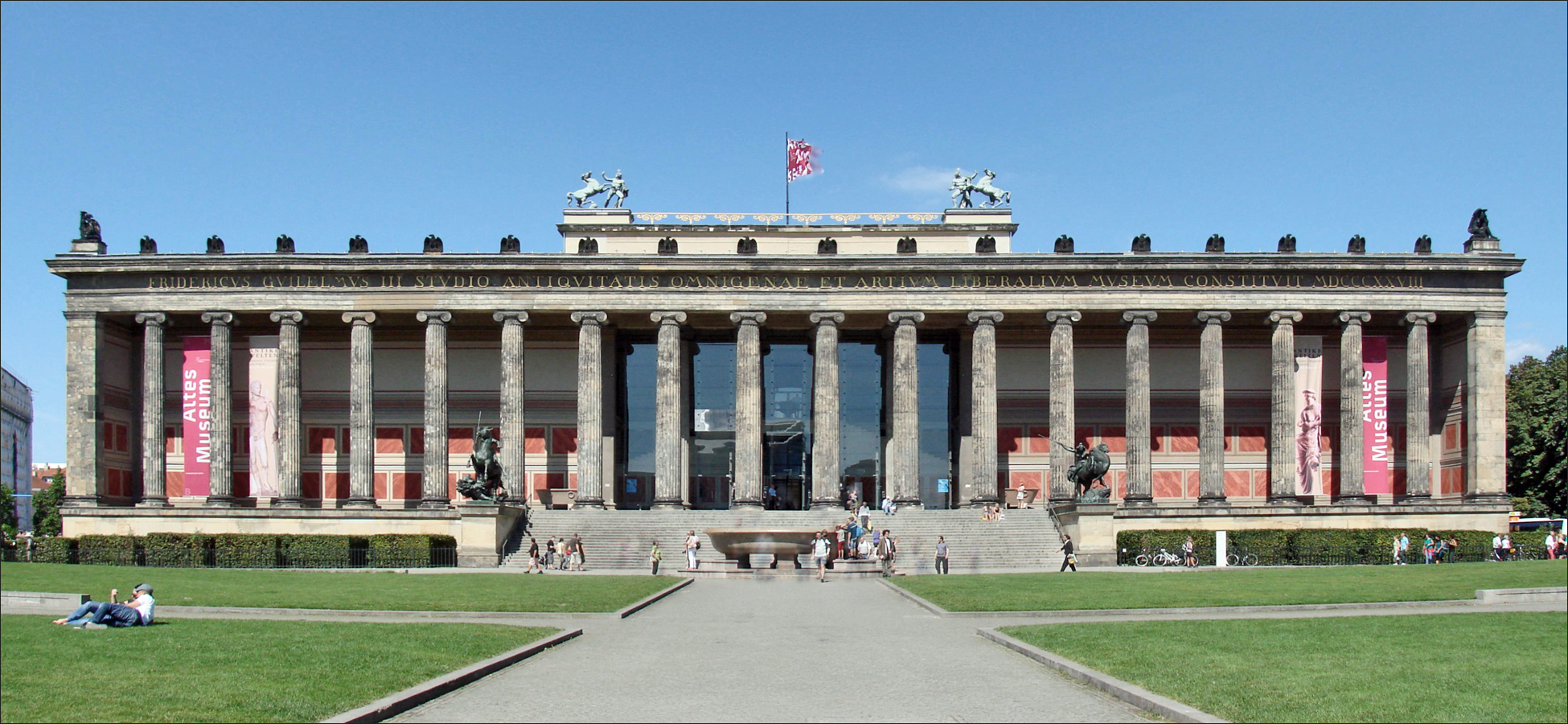
The Altes Museum (English: Old Museum) is a listed building on the Museum Island in the historic centre of Berlin, Germany. Built between 1825 and 1830 by order of King Frederick William III of Prussia according to plans by Karl Friedrich Schinkel, it is considered a major work of German Neoclassical architecture. It is surrounded by the Berlin Cathedral to the east, the Berlin Palace to the south and the Zeughaus to the west. Currently, the Altes Museum houses the Antikensammlung and parts of the Münzkabinett. As part of the Museum Island complex, the Altes Museum was listed as a UNESCO World Heritage Site in 1999, in recognition of its testimony to the development of the museum as a social and architectural phenomenon.
In the early nineteenth century, Germany's bourgeoisie had become increasingly self-aware and self-confident. This growing class began to embrace new ideas regarding the relationship between itself and art, and the concepts that art should be open to the public and that citizens should be able to have access to a comprehensive cultural education began to pervade society. King Friedrich Wilhelm III of Prussia was a strong proponent of this Humboldtian ideal for education and charged Karl Friedrich Schinkel with planning a public museum for the royal art collection.
Schinkel's plans for the Königliches Museum, as it was then known, were also influenced by drafts of the crown prince, the future King Friedrich Wilhelm IV, who desired a building that was heavily influenced by Classical antiquity. The crown prince even sent Schinkel a pencil sketch of a large hall adorned with a classical portico.
Schinkel's plans incorporated the Königliches Museum into an ensemble of buildings, which surround the Berliner Lustgarten (pleasure garden). The Stadtschloss in the south was a symbol of worldly power, the Zeughaus in the west represented military might, and the Berliner Dom in the east was the embodiment of divine authority. The museum to the north of the garden, which was to provide for the education of the people, stood as a symbol for science and art—and not least for their torchbearer: the self-aware bourgeoisie. For the front facing the Lustgarten, a simple columned hall in grand style and proportionate to the importance of the location would most certainly give the building character. The arrangement of the eighteen Ionic columns was effected by the Lustgarten. The portico was designed with a function in order to give the museum building an exterior befitting its site, in which the monuments can be placed.
Schinkel had developed plans for the Königliches Museum as early as 1822/23, but construction did not begin until 1825. Construction was completed in 1828 and the museum was inaugurated on 3 August 1830. Schinkel was also responsible for the renovation of the Berliner Dom, originally a Baroque cathedral, in the Neoclassical style, and he exercised considerable influence on Peter Joseph Lenné's renovation of the Lustgarten, which coincided with the construction of the museum, resulting in a harmonized and integrated ensemble.
In 1841, King Friedrich Wilhelm IV announced, in a royal decree, that the entire northern part of the Spree Island (now known as Museum Island) "be transformed into a sanctuary for art and science". In 1845, with the completion of the Neues Museum ("New"), the Königliches Museum was renamed the Altes Museum ("Old"), a name it holds to this day.
With the completion of the Neues Museum by Friedrich August Stüler in 1855, Museum Island began to take form. This was followed by the Nationalgalerie (now the Alte Nationalgalerie) by Johann Heinrich Strack (1876), the Kaiser-Friedrich-Museum (now the Bodemuseum) by Ernst von Ihne after plans by Stüler (1904), and the Pergamonmuseum by Alfred Messel and Ludwig Hoffmann (1930). Thus, Museum Island evolved into the institution it is today. Julius Carl Raschdorff's 1894–1905 reconstruction of the Berliner Dom into a neo-Renaissance cathedral (replacing the classical cathedral designed by Schinkel) severely disrupted the classical ensemble, especially since the new cathedral has significantly larger dimensions than its predecessor.
Adapted from Wikipedia (CC BY-SA). Photography via Wikimedia Commons.