
Western Netherlands
Netherlands · Other
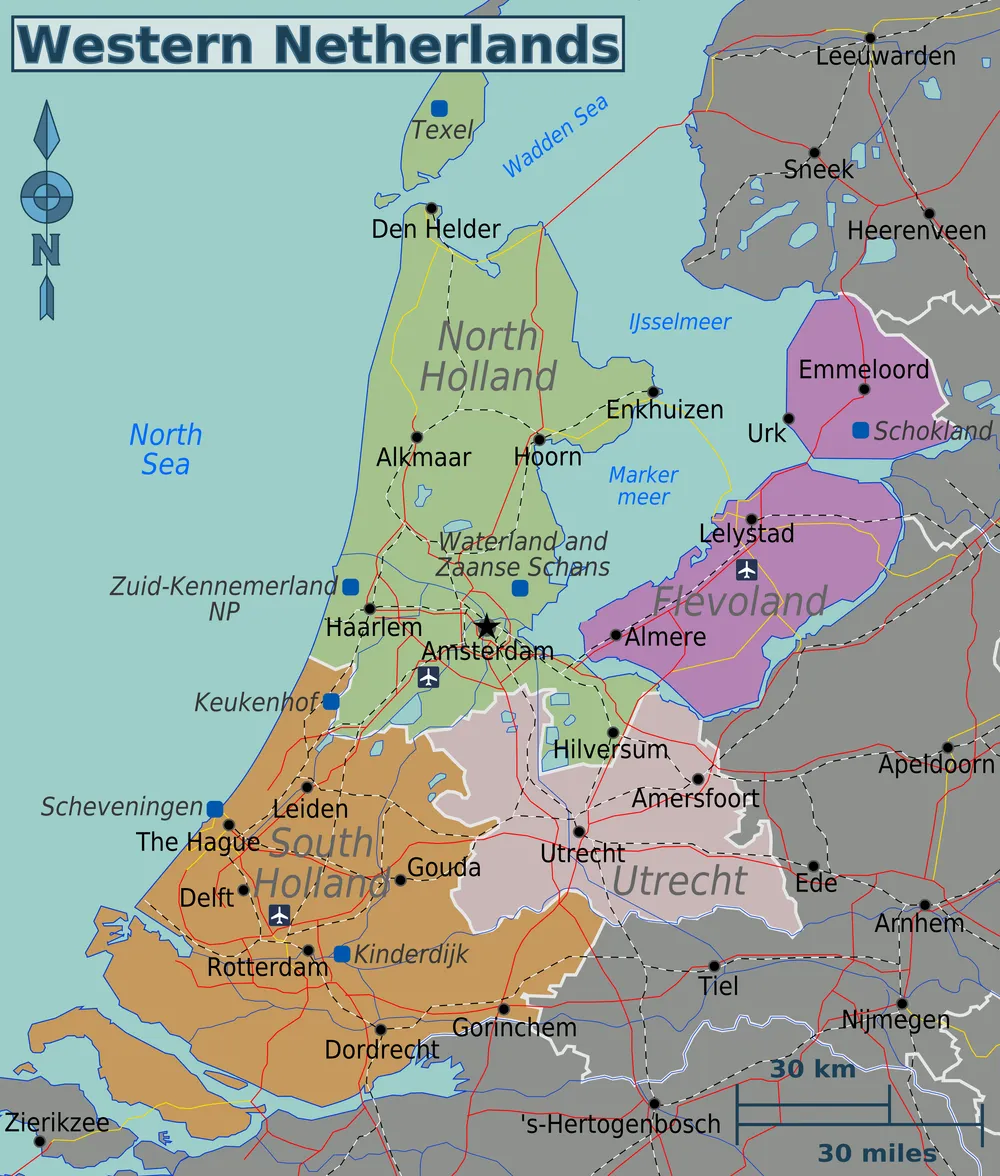
About Western Netherlands
The Western Netherlands is the region that most foreign visitors to the Netherlands attend. Quite frankly, many of them don't even see any other part of the country at all—this region has everything you'd expect from the country and has the most sights and activities. It is the most urbanized area of the country. Amsterdam, The Hague, Rotterdam and Utrecht, the four largest cities of the country, are all in this region. There is an abundance of airports, ports, museums, restaurants and nightlife. However, most of the land is still of a rural nature. The endless flat polders Holland is famous for are omnipresent—with the occasional cute village popping up. Interesting places like Kinderdijk, Marken, Oudewater, Volendam and Zaanse Schans are just a short train/bus (or bike!) ride from the major cities.
Western Netherlands travel guide
Understand
The Western Netherlands is the most visited part of the Netherlands and is a very diverse region. It is home to the largest cities of the country, but the typical Dutch rural landscapes can also be found here. Its four provinces are among the most densely populated areas in Europe. Much of the territory is part of the Randstad, a conurbation with more than 7.5 million inhabitants. It consists of the four largest cities (Amsterdam; Rotterdam; The Hague and Utrecht) and their surrounding areas. Randstad means "rim city", as it is shaped like an urbanized circle with an empty green space in the middle. That center is known as the Groene Hart ("Green Heart"), a rural area that mostly consists of pancake flat polders and lakes. The Randstad is an economic powerhouse that other regions of the country rely on. Trade is probably the most important economic activity in the Netherlands due to its geographic location between Germany and the North Sea. The Port of Rotterdam is the largest port of Europe and its trade over the Rhine with the German Ruhr area is an important engine for the Dutch economy. Amsterdam is an important financial center and many multinationals have their headquarters in the city. Amsterdam also has the country's largest airport, Schiphol Airport, which is the third busiest airport of the continent (2016), and one of the world's airport cities. Not the capital Amsterdam, but The Hague is the country's political center. The Binnenhof is where much of the country's important political decisions are made. The Hague is not just important nationally, but also has a large influence on justice and international relations on a global scale. It is known as the "judicial capital of the world" as it is home to some of the world's most important international institutions: the International Court of Justice, the International Criminal Court, the Permanent Court of Arbitration, the International Criminal Tribunal for the former Yugoslavia and Europol. The Peace Pala
Getting there
By plane Many visitors to the Western Netherlands (and the Netherlands in general) arrive at Schiphol Airport. It is not in Amsterdam, but is in the adjacent municipality of Haarlemmermeer on reclaimed land below sea level. Rotterdam The Hague Airport is a much smaller airport that been functioning as a base for low-cost carriers to other European destinations. More information about the airport can be found in the Rotterdam article. In the future Lelystad Airport in Lelystad will be further expanded to allow low-cost carriers to land there.
By train There are a plethora of train services running to all other provinces of the country. Also, there are international connections with Antwerp, Brussels, Berlin, Frankfurt and Milan. Amsterdam, Rotterdam, The Hague, Utrecht and Leiden are the major train hubs.
By car Many roads connect the western region with other regions of the Netherlands. If you're coming from the south, the A2 connects Amsterdam and Utrecht with 's-Hertogenbosch, Eindhoven and Maastricht, while the A27 is the principal connection from Breda and the Flemish Diamond metropolitan region. If you're coming from the east, the A12 connects the region with the Hoge Veluwe National Park, Arnhem and the Ruhr in Germany, and the A1 is leading to the region from Twente and Apeldoorn. From northern provinces like Friesland or Groningen, the A6 or A7 (over the Afsluitdijk) is the fastest route.
Getting around
By train Most foreign visitors use the train to get around. The Netherlands Railways serves nearly every large town, and you can use the website to plan your journey ahead of time. The major cities of Amsterdam, Rotterdam, and Utrecht all have local urban rail services as well. Trams serve all these 4 cities, with metro subway services available in Amsterdam and Rotterdam. Line E of the Rotterdam Metro extends to serve The Hague's central station.
By bus The bus is mostly used as a way of transport within towns or between towns in the same area. Bus travel can be time-consuming, confusing and slow, so avoid it if there's rail transport available. There's a plethora of bus companies available that all serve a different set of regions and provinces. You can plan your journey at 9292.nl.
By car The Randstad has various motorways. Traffic jams can occur at any time of the day; however rush hour lasts during 06:00–10.00 and 15:00–19:00. Major bottlenecks can create traffic jams up to 20 kilometres in length. Most motorways are no wider than 2x2 or 2x3 lanes. Some hard shoulders are in use as peak hour lanes - traffic is allowed to use the hard shoulder as a third lane during periods of congestion, when signs indicate. Because of the lack of sufficient minor roads, local traffic also uses the motorways for short distances.
By bicycle Cycling is a popular activity among the Dutch and a great way to see more of the landscape. There are bicycle paths between all towns, some of which traverse through picturesque villages, green polders and forests. Some scenic bicycle paths are numbered and sign-posted throughout the region; maps for them are provided at local tourist information offices. Cycling is especially appealing in the Zaanstreek-Waterland, Gooi en Vechtstreek and the Green Heart.
See
Historic towns
There are dozens of historic towns in the Netherlands that deserve a visit. The most well-known obviously is the historic 17th-century city center of Amsterdam. Its historic architecture can be explored by a boat tour which goes through its lovely canals (known as grachten). The center became a UNESCO World Heritage Site in 2010. Many visitors include a day-trip to one of the West's other historic cities. North Holland is filled with them — Haarlem, Alkmaar, Hoorn and Enkhuizen are less than one hour away as a day-trip from the capital. South Holland also has a few interesting historic towns. Delft is a tourist-favorite with its traditional architecture, canals, bikes, and the world famous blue and white ceramics. Gouda is known from the world famous Gouda cheese — but besides the cheese market, its historic town center is a really fun walk. Leiden, while historical, has much of a student-feel due the presence of the oldest university of the Netherlands there. The traditionally Catholic city of Utrecht is not visited a lot by foreigners, but it’s hard to understand why — it has the amenities of a big city, but its canals feel even more calm and relaxed than those in average medium-sized cities. It's an excellent destination to visit some antique stores or grab a beer while seeing the boats pass by. Amersfoort is a lot smaller, but again, its ancient center makes for a nice day out.
Traditional Holland
The Holland of cheese, windmills, clogs and polders can best be seen in the countryside. Most foreigners at least incorporate a visit to the Zaanstreek-Waterland — a traditional region of small villages where a traditional folk culture is still present. The most visited attraction of the area is the Zaa
Overview adapted from Wikipedia, travel guide fromWikivoyage (CC BY-SA). Photography via Wikimedia Commons.