
West Zone of São Paulo
Brazil · Americas
About West Zone of São Paulo
West is a region in São Paulo. If the Downtown represents the São Paulo of the past, probably no other region represents the São Paulo of present day as well as the West. Although it contains only 7.7% of the population of the municipality, the West is by far the most economically active region, concentrating 28.5% of the jobs. And with little doubt, the West is the place to be in the city for dining, drinking, clubbing, art, culture, business and science.
However, despite its reputation as a "wealthy" area, the West is also the region where São Paulo's social inequalities are most blatant. Here it is possible to find everything, from mansions and luxurious apartments to working class suburbs and slums (favelas), with extremes sometimes quite close to each other.
The West is divided into 15 districts, grouped into three subprefectures:
Lapa subprefecture: Jaguará, Jaguaré, Vila Leopoldina, Lapa, Barra Funda and Perdizes.
Butantã subprefecture: Rio Pequeno, Butantã, Raposo Tavares, Vila Sônia and Morumbi.
Pinheiros subprefecture: Alto de Pinheiro, Pinheiros, Jardim Paulista and Itaim Bibi.
West Zone of São Paulo travel guide
Understand
Although neither the largest nor the most populous region of the city, the West is a probably the most diverse. The districts described below are the ones that have more attractions for a visitor, although many attractions listed in this page are in other districts.
Butantã — The life in this former farming area changed during the early 1900s, with the coming from Instituto Butantan and University of São Paulo. Butantã turned into a middle-class suburban area, whose real estate is quickly rising in value. Barra Funda — For decades, this district carried industrial activity and was home to Italian immigrants who worked in the factories. After the decline of industry, many areas become degraded, but the population became more diversified and cultural activity has intensified. Today, Barra Funda has economically recovered and is home to many attractions, and it is emerging as a new center of nightlife in the city. Itaim Bibi — For most of the past century, the neighborhoods of this district, like Brooklin and Vila Olímpia, were calm and residential, strongly influenced by German and Italian immigrants who lived in little ranches. The constant expansion of the city on a northeast-southwest direction, combined with government investment, made the region the new point for businesses, hotels and residences. As one may expect, the area also began to attract all kinds of service to cater to the richer people who moved here, including restaurants, bars, clubs and shopping malls. Jardim Paulista (Jardins) — From Avenida Paulista, if you decide to go down on Rua Augusta towards river Pinheiros, you will find a sea of side streets named after countries of Europe and the Americas, full of trees and elegant houses (although some are hard to see; hidden behind tall walls). It is probably the area with the most expensive shops and restaurants in the city. Morumbi — The district is home to the government of the state of São Paulo, and a large portion of the district is occupied by
Getting there
By metro and train The east side of the Pinheiros river is well-covered by the rail network. In the other side there are three stations (Butantã; Vila Sônia and Morumbi), accessible via the Line 4 (Yellow). These are metro and train stations in each district:
Alto de Pinheiros: Pinheiros, Cidade Universitária, Villa Lobos-Jaguaré Barra Funda: Barra Funda Butantã: Butantã Itaim Bibi: Vila Olímpia, Berrini Jardim Paulista: Consolação Lapa: Domingos de Moraes, Lapa Perdizes: Sumaré, Vila Madalena Pinheiros: Hebraica-Rebouças, Cidade Jardim, Faria Lima Vila Leopoldina: Ceasa, Imperatriz Leopoldina
By car The West is connected to the Northwest, Northeast, South, and north part of the Southeast by Marginal Pinheiros, and to the South-Central and south part of the Southeast by Avenida dos Bandeirantes. Connection to the Historical Center and to the north part of the South-Central is made by non-express corridors, like Av. Rebouças, Av. Cidade Jardim and Av. Juscelino Kubitschek. A car (or taxi) is particularly convenient to reach places in the west side of the Pinheiros river, and also to enjoy the nightlife as walking during the night is not recommended in most places (see #Stay safe).
By bus Other than car, buses are the only way to reach most places in the west side of the Pinheiros river. There is a dedicated bus corridor that crosses the West region in east-west direction, starting at the Historical Center and passing through Av. Rebouças and Av. Francisco Morato.
Getting around
The West is a large region, with main attractions relatively spread. As such, using metro/train, buses or a car is recommended to extensively cover them. If you have a bit more time, however, some areas can be nicely explored on foot or on pedals.
By bicycle Cycleway Marginal Pinheiros (see São Paulo main section) is partly located in the West. Cycleway USP, from Butantã train station to Gate 1 of University of São Paulo. Mostly intended for students of USP commuting to the Metro station. 840 m. A large portion of Ciclofaixa de Lazer (see São Paulo main article) is also in the West and can be used on Sundays.
On foot Two nice areas to be explored on foot are the Itaim Bibi (see #Skyscrapers) and Jardim Paulista districts. The two areas are relatively large, however, so it is a good idea to plan your walking route to pass through the most interesting museums, landmarks and shopping areas. Otherwise you may spend a lot of time in boring residential streets.
See
Skyscrapers
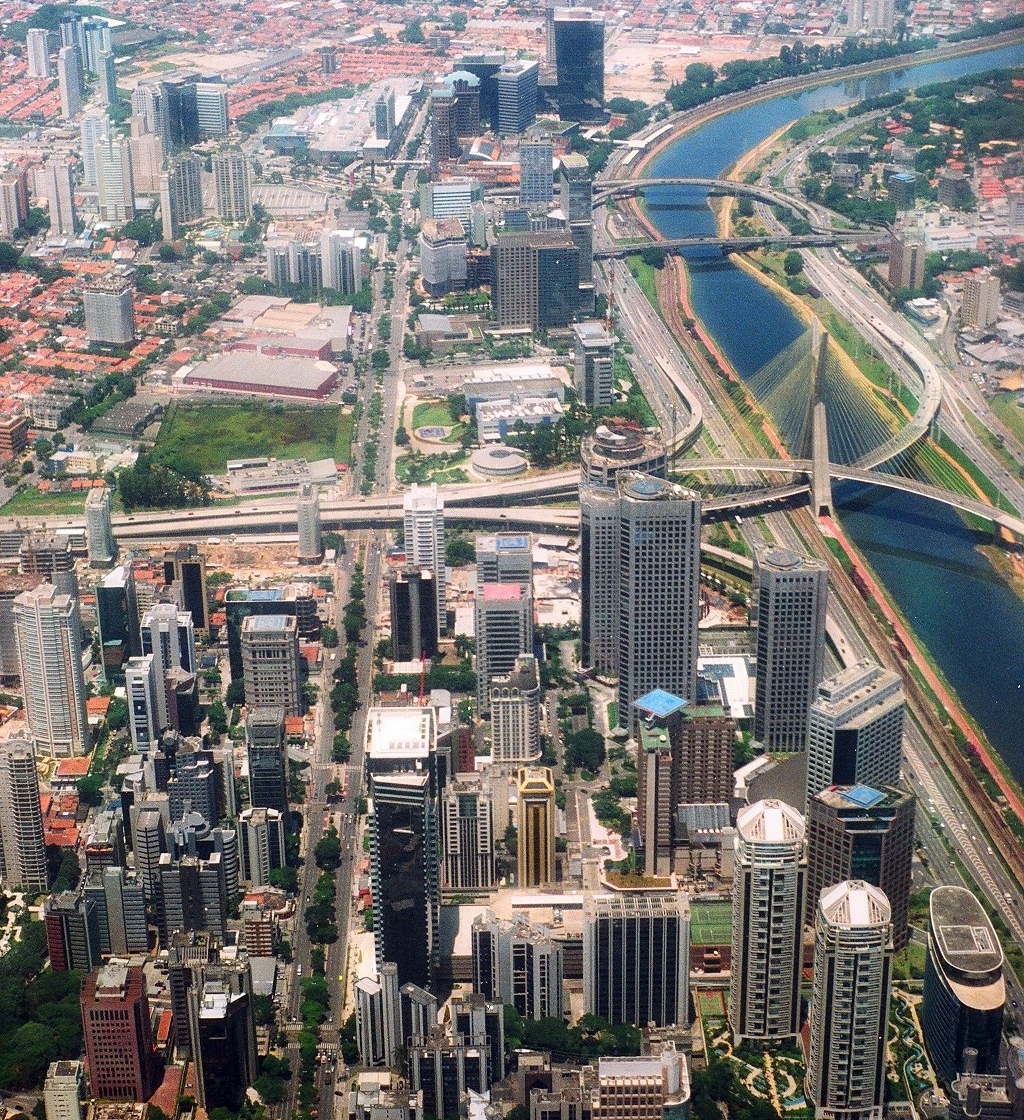
1 Brooklin Novo, Itaim Bibi (station Berrini; next to station Morumbi). Perhaps the most impressive business center of the city, Brooklin Novo is between Av. Eng. Luiz Carlos Berrini and the Pinheiros river. From here you can also see one of São Paulo's most famous landmarks, the bridge Ponte Octavio Frias de Oliveira, more known by locals as Ponte Estaiada (tip: the best view of the bridge is from Ponte do Morumbi). Not many restaurants in the streets, but you can eat at Shopping Nações Unidas (more like a food court than a shopping mall) or at the furniture shopping center D&D. 2 Vila Olímpia, Itaim Bibi (Contains stations Cidade Jardim and Vila Olímpia). Another important business center is between Av. Faria Lima and the Pinheiros river. In comparison to Brooklin Novo, this area has more bars and restaurants, and you can also see more people in the streets. A curious phenomenon is that during weekends at 1AM or so, you can see traffic jams in Av. Faria Lima, due to many young people going to the nightlife in Vila Olímpia.
Museums and cultural centers The campus of University of São Paulo (USP) in Butantã, Cidade Universitária, is home to 7 museums (only 3 described below: see the USP website for others). Pinheiros and Jardim Paulista are the place to find small and medium art galleries of local and international artists (not listed here). Combined with Memorial da América Latina, Instituto Tomie Ohtake, Instituto Butantan, and other museums and institutes, that makes the West possibly the city's most important area in terms of culture and science.
3 Memorial da América Latina, Av. Áuro Soares M Andrade, 564 - Barra Funda (Near Barra Funda station), ☏ +55 11 11 3823-4600. This cultural and political center about Latin America and its culture was designed by the Brazilian premium architect Oscar Niemeyer. It was the former meeting point for the Latin American Parliament. Now it hosts expositions, a library, a research center, and many cultural
Do
Cultural activities 1 Feira de Artes, Cultura e Lazer da Praça Benedito Calixto (Benedito Flea Market), Praça Benedito Calixto, Pinheiros (13-min walk from Sumaré station). Sa 08:00-19:00. On Saturday, this square is home to one of the most famous and charming fairs in São Paulo. Everything is on offer: antiques, rarities, collections, etc. It’s also a great place to have lunch or a snack, as there are many bars and restaurants—such as the excellent Consulado Mineiro, where the long wait is softened by a delicious lime
Overview adapted from Wikipedia, travel guide fromWikivoyage (CC BY-SA). Photography via Wikimedia Commons.