
Vietnamese Demilitarized Zone
South Vietnam · Other
About Vietnamese Demilitarized Zone
Vietnam's Demilitarized Zone, or DMZ, is the area around the former border between North and South Vietnam. Historically it was a narrow band of terrain extending from Laos to the coast, 5 km on either side of the Ben Hai River, roughly on the 17th parallel, north latitude.
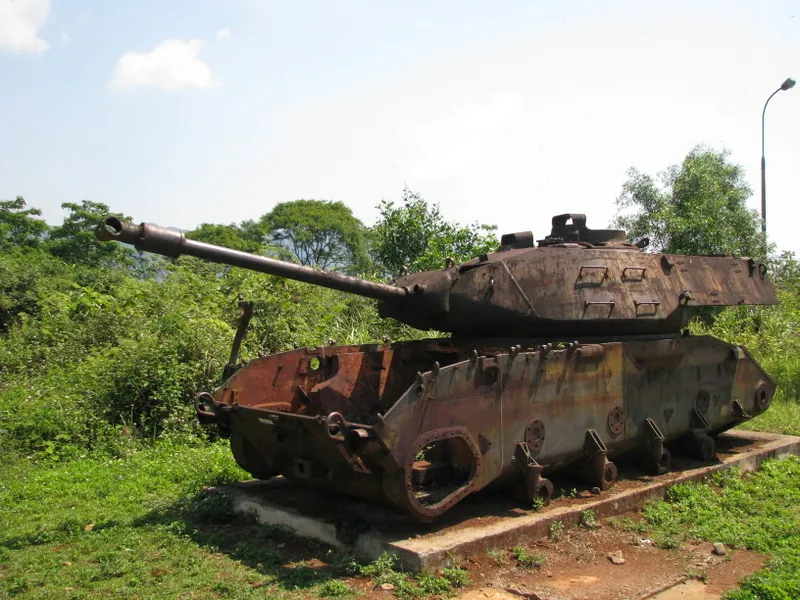
The area saw heavy fighting in the war, and ruins of old American military bases still exist. Even if you're not interested in the history, the area has some spectacular mountain scenery and rugged jungles.
Vietnamese Demilitarized Zone travel guide
Understand
While the border was marked by the Ben Hai river, most historical sights (i.e., American bases) are along Highway 9, which runs parallel to the river several kilometers to the south. This road runs to the Lao border and continues onward.
Getting there
The area's only major city is Dong Ha, on the coast. It's on Hwy 1, and easily accessible from Hue and Da Nang. Tours can be arranged from Dong Ha by DMZ Tours (located along Le Duan street) for US$15-17. This tour will pick you up on the bus coming from Hue, and go to the tunnels, Dakrong bridge, rockpile, and Khe Sanh. Does not include Camp Carol, Con Tien, or food/water, but is a pleasant ride with a spirited guide (some propaganda). Lots of travel agents in Hue offer convenient day trips by bus. They are cheap at US$10-15 per person, but be forewarned that you will have to get up very early, as the tours usually start at 06:00. Expect to return to Hue between 18:00-19:00. You will also be herded back on to the bus to continue to the next stop, only to find yourself waiting for some stragglers. It can get crowded in the Vinh Moc Tunnels if your bus group is large. You can go by car, which can be expensive, but if it's raining, which it often is, you'll be glad you did. Also, private tours can take you to some places where the big buses and large groups don't. Tours by motorbike can be arranged, but unless you are a diehard such is likely very tiring as distances for a round trip can be as high as 300 km. If you want a motorbike tour, it may be better to spend a night in Dong Ha and make arrangements there. Booking through a hotel will probably cost more due to commission.
Getting around
Unless you have your own transportation, you'll need to hire a taxi or take a guided tour to see the sights. Some local tour operators offer motorcycle trips along the Ho Chi Minh Trail.
See
Arranged in order from east (Vietnamese coast) to west (Lao border):
1 Vinh Moc Tunnels. Where an entire village lived for two and a half years. 17 babies were born in the tunnels. There is a small but informative museum here, with photos of the construction of the tunnels, and of daily life underground. 40,000 dong. (updated May 2015) 2 Hien Luong Bridge. Crosses the Ben Hai River at the middle of the DMZ and marks the former border between North and South Vietnam from 1954-1972 when the North Vietnamese Army captured Dong Ha town in the 1972 Easter Offensive and pushed the border to the Thach Han River in Quang Tri town, some 32 km further south. During the partition of Vietnam, the bridge was painted with the two different colors. There is a monument on the north side. 3 Truong Son National Cemetery. Vietnam's national war cemetery. 4 Camp Carroll. This was the largest fire base of the US Marines below the DMZ. There were 24 big guns there to provide fire support for the Marines. In the 1972 Easter Offensive it was captured by the NVA when LTC Pham Van Dinh of the Army of Republic of South Vietnam surrendered his 1,600 soldiers and 24 guns to the NVA. Rockpile. A Marine outpost built on top of a huge outcropping. Though it's inaccessible, it's a prominent sight from the highway. Dak Rong Bridge. Midway along Hwy 9, and is the starting point of Hwy 15, one of the main branches of the Ho Chi Minh Trail, which leads south to the A Shau valley and the infamous "Hamburger Hill". Though not entirely legitimate, there is a monument commemorating it as a point on the Ho Chi Minh Trail, (called Đường Trường Sơn in Vietnamese). 5 Khe Sanh Combat Base. Just east of the Lao border, was the site of a US base which fell under attack in early 1968. The attack of the NVA on Khe Sanh was a diversion for the 1968 Tet Offensive in the south. The old airfield of red dirt remains.
Do
Mr Vinh, Stop & Go Cafe - 03 Hung Vuong Hue City, ☏ +84 935330275. 10:00-22:00. Mr Vinh, known to his American friends during the hostilities as "Davis", is an ex-ARVN military intelligence interpreter veteran from the war. He's old, speaks excellent English and is hospitable. At one stage, he interpreted for Colin Powell when he was a major general and General Westmoreland. He brings the sites of the DMZ alive. He is based in the Stop & Go Cafe in Hue but his cell number is listed here. (updated Mar 2018)
Buy
Though you'll probably encounter vendors selling GI dogtags, lighters, and other paraphernalia, you can be sure that none of them are genuine. Quang Tri is famous for pepper bean and Arabica coffee, and can be purchased in Dong Ha Market, next to the Dong Ha bridge, on Hwy 1.
Eat
Food options around the Vietnam DMZ are mostly simple local restaurants and family-run eateries serving traditional Central Vietnamese dishes. Along the route, especially near Đông Hà Town, Khe Sanh, and Vĩnh Mốc, travelers can easily find places offering rice meals, noodle soups, fresh seafood, and Vietnamese coffee at reasonable prices. One of the most popular local specialties is Bún Bò Huế, a flavorful beef noodle soup originally from Hue but commonly served throughout Quảng Trị Province. Visitors may also try grilled pork with rice, bánh lọc (Vietnamese tapioca dumplings), or fresh seafood near Cửa Tùng Beach after visiting the DMZ relic sites. Most restaurants in the DMZ area are casual and local in style rather than luxury dining venues. English menus may be limited in some places, but local people are generally friendly and helpful. It is recommended to carry some cash because smaller restaurants and roadside cafés may not accept credit cards. For travelers joining a private Vietnam DMZ tour, many local guides and drivers can recommend reliable restaurants with clean facilities and authentic local food along the way.
Drink & nightlife
While traveling around the Vietnam DMZ area, visitors can easily find small local cafés, roadside coffee shops, and family-run restaurants serving a variety of Vietnamese drinks. Vietnamese iced coffee (cà phê sữa đá) is one of the most popular choices, especially during the hot summer months in Central Vietnam. Fresh sugarcane juice, iced tea, coconut water, and local fruit smoothies are also widely available along the route. Near historical sites such as Khe Sanh, Vinh Moc Tunnels, and Hiền Lương Bridge, there are several local restaurants and rest stops where travelers can relax and enjoy cold drinks after visiting the war relics. Beer lovers may also want to try local Vietnamese beers such as Huda Beer, a famous beer brand from Central Vietnam, or other popular options like Larue and Saigon Beer. For a more authentic experience, many local eateries in Quảng Trị Province serve traditional Vietnamese drip coffee while sharing stories about the history and daily life of the former DMZ region. Although the area is not known for nightlife or luxury bars, the peaceful atmosphere and friendly local hospitality make it a pleasant place to stop for refreshments during your journey.
Sleep
Most travelers visiting the Vietnam DMZ choose to stay in either Hue or Dong Hoi, as accommodation options inside the former DMZ area are still quite li
Overview adapted from Wikipedia, travel guide fromWikivoyage (CC BY-SA). Photography via Wikimedia Commons.