
Tsuyama
Japan · Asia
About Tsuyama
Tsuyama (Tsuyama-shi) is a city in northern Okayama Prefecture, Japan with around 100,000 citizens. Much of the city's historical sites remain well-preserved, making Tsuyama a quiet yet charming town.
Tsuyama travel guide
Understand
First known as Soja (not to be confused with the present-day city of Soja), Tsuyama City was established in 713 as the capital of Mimasaka Province. In its early years, it was just a small town with little influence, but in 1603 things began to change after Tokugawa Ieyasu defeated the local warlords and united the nation under his rule. Tokugawa Ieyasu awarded Mimasaka Province to Tadamasa Mori who rapidly began to develop the capital of his domain. Upon becoming ruler, Mori constructed plans to build his own castle and thirteen years later, the construction of Tsuyama Castle in Tsuruyama (from which the name "Tsuyama" is believed to have originated) was completed. During its heyday, Tsuyama Castle was said to be the most magnificent castle in all of Japan with an impressive amount of fortifications. The city flourished as a castle town and a major stop for pilgrims along the Izumo Kaido. As the nation came into contact with the West during the 18th century, Western learning became increasingly crucial, and scholars from Tsuyama played an important role in translating foreign writings and forming policies to deal with the West. Unfortunately, during the Meiji Period, as castles became less practical and upkeep increasingly burdensome, the government commissioned Tsuyama Castle to be demolished, along with many others throughout the nation. While the city is not as busy and bustling as it used to be, the citizens are proud of their history.
Tourist information site The local tourist association has a multilingual guide site.
Getting there
By plane Okayama Airport (OKJ IATA), Okayama. The nearest airport is some distance away. If you don't have a car, you can get a Share-Ride Taxi (☏ +81 86-822-1234) for ¥2,500. Departure times vary by month. Reservations required. (updated Jul 2020)
By train Most train travelers take the Sanyo Line to Okayama Station. From there, you can take the Tsuyama Line directly to Tsuyama Station, the terminus, in about an hour for ¥1140. Alternatively, the Kishin Line connects Himeji to Tsuyama with a couple transfers. This can be a better option when using local trains with the Seishun 18 Ticket for travelers coming from Kansai. The Kishin Line also connects to Tsuyama with Niimi (¥1; 320) to the west, but trains are infrequent. If you are coming from the north, the JR Inbi Line connects Tottori to Tsuyama. Trains are less frequent, and it takes about 3 hours (¥1; 490) to reach Tsuyama due to the lack of alignment with connections in Chizu. If you're waiting an hour or longer for a transfer, there is enough time to explore Chizu's historic district.
By car The Chugoku Expressway running from Nishinomiya in the east all the way to Shimonoseki in the west passes through Tsuyama. Route 53 connects Okayama and Tottori to Tsuyama. From the expressway or Route 53, take the exit at the Tsuyama Interchange. From Fukuchiyama, travel on Route 429 to reach Tsuyama. From Yonago, travel south on Route 181.
By bus Ryobi Bus operates direct buses all the way from Shinagawa in Tokyo to Tsuyama for ¥9930 one way. The JR Highway Bus and JR Shinki Bus have buses in Kyoto and Osaka bound for Tsuyama departing daily. The bus from Kyoto boards at Kyoto Station and costs ¥3000. There are two different boarding points in Osaka. The first stop is at Osaka Station (¥2670) from the Sakurabashi Exit. The other option is at Shin-Osaka Station. Buses departing from Osaka are much more frequent than those departing from Kyoto, so it is often easier to reserve seats or buy bus tick
Getting around
By bus The Tsuyama City bus is the Gongo Bus, named after the city's mascot. Each ride costs ¥200. From Tsuyama Station, buses travel to places around central Tsuyama, including Joto Street, along with buses to the Kume area. Buses to the northern regions can be accessed from stops closer to Higashi-Tsuyama Station.
By car Upon exiting the station, there are car rentals available.
By taxi Taxis are available at Tsuyama Station.
By bike Bike rentals are a great way to explore Tsuyama. You can rent bikes at the Tourist Information Center to the right of Tsuyama Station. Two-hour rentals cost ¥400 or ¥1000 for the entire day. Motorized bikes cost ¥600 for two hours or ¥2000 for the day. When renting bikes, pay the daily fee upfront and when you return, depending on how long you were out, you will get money back.
On foot Although some of the sites are too far to reach on foot, the sites in and around Joto Street are all within walking distance of Tsuyama Station. For a map of the area, visit the information center just to the right of Tsuyama Station. Kakuzan Park takes 15-20 minutes to reach from the station on foot. Even some of the sites off Joto Street, such as Shurakuen Garden can be reached on foot.
See
Joto Street
Joto Street is Tsuyama's historic district. During the Edo Period, Tsuyama was an important stop along the pilgrimage route to Izumo Shrine. Joto Street was where the pilgrims would pass through and stay. The old houses have been preserved so that visitors can get a feel for what the city was like in its heyday as a castle town.
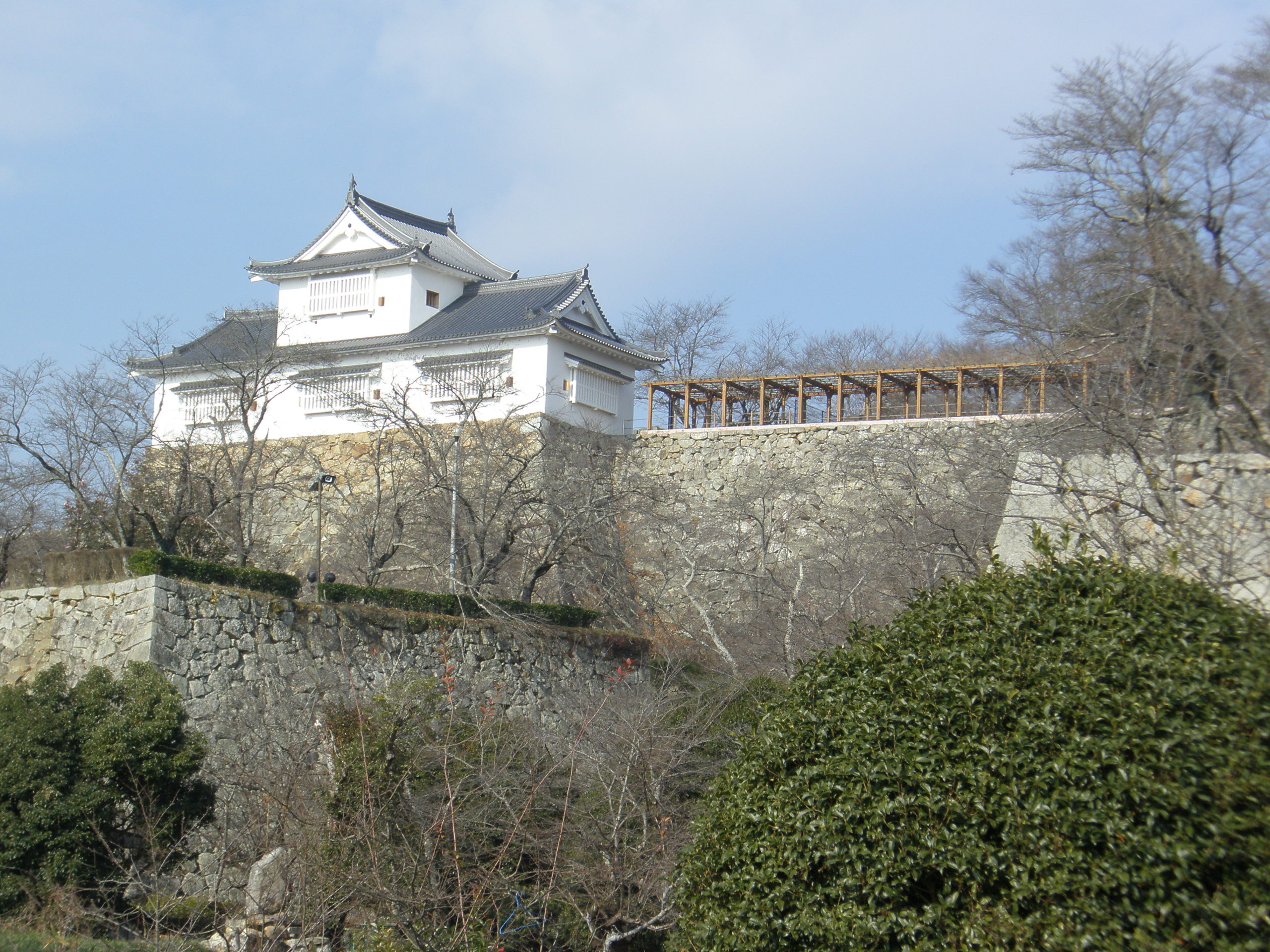
1 Kakuzan Park (Kakuzan koen), 135 Yamashita, ☏ +81 86-822-4572. 08:40-17:00. This park contains the ruins of Tsuyama Castle, once considered to be the most spectacular Japanese castle. Since the castle was decommissioned during the Meiji Period, all that remains₨ are the castle walls however, they are truly well-preserved, and a walk around the castle grounds offers many great views of the city and a feel for the castle's former grandeur. The small turret, the only castle structure in the park, was reconstructed in 2004 out of wood to stay true to the original to commemorate the 400th anniversary of Tsuyama Castle. The park has gained fame as not only being the best place in Okayama but also as the best place in the entire Chugoku region for viewing cherry blossoms due to its 1,000 cherry blossom trees, scenic ruins, and festive atmosphere. It is also a great place to view the changing leaves in the fall. There is a heart-shaped stone in the walls of the former honmaru that is a popular photo-op, particularly among women. It is even featured on some of the souvenirs. ¥300. 2 Former Residence of Mitsukuri Genpo (Mitsukuri genpo kyuutaku), 6 Nishishinmachi. 09:00-16:00. Mitsukuri Genpo was an important figure during the time when Japan first encountered the West. He translated many Western texts into Japanese and helped create policies in dealing with the Western powers. His former residence is on Joto Street — look for the prominent signs. Free. 3 Tsuyama Archives of Western Learning (Tsuyama yogaku shiryokan), 5 Nishishinmachi, ☏ +81 86-823-3324. Tu-Su 09:00-16:30. A museum with information a
Do
1 Green Hills Tsuyama (グリーンヒルズグラスハウス), 512 Oda, ☏ +81 868-27-7140. Although it offers some gardens and areas for outdoor activities, most people come here for the Glass House, an indoor swimming area. It is divi
Overview adapted from Wikipedia, travel guide fromWikivoyage (CC BY-SA). Photography via Wikimedia Commons.