
Thorn
Netherlands · Other
About Thorn
Thorn is an old city and former independent microstate in Limburg, The Netherlands and small parts of Belgian Limburg.
Thorn travel guide
Understand
It was founded as a proprietary nunnery (a cloister founded on private ground by a feudal lord) belonging to the dominium of Kessenich (Belgium), which was a dominion of Liège. Thorn broke its ties with Liège in the 12th century, and began acting as if it were an independent domain directly under the Emperor's control. Its overlordship was shared between Guelders (roughly modern-day Gelderland and Dutch Limburg) and the small neighbouring dominion of Horn. Reginald (Reinoud) I, Count of Guelders, confirms Thorns' independence in 1282, and Adolf of Nassau does the same ten years later when he becomes King of the Romans.
The principality was governed by the nunnery, and during its first decades of independence saw some of its properties usurped by surrounding states. In 1487, Thorn is adopted into the Reichsmatrikel, a list of the Holy Roman Empire that dictated how many troops a country in the empire had to supply to the Imperial Army, and in 1548 the abbey and its possessions is reorganised into the Lower Rheinish-Westphalian Circle. Friction between circles existed, however, as the Duchy of Guelders organised legislative law, and it belonged to the Burgundian Circle. After centuries of going back and forth between circles, the Emperor cuts the ties between Thorn and Guelders, leaving Thorn wholly independent as a microstate within the Holy Roman Empire, which lasted until its incorporation into Revolutionary France in 1794. During the 18th century, Thorn remains relevant on the international stage as the abbey becomes a retreat for girls of nobility to be prepared for marriages with husbands of the highest standing, or, should they not come around, for them to live a comfortable life in a protected environment. Of the noblewomen that lived in Thorn, they elected one of their own to reign as abbess-monarch. Thorn suffered under the French occupation, and led to the city centre getting its characteristic white buildings. Due to a French tax on windows, many of the p
Getting there
By car Thorn lies along the A2 highway between Weert and Echt. From Eindhoven, follow the A2 highway heading southeast towards Roermond and Maastricht, and use exit 41 (Grathem; Ittervoort), turning right onto the N273 (Napoleonsweg). Once you reach Ittervoort, take a left onto the Ittervoorterweg. This road will become Casino, then Wal, then Steenputstraat and Meers once it reaches Thorn. From Nijmegen, use the A73 highway to head south towards Venlo, Roermond and Maastricht. Use the highway to pass the first two of those cities. Use exit 22 (Maasbracht) to leave the A73, then turn right twice, joining the A2 highway heading for Eindhoven. After crossing the river Meuse (Dutch: Maas), use exit 42 (Wessem) to leave the highway. Cross underneath the highway, turn right immediately after, avoiding the town centre of Wessem, and follow the road Paardenbeemd, which becomes Meers, to get into Thorn. From Maastricht, use the A2 highway heading north for Eindhoven. From here, use exit 42 (Wessem) once you've crossed the river Meuse, and follow the instructions above.
By public transit Getting to Thorn by public transit is not necessarily difficult, but it is inconvenient. The town has three bus halts, the main one being 1 Thorn, Centrum. The nearest train stations that offer a connection to the city are in Roermond and Weert. Both of them connect to Thorn using bus line 73, which runs between both cities on an hourly basis, departing from Roermond at:05, and from Weert at:01. Both departure times have a few minutes of play to them. The journey by bus takes 27 minutes from Weert, and 23 from Roermond. The latter is the more equipped station, but Weert is an earlier stop coming from Utrecht. Roermond is more convenient when travelling via Nijmegen or coming from the south (Heerlen; Maastricht). From Belgium, your journey by public transit will be highly inconvenient. All traffic either goes through Maastricht or Eindhoven, excluding a single bus line (35) from Maaseik
Getting around
As mentioned, getting around Thorn by public transit is inconvenient, having only three bus stops and a single hourly service serving them. The city centre can easily be explored on foot - It's not exactly vast. The wider area is best explored by bicycle.
1 Bruno Rent, Hofstraat 4 (behind the church), ☏ +31 610 665 037, [email protected]. 10:00-17:00. Only bicycle rental company in Thorn. Every rental comes with a map of the cycling nodes in the area, as well as optional routes. Prices are per day, and do not include a deposit of €50 for a normal bike, and €100 for an e-bike. €17½ (e-bikes: €29½). (updated Apr 2024)
See
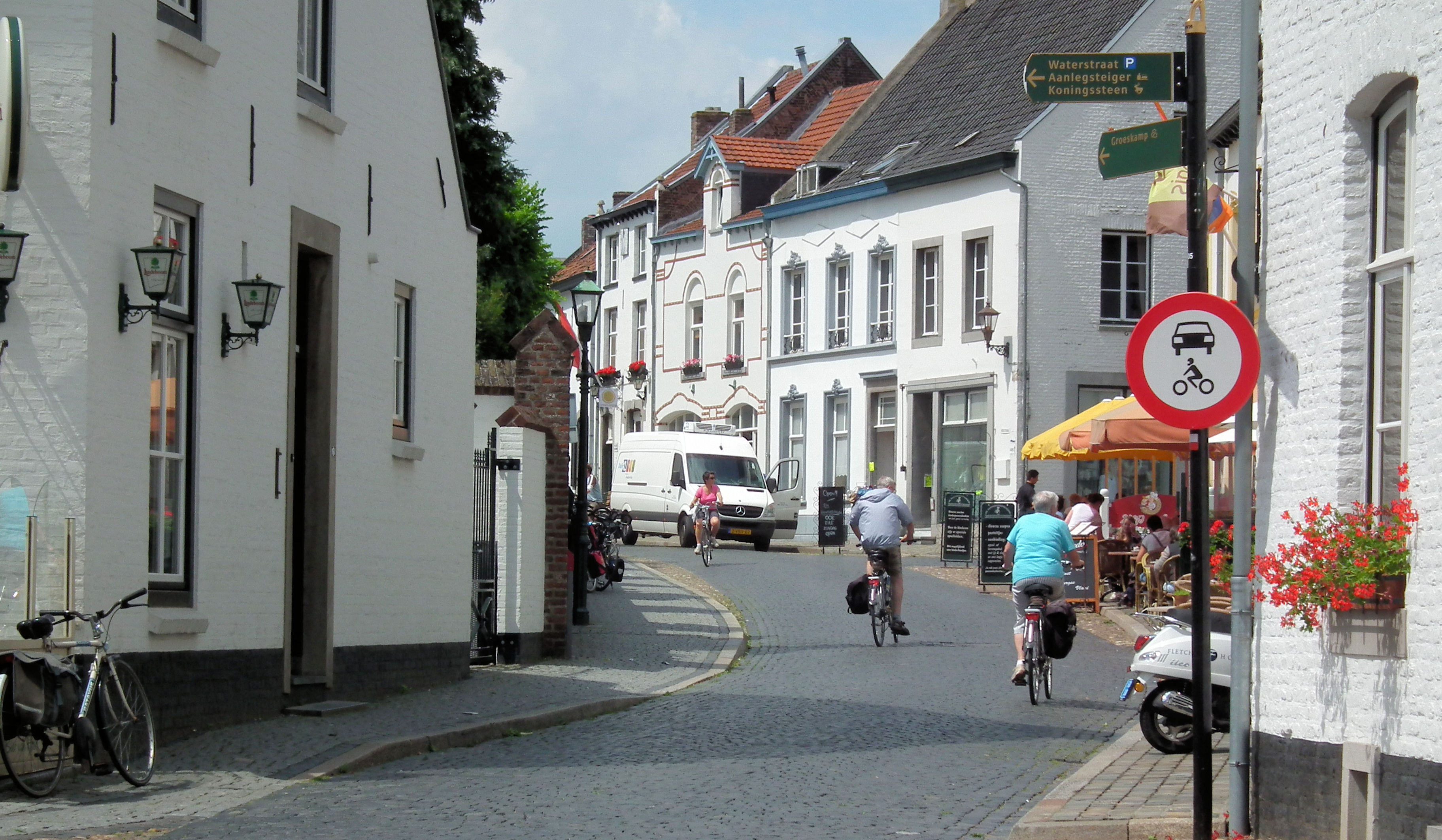
The city centre of Thorn is easily explored on foot. It's best known for its white houses, and is dense with listed monuments. Do note that most streets are paved with rocks, which might prove problematic for people with impaired mobility. Throughout it, you will also find remnants of the abbey that once reigned the microstate: Hofstraat 10-14. A set of three houses. Numbers 10 and 14 served as gate buildings, lining one of the entry points into the abbey. Number 12 housed the abbey kitchens. Remnants of the Immunity gate along the Kloosterberg. Its name is based around the city's special place when it came to international law. Within the walls, foreign authorities had no direct say over you. 1 Sint-Michaëlskerk (Abbey Church of Thorn), Hoogstraat 5. The parish church of Thorn, which mostly dates from the 14th century and once formed a key part of the abbey complex. The Gothic church contains a crypt in its core, and has a raised choir for the ruling class consisting of noblewomen, aptly named the "Regentess' Choir", The church is partly built on the remnants of its predecessor, a smaller romanesque church. The church was renovated in the 19th century by the revered neo-Gothic architect Pierre Cuypers (famous for iconic buildings of the Netherlands such as the Rijksmuseum and Central Station in Amsterdam). Cuypers had the eastern chapels demolished and the tower expanded. (updated Apr 2024) 2 Begijnhof (Former beguinage), Kloosterberg 1. (updated Apr 2024) 3 Munthuis (Former mint), Daalstraat 3. Former minting house of Thorn, which was in use during the 15th and 16th centuries. (updated Apr 2024) 4 Kraekermolen (Kraeker Mill), Beekstraat 13. (updated Apr 2024) 5 Museum Thorn, Wijngaard 14, ☏ +31 475 561 380, [email protected]. Tu-Su 11:00-16:00. (updated Apr 2024)
Do
Thorn and its surroundings are very accessible for cycling and hiking due to its location on the river Meuse. The landscape is quite flat from north to south, but going inland will give you more gradients. Much of the Meuse here, is organised into Landschapspark Maasvallei, a network of connected nature reserves along the river itself. Many of these are accessible to walk and bike through. Two of these nature reserves are located on the Belgian side of the border from Thorn: 1 Vijverbroek (nearest entry point by Thornerweg 1, Kessenich (B)). (updated Apr 2024) 2 Koni
Overview adapted from Wikipedia, travel guide fromWikivoyage (CC BY-SA). Photography via Wikimedia Commons.