
Tayrona National Natural Park
Colombia · Americas
About Tayrona National Natural Park
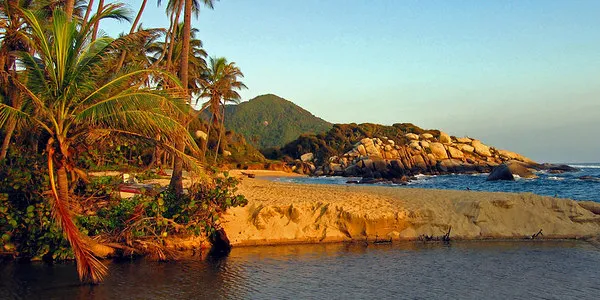
The popular Tayrona National Park lies on the Caribbean coast near Santa Marta in Colombia. It has some of South America's loveliest coastline. This little, delightful spot has beautiful beaches, hammocks to rent for the night, food, water and surf Additionally, you can get a guide to take you to a native village in the nearby mountains.
Tayrona National Natural Park travel guide
Understand
History The national park was created in 1964. It is on the Caribbean Coast in the north of Colombia, 34 km from the city of Santa Marta. It has not only an immense natural importance in this region, but it is also a cultural treasure. The Koguis are descendants of the Tayrona People living there today.
Landcapes
Flora and fauna
The park offers a big variety of flora and fauna because it includes two ecosystems between the mountain and the sea. It boasts fascinating wildlife including black howler and titi monkeys, red woodpeckers, iguanas, jaguars (which are rarely seen as they hunt at night), a variety of lizards, tropical marine life, and more than 400 species of birds, such as eagles, condors and the odd pet parrots kept at the restaurant at Arrecifes. The vegetation is characterized by the ecological influence and the rain depending on the sector, from tropical dry forest to coral reefs.
Climate The temperature varies between 25°C and 30°C, depending on the location and elevation. There are two rainy seasons from May to June and from September to November. The climate is temperate and hot.
Getting there
By bus From Santa Marta take a white bus from the corner of Calle 11 with Carrera 9, by Mercado Público. It leaves about every 15min and costs COP$10,000 (Mar 2025). Ask the bus driver to drop you off at the park entrance, it is about one hour and can't be missed. From the park entrance it is another 4 kilometers to Cañaveral. You can either walk, take a van for COP$3,000 (June 2019) or try to hitch a ride. From the entrance to Arecifes is about 1.5 hours on foot, but you can see monkeys and other wildlife along the way.
By car A taxi from Santa Marta or Taganga might be an alternative for groups of 3 or 4 persons. It should cost around COP$70,000. GPT offers low emission rides from Santa Marta to the Tayrona Park and other destinations in this area.
By boat From Taganga there is a daily boat leaving early in the morning at about 9:30AM to El Cabo San Juan and returning at around 3PM. The 1 hour boat ride can be really rough in the open ocean. Protect your belongings with plastic bags, because especially in the back of the boat you get all wet. There is a fix price of COP$50,000 each way. The entrance fee has to be paid at the beach. The boat drops you straight at El Cabo, so if you are planning to stay there it is ideal. You can always take the boat to El Cabo and spend some time trekking to the end and then getting a bus out. With a large number of people it might work out cheaper to rent a boat from Santa Marta or Taganga. You get dropped off at one of the park's beaches and this way you avoid the entrance fee.
Getting around
A jeep or other vehicle can be caught from El Zaino entrance which will take you to the start of the hiking trail. Mules and donkeys can be hired to transport you and your luggage to Arrecifes, but are mostly used for transporting groceries (fruit; food; drink and water) to the local restaurants in the park. The walk to Arrecifes is about 45 min-1 hour, depending on how much you stop to observe the local fauna and flora. It is recommended that hiking boots or trainers are worn for the duration of this walk, as it can get really muddy and slippery during the rainy season. The walk from Arrecifes to La Piscina is about 15-20 min, the majority of the walk is along the beach and sea edge with some palm forested areas. The walk from La Piscina to El Cabo is another 30-40 min, but well worth it once you arrive. For finding park amenities and getting around, OsmAnd or Mapy.cz cover the area better than Google Maps.
See
1 El Zaíno. Most of the tourist attractions are located in the east of the park. So everybody has to enter the park through the gate of El Zaíno. It is on the highway between Santa Marta (36 km), Palomino (63 km) and Riohacha (134 km). At the gate unofficial guides are offering cheaper prices for tours. But most of the tours can be done on your own anyway. 2 Cañaveral. Cañaveral is the only place which can be reached by car. A jeep or truck is running on this 4-km-long road for COP$2,000 per person. In Cañaveral there are a camping ground, exclusive cabanas and a restaurant. The beach is nice, but sometimes dangerous for swimming. The beach of Castilletes is a little off the road with the first accommodations in the park at the beach. 3 Arrecifes. Arrecifes is the place with most of the good budget accommodations. It is as 45-min hike from Cañaveral to reach there. If you don't want to walk all the way you can go by horse (COP$20; 000) or rent a donkey to carry your luggage. The beach is nice but dangerous for swimming. Instead head another 10 min to La Aranilla or 20 min to La Piscina. (updated Mar 2017) 4 La Piscina. La Piscina is the safest place to swim and a great beach to hang out. It has a beautiful accommodation where you can enjoy your stay in Tayrona National Park. 5 El Cabo San Juan de la Guía. A pair of spectacular beaches separated by a rocky outcrops. There is a large campground and restaurant that serves breakfast, lunch and dinner, which is surprisingly good and affordable. Besides there is also a basic but exclusive two-story wooden bungalow for rent on the rocky point. From La Piscina it's a 10-min walk and from Arricifes around 30 min of easy hiking. (updated Mar 2017) 6 El Pueblito. An archaeological site similar to Ciudad Perdida only much smaller in size. It is a 1-2 hour uphill walk from El Cabo.Since March 2019 the path to El Pueblito is closed, a local restaurant owner said it will be closed for the next 10 years (unverified). (updated Mar
Do
Swimming. In La Piscina a reef in front of the coast forms a natural swimming pool. Other than Arrecifes it is safe to swim here. Snorkeling. Snorkeling at El Cabo is also a great pastime, provided the visibility is good. A variety of marine life including tropical fish can be seen nearer the rocks and on the reef further out into the ocean. It is recommended to bring one's own snorkeling gear.
Hiking and beaches Tayrona's main hiking circuit starts at the El Zaino entrance and traces the coastline through tropical dry forest, reaching the iconic beaches of Arrecifes (rough surf; not for swimming), La Piscina (sheltered cove; snorkel-friendly), and Cabo San Juan (the most photographed double-beach with palm-thatched palapas). The El Zaino-to-Cabo San Juan walk takes 2–2.5 hours one-way and is moderately strenuous in heat. Two indigenous Pueblito ruins (related to the Tayrona Lost City civilization) are reachable via a separate, steeper trail. Eco-cabin accommodation inside the park is available via Ecohabs (Aviatur; mid-range to upper-mid-range; US$200–400/night) and Senda Koguiwa. Hammocks at Cabo San Juan are budget-friendly but book quickly. The park closes annually for approximately 30 days starting in February or June (rotating) for cultural and ecological restoration — check ParquesNacionales.gov.co for current closure dates.
Eat
Food in Tayrona is a bit more expensive than oth
Overview adapted from Wikipedia, travel guide fromWikivoyage (CC BY-SA). Photography via Wikimedia Commons.