
Taveuni
Fiji · Other
About Taveuni
Taveuni is the third largest island in Fiji. It has the distinction of being one of the few places (other than Northeastern Russia and Antarctica) where the 180th meridian crosses land. It rains here a lot, so be prepared and do not wait until it stops raining. Do not trust weather forecasts.
Taveuni travel guide
Understand
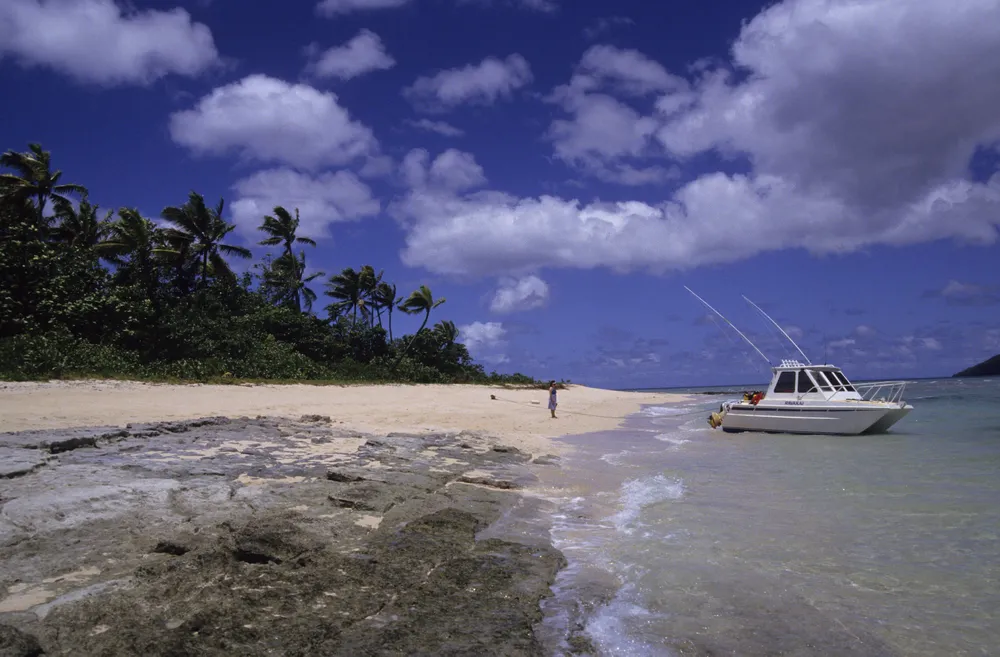
Taveuni, also called the "garden island" of Fiji, is rugged, verdant and pristine. It lies about 7 km off the south east coast of Vanua Levu and is 42 km long and averages about 12 km wide. Taveuni is an archetypally beautiful tropical island, thick with vegetation and resplendent with tropical flowers. Pristine rainforest covers much of the island and around 80% of this is protected by forest reserve and the Bouma National Heritage Park. Taveuni offers the visitor a rich natural history, in particular, a fine array of birdlife. Fortunately, unlike the rest of Fiji, the mongoose was never released or introduced to Taveuni and consequently many birds that have disappeared on the Main Islands still thrive here on Taveuni. Taveuni was once home to fierce warriors; Taveuni locals still exude pride and confidence in their personalities and are called one of the most friendly people in the islands of Fiji - which is saying quite something! Taveuni has a population of about 12,000 inhabitants, and is sparsely populated. Virtually all of the local residents live in traditional villages. Once known for its coconut plantations, Taveuni's attractions include world-class diving, dozens if not hundreds of waterfalls and an array of indigenous flora and fauna.
Getting there
By plane 1 Matei Airport (TVU IATA). Fiji Airways flies to Taveuni from Nadi and Suva. (updated Feb 2023)
By ferry You can take a Goundar Shipping ferry from Suva or Nadi via Savusavu to Taveuni. It runs 1-2 times a week as of 2024. The alternative is a cheaper and much smaller SunCity ferry from Natuvu Jetty at the very east end of Vanua Levu. It runs almost every day as of 2024. You can buy the tickets along with a bus transfer to/from Savusavu (1.5h) or Labasa.
Getting around
There is a local bus going around the island (all the way to Lavena). It runs a couple times a day and costs around $5, depending on the distance travelled. It is much cheaper than taking a taxi. You can pay with cash or an eTransport card from Vodafone.
See
Bouma National Heritage Park. Aimed at conserving the rainforest of Taveuni and the Vanua Bouma (the land; the sea and people of Bouma). The Park was established in 1990 not only to protect the forest but also as a means of generating an income for the four villages whose land is bounded by the park. Technical assistance for the project is provided by the New Zealand Official Development Assistance (Fiji Ecotourism) Programme and the Fiji Native Land Trust Board. For more information you can contact the Tavoro Waterfalls Visitor Centre on +679 888 0390. Lavena Coastal Walk. Give yourself at least half a day or more to experience Lavena's wild and scenic coastline and waterfalls. A well formed track takes you from Lavena village along the coast (great for swimming and snorkelling) to an idyllic swimming hole and waterfalls. Allow four hours return to complete the walk which is mostly flat with plenty of places to stop and swim. Walk costs $15. You have to swim about 100 m to the waterfall pit, so take swimming suit and waterproof camera. Tavoro Waterfalls. Walking, swimming, picnicking and taking in the views – it's all possible at Tavoro Waterfalls (also known as Bouma Waterfalls). These are the most accessible waterfalls and a classic must do. There are three falls to choose from. The lower waterfall is an easy 15-minute walk, the middle fall is a moderate walk for 45 minutes and the upper fall can be reached in another one hour moderate to challenging walk. At over 30 m high, the lower fall is the most spectacular and has the biggest swimming hole. There are fantastic views on the track from the lower to the middle fall, so don't miss this one. Vidawa Rainforest Hike. If you want a challenging full day hike into the heart of the forest, this is it. Knowledgeable local guides will take you to archaeological sites, great view points and into the deep rainforest where you will see the traditional uses of the forest and lots of birds. Cost: $40 (with guide), booking i
Do
Diving Beneath the surface of sea, in the coral reefs that fringe the island, is an extremely rich eco-system that rivals the bio-diversity found on the surface. Fed by rich nutrients that emerge from the depths of the Tongan trench, Taveuni is famous for its multitude of tropical, pelagic fish. However, if there is one trademark or signature species in the area, it is soft coral, which billows and undulates in the currents. Soft coral comes in dramatic, sometimes electric hues of orange, red, pink and white, which is fringed by purple. While the diving in the Taveuni area is stunning and virtually unscathed by the 21st century, it is not generally a place to bring absolute novice divers. The currents can be strong and unwieldy for those unaccustomed to them and one should have some prior experience as a diver before venturing here. This is true when diving the Somosomo Strait, a relatively narrow waterway located between Taveuni and Vanua Levu. Along the southeast shore of Vanua Levu one will find a barrier reef continually fed by micro-organisms washed by the currents driven by the narrowing of the fun eel-like strait. Protruding into the strait from the Vanua Levu side to about 3km from the shores of Taveuni is a magnificent reef, called Rainbow Reef. Here one can find one of the most famous dive sites in the South Pacific, the Great White Wall. It is named because of the unusual soft coral that inhabit the area. Starting at a depth of about 15 m and continuing to over 65 m, this underwater escarpment is covered with an almost luminescent white coral tinged with lavender. There are a great number of other dive sites sprinkled throughout the area and new attractions are found all the time. It is estimated that only 5% of the entire reef system in the Taveuni area has been explored by divers and it's not unusual to see pelagics such as dolphins, turtles, eagle rays and a number of species of shark.
Fishing Pristine and abundant waters surround your home bas
Buy
YanuyanuART in Matei, where you can purchase or even hand print your own sulu with designs carved from wood. Carving, artworks, jewellery, commissions and good conversation also available. As of 2024, there is only ATM on the island. It is located in Taveuni's biggest town - Naqara.
Eat
On Taveuni, all but one restaurant are attached to a hotel.
Sleep
Budget 1 Maravu Lodge, Main Coast Road, Matei, Taveuni Island, ☏ +679 8880555, [email protected]. Vuna Lagoon Lodge, Southern end of Taveuni island next to Vuna village, ☏ +679 949-6646. Your host is a traditional owner, daughter of the late Tui (Two-ee; means King or Paramount Chief) Vuna, Adi (pronounced An-dee; means Noble Lady) Salote Samanunu. The accommodation is right on a large lagoon, and it takes some time to get to the reef from the water's edge. Electricity is available for 3 hr in the evening. The surrounds are amazingly beautiful, and a small boutique 4-star resort, Paradise Taveuni, is a short drive which offers snorkeling/divi
Overview adapted from Wikipedia, travel guide fromWikivoyage (CC BY-SA). Photography via Wikimedia Commons.