
Tanjung Aru
Malaysia · Asia
About Tanjung Aru
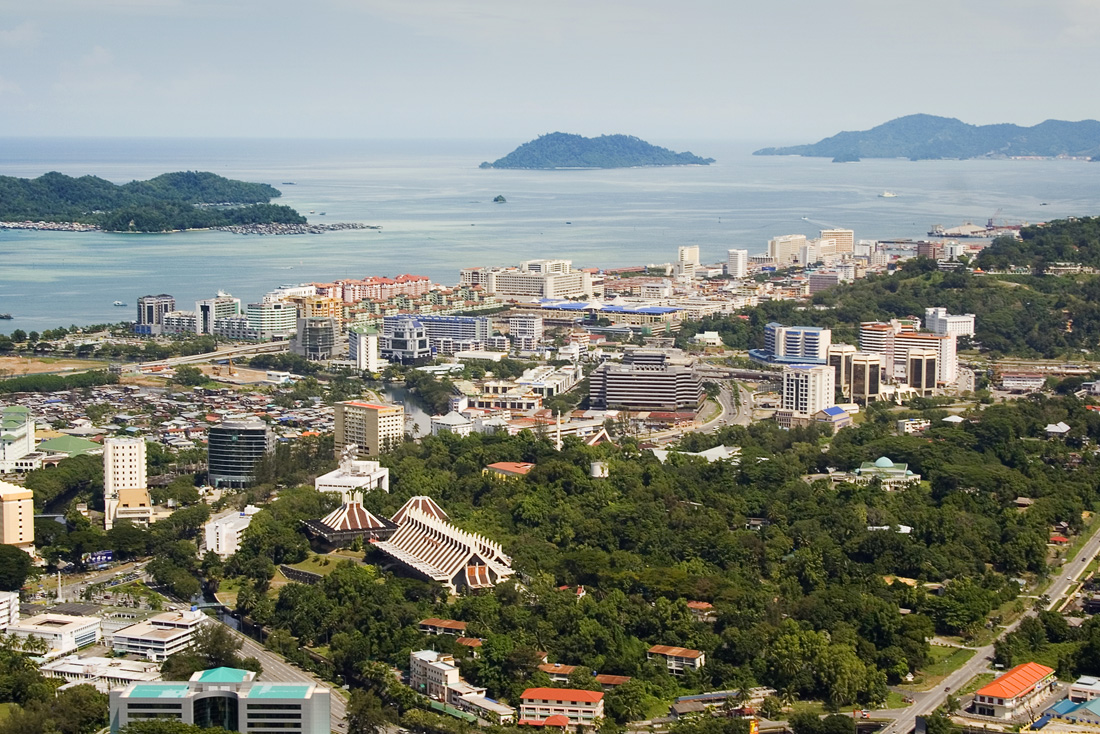
Kota Kinabalu is the capital of Sabah on the island of Borneo, often referred to by locals as just KK. This Malaysian city is a growing resort destination due to its proximity to tropical islands, sandy beaches, lush rainforest and Mount Kinabalu. KK is one of the smallest districts in Sabah but has the largest population and is the largest city in the state.
KK lies by the coast overlooking the South China Sea on a narrow flatland and occasional hills bordered by the Crocker Range which hosts Mount Kinabalu. Hence the urban sprawl is concentrated along the coast towards the north and south of the city.
Tanjung Aru travel guide
Understand
Kota Kinabalu is a growing city of around 500,000 inhabitants. Economic growth has resulted in urbanisation of the city reaching adjacent districts of Penampang and Putatan with a total population of almost 800,000. Its growth and importance is due to being the administrative capital, a major transportation hub, growing port, manufacturing hub, growing tourism and because it is the major gateway into Sabah and East Malaysia. Kota Kinabalu was granted city status in 2000, becoming the sixth city. It is the sixth largest urban/metropolitan area in Malaysia. Kota Kinabalu was known as Jesselton while under British colonial rule from the late 1800s until 1963 when the British left and after Sabah became part of Malaysia. Most of the town was destroyed due to bombings during World War II hence there are not many pre-war historical sites around the city. Before the British arrived, the area was also known by a number of other names such as Deasoka (below the coconut tree), Singgah Mata (pleasing to the eye), Api-Api (fire!) and Gaya Bay. The people of Kota Kinabalu are Chinese, Kadazandusun, Bajau, Murut, Brunei Malays, and there is significant migrant population from Indonesia and Philippines, many of whom are naturalised citizens. There are also many migrant/expat population from India and a growing number from Korea. Central Kota Kinabalu is often referred to as Kota Kinabalu City Centre or the Central Business district (CBD) or simply Downtown KK and is on the narrow coast overlooking Gaya Island. This is where most hotels, travel agents, transportation bases and most of the action are found. Most of the city centre lies on reclaimed land due to a shortage of land in the area, as it is blocked in by Bukit Bendera (Signal Hill). District areas which lie within the city centre include Sadong Jaya, Api-Api, Asia City, Bandaran Berjaya, Sinsuran, Kampung Air, Segama, Pantai Street, Gaya Street, Jesselton Point. Just outside the City centre are the Districts towards the So
Getting there
By plane There are direct international flights from these destinations to Kota Kinabalu: Bandar Seri Begawan, Brunei (Royal Brunei Airlines), Hong Kong (Air Asia), Manila, Philippines (Cebu Pacific & Philippines AirAsia), Seoul Incheon & Busan South Korea (Air Busan; Air Seoul; Jeju Air & Jin Air), Singapore (AirAsia; Malaysia Airlines & Scoot), Taipei, Taiwan (Malaysia Airlines; AirAsia), Domestic flights from the following cities: Johor Bahru, Kota Bharu, Kuala Lumpur, Kuching, Kudat, Labuan, Lahad Datu, Lawas, Limbang, Miri, Mulu, Penang, Sandakan, Sibu, Tawau. Operated by MASWings, Malaysia Airlines, Batik Air, and AirAsia.
1 Kota Kinabalu International Airport (BKI IATA; abbreviated to KKIA). Malaysia's second busiest airport and the main gateway to Sabah and around 8 km from the city centre. There are two terminals in the airport. Terminal 1 serves full-service airlines such as Malaysia Airlines, Asiana Airlines, while Terminal 2 serves air cargo, a tourist helicopter service, and charter flights. The State government has foreseen maximum capacity is fast approaching and plans are under way to move some of the traffic directly to Sandakan once Sandakan airport has been lengthened.Terminal 1 and Terminal 2 are on different sides of the runway. Terminal 1 is accessible from Jalan Kepayan near Kepayan and Terminal 2 is accessible from Jalan Mat Salleh in Tanjung Aru. There are ATMs and a currency exchange in Terminal 1 but if you're arriving late it will almost certainly be closed and the ATMs are not always working. Make sure you've got some Malaysian ringgit before you arrive as you'll need it for the taxi or the bus. If you find yourself having just arrived and without any ringgit, you can have a taxi take you to an ATM on the way to wherever you're staying.There is free Wi-Fi within the departure zone of the airport.There is hostel at the airport, Skypod that charged RM39/night in 2017 including wi-fi and breakfast. They also offer 4-hour transit stays.
Getting around
By foot
The city centre is quite small, and you can walk from one end to the other in less than 30 min. The city is set out along a grid system with the long main roads running parallel to the nearby waterfront with intersecting roads forming the local districts within the city. As KK has grown there are dual carriageways that weave around the city on the land available and the new buildings/malls, hospitals, etc. Further from the old city centre the roads do not conform to the original grid planners used. Safely crossing the street can be an issue, but most streets are at least equipped with sidewalks and there are pedestrian crossings on the main roads. The sidewalks in places can be uneven and the storm gutters are easy to trip or fall into. You can also walk to and from the airport (1-2 hr each way). Even the highways outside of town usually have a walking path or a wide grassy shoulder to walk on.
By taxi Short fares are around RM10, longer trips around RM20. A whole day shouldn't cost more than RM300. Haggling is absolutely vital in order to get a fair price. Many taxi drivers in Malaysia are infamous for raising their fares, even after a price has already been negotiatied. They frequently attempt to manipulate and deceive unknowing tourists by feigning ignorance and delivering tourists to the wrong hotels, which sometimes provide kickbacks to the drivers. Mentioning a call to the authorities may resolve the situation quickly. Grab Car operate, with rides costing RM4 for the first 3 km and RM1.2 for each sequential km. Uber merged with Grab in 2018, and they have similar functionality. Typical prices are half those of taxis and there is no need to haggle; the price is confirmed before a ride arrives and you pay cash at the end or via GrabPay (e-wallet).
By bus and minibus To travel within the city centre, the City Bus is used. The green and yellow City Bus departs from Wawasan Bus Terminal and circles the city center using 4 routes: Route 1A, 1B, 2A a
See
Central part 1 Atkinson Tower (on a hill beside Jalan Tunku Abdul Rahman; a few min away from the city centre). Built in 1902 in memory of Francis George Atkinson, the first district officer of Jesselton, as Kota Kinabalu was then called. He died of a tropical disease in the same year at the young age of only 28. The clock tower is one of only two structures to survive the World War II destruction of Jesselton (renamed Kota Kinabalu in 1963), the other being the Post Office building, which is now the Sabah Tourism Board building on Jalan Balai Polis. Not to be confused with the general Post Office building on Jalan Tun Razak in Segama district of KK city.
2 City Park. A small park and the only park in the city center opposite the court complex. It contains the British North Borneo Memorial which commemorates the soldiers who fought and died defending the British Empire during World War I. The memorial was built in 1923. 3 Chinatown (Gaya Street). Located in the city centre surroun
Overview adapted from Wikipedia, travel guide fromWikivoyage (CC BY-SA). Photography via Wikimedia Commons.