
Suakin
Sudan · Africa
About Suakin
Suakin is a port city in Northern Sudan. Once considered the height of medieval luxury on the Red Sea, the old city built of coral is now in ruins.
Suakin travel guide
Understand
Suakin was likely Ptolemy's Port of Good Hope, Limen Evangelis, which is similarly described as lying on a circular island at the end of a long inlet. Suakin was first mentioned by name in the 10th century by al-Hamdani, who says it was already an ancient town. At that time, Suakin was a small Beja settlement, but it began to expand after the abandonment of the port of Badi to its south. The Beja were originally Christian. Despite the town's formal submission to the Muslim Mamluks in 1317, O. G. S. Crawford believed that the city remained a center of Christianity into the 13th century. Muslim immigrants such as the Banu Kanz gradually transformed this: Ibn Battuta records that in 1332, there was a Muslim "sultan" of Suakin, al-Sharif Zaid ibn-Abi Numayy ibn-'Ajlan, who was the son of a Meccan sharif. Suakin was sieged by the Portuguese in 1513 and captured briefly in 1541. Ottoman sultan Selim I nominally added the port to the territory of the Ottoman Empire in 1517, though it was only loosely controlled, until the Ottoman province of Habesh was established in 1555 with the residence of its pasha in Suakin. The Ottomans restored the two main mosques – Shafi'i and Hanafi, strengthened the walls of the fort and built new roads and buildings – but by the 18th and 19th centuries, the Swiss traveler Johann Ludwig Burckhardt found two-thirds of the homes in ruins and described it as a place of "ill-faith, avarice, drunkenness and debauchery". The Khedive Isma'il of Egypt received Suakin from the Ottomans in 1865 and attempted to revitalize it, building new houses, mills, mosques, hospitals, and a church for immigrant Copts.
The British Army was involved at Suakin in 1883–1885 and Lord Kitchener was there in this period leading the Egyptian Army contingent. Suakin was his headquarters and his force survived a lengthy siege in the city. After the defeat of the Mahdist State, the British preferred to develop the new Port Sudan, rather than engage in the extensive rebuilding
Getting there
By bus You can take a public minivan from Port Sudan. The journey takes one hour and costs US$2.
By ferry There is a ferry from Jeddah, Saudi Arabia, that takes 12-14 hours and departs every two days. Vehicles can be transported.
1 Ferry terminal. The ferry terminal is in the harbour. Baabud Ferries ☏ +996 2627 0000, or El Salam (Sorbate for Maritime Service) ☏ +249 31 182 9634 (updated Jan 2019) The Suakin bus station is about a 10-minute walk from Suakin Island.
By plane The nearest airport is the Port Sudan New International Airport (PZU IATA).
Getting around
Motor rickshaws run from the bus station.
See
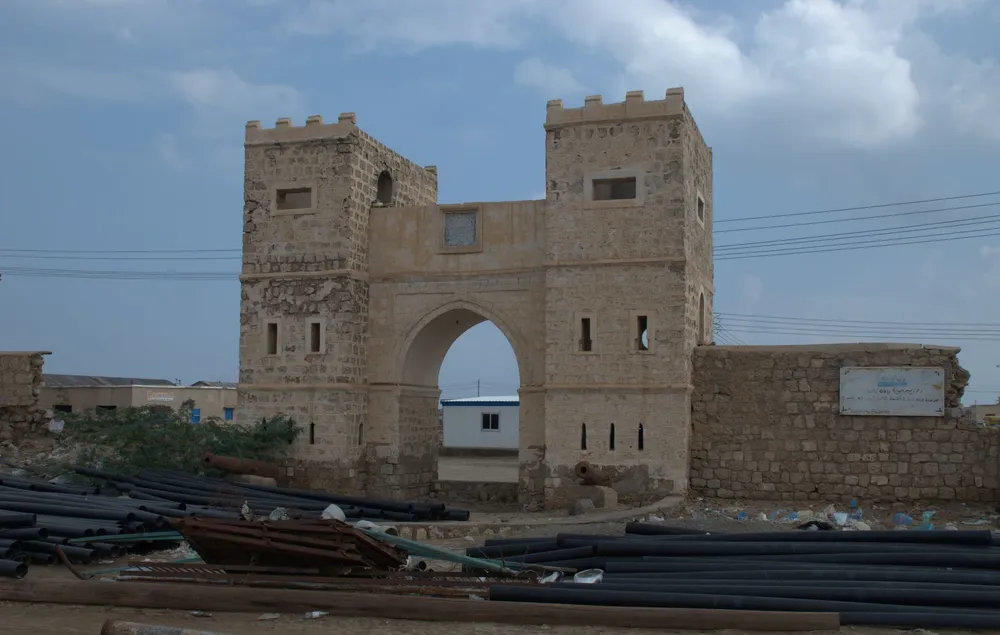
On the mainland 1 Taj as-Sirr Mosque (مسجد السيد تاج السر الميرغني). (updated Jan 2019) 2 City gate (بوابة كتشنر; Kitchener Gate). (updated Jan 2019)
On the island 3 Suakin Island. The location of the old city, now mostly in ruins. Highlights include Khorshid Effendi’s House, the Hanafi Mosque and the Shafai Mosque. The ticket office is located at the entrance to the island, after the causeway. SDG10 per person, although you may be asked for US$0.50 instead. (updated Nov 2023)
Buy
There is a vegetable market near Taj al-Sirr Mosque.
Sleep
1 Bohein Hotel, ☏ +249 92 283 5200. US$24/night for a double room. (updated Nov 2023) 2 Basiri Plaza Hotel, ☏ +249 91 213 3278. US$80/night for a double room. (updated Nov 2023)
Overview adapted from Wikipedia, travel guide fromWikivoyage (CC BY-SA). Photography via Wikimedia Commons.