
Snowy Mountains
Australia · Oceania
About Snowy Mountains
For other "snowy mountains" see Sierra Nevada (disambiguation), for example.
The Snowy Mountains, nicknamed the Snowies (or Snowys), is a region in Southeastern New South Wales. The highest region of mainland Australia and one of the cooler areas of New South Wales, they are notable for their ski-fields and are the centre of snow sports in New South Wales.
Snowy Mountains travel guide
Understand
The Snowies are the tallest in Australia (if still no match for New Zealand or New Guinea) and the best it gets in terms of alpine weather on the continent. While the mountains here are nowhere near as tall as New Guinea's 4500-m mountain range, those don't receive as much snowfall as the Snowies. Interestingly, the Australian Alps receive more snowfall than the Swiss Alps, which sounds unusual to most.
Flora and fauna The usual alpine vegetation, as well as kangaroos, dingos, etc. Emus, a rare sight elsewhere in New South Wales, are frequently spotted around Mt Kosciusko National Park.
Tourist information Snowy Mountains Tourism information
Getting there
The Snowy Mountains are on Australia's eastern seaboard and are equidistant from Sydney and Melbourne. Most people travel to the region by car as this is the most flexible and rewarding way of exploring the mountains. However for visitors traveling from afar, there are regular bus services to Cooma and Tumut from Sydney and Canberra, and many plane connections into Canberra (CBR IATA) with car hire available. Flights also serve Cooma Snowy Mountains Airport (OOM IATA), however, delays are common due to morning fog. The Snowies are well served by a network of sealed roads with diverse and spectacular scenery. The Alpine Way from Jindabyne to Khancoban, the Snowy Mountains Highway between Tumut and Cooma, the Monaro Highway running south from Canberra and the Elliot Way from Tumbarumba to Cabramurra all pass through stunning landscapes. If you are just interested in the skiing, Murrays offer a day trip from Canberra to the ski resorts during the ski season, with lift packages, and one-way fares available. Often you can get this bus for little more than the cost of the lift passes and ski hire. If you are coming from the south via Khancoban, make sure to fill up at the Independent there, since that will be the last stop for alpine diesel or even just normal fuel for the mountain drive up north which takes 78 km and 2 hours. There are numerous coffee shops nearby as well, so your cup of coffee or hot chocie won't be missed. This is also the only part where you might see snow on the road throughout winter, due to the high altitude of 1600 m, but the entire journey's elevation ranges from 250 m in Khancoban to about 1600 m in Siberia.
Getting around
During winter snow chains must be carried by 2WD vehicles on the Alpine Way, Kosciuszko Rd and Guthega Road. Some roads may close at short notice, so check conditions on the official New South Wales traffic site. When in town, it's best to walk rather than take the car. Cars can be freezing in the mornings, and often it's not worth the effort to take it out and park it. When climbing up, gondolas are also available, however, passes are required. The nearest fully run airport is in Cooma OOM IATA, however, to get around, flights won't do the job, so you'll need to know how to drive, and not just urban driving, but also driving on narrow winding roads that vary in elevation. See driving in New Zealand for some useful advice. Since 2024, TfNSW has new bus services from Jinabyne to Thredbo and Perisher.
See
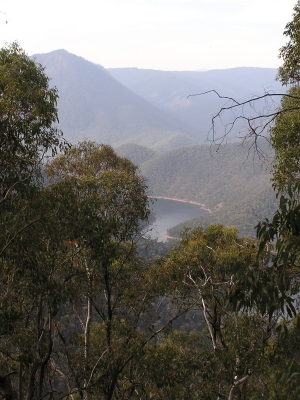
Australia's high country is home to spectacular peaks, clear mountain streams and a plethora of accessible natural attractions for lovers of the outdoors. Walking and horseriding are two great ways to explore the alpine landscape and take in some of the country's most impressive scenery in the warmer months. The Snowy Mountains is a significant and untamable high country where many Australian myths and traditions of Australian identity were born. Whether from nature's pure beauty or legends of early settlers, there's a story to be told and history to be learnt - from icons like the heights of Mount Kosciuszko to the famous high country huts, to Snowy Hydro feats of ingenuity, beautiful mountain brumbies and to rivers that flow with legends. The Snowy Mountains Scheme is one of Australia's largest engineering and construction operations. The idea behind the scheme is to divert the winter snowmelt waters westward into the Murrumbidgee rivers, irrigating large parts of inland Australia and at the same time generating Hydro-Electricity. There are several large lakes, tunnels, and Hydro power stations that form part of the scheme that you can visit. Tours take visitors a kilometre into the mountainside and offer a vivid insight into the sheer scope of this iconic part of the nation's post-war development. You can see the headwaters of the Murray River at Tom Groggin, along the Alpine Way between Thredbo and Khancoban.
Do
The mountains are beautiful year round and the region annually attracts some three million visitors seeking nature-based and adventure holidays. If you've come this far, you can't go home without doing some form of snow-related activity. Skiing is by far the most common activity, but snowboarding is still very popular. If it's your first time visiting the Snowy Mountains, most beginner skiers choose to ski at one of the state's two main ski resorts: Perisher and Thredbo. For skiers up for a challenge, Charlotte Pass or Cabramurra are two off-the-beaten-track ski resorts designed for skiers with previous skiing experience. The Snowy Mountains offer a variety of attractions, outdoor activities, tours and events, whether you're after a rugged back-to-nature experience, want to be cosseted in alpine splendor or feel like going somewhere beautiful, diverse and interesting with the whole family.
Abseiling, rock climbing and caving Bushwalking, the top of Australia is only a few hours hiking from Charlotte Pass or Thredbo during summer via the many Mount Kosciuszko summit trails. Cycling/mountain biking and motorcycling Fishing Horse riding White water rafting, kayaking and canoeing In winter, alpine skiing and snowboarding. Thredbo, Perisher, Mount Selwyn, or Charlotte Pass all have a large variety of terrain for beginners to advanced. You can ski with gum trees. Snow shoeing and cross country skiing: see also Winter sports in Australia
A wide variety of Backcountry/off-piste skiing/spit boarding options are available and easily accessible from Guthega and Dead Horse Gap. Snowy Mountains Backcountry, ☏ +61 400 349 319. Guided backcountry skiing/snowboarding/snowshoeing tours, equipment hire and sales. (updated Sep 2020)
Buy
For supplies, large towns like Cooma or Tumut should have a Woolies (Woolworths) or a Coles. If in a small town, then there are smaller local shops for you to get your supplies from. To get ski equipment, renting equipment is often cheaper at cities or large towns and in some cases, the equipment may be of better quality. Snow chains are also cheaper to rent here, and some shops are open 24 hours a day. However, if you can't have access to one of these towns, then equipment is available at the ski. However, these can be a little expensive and have a lower quality.
Eat
There are many places to eat and drink in the Snowy Mountains. Cafes are scattered all around the towns, including the mo
Overview adapted from Wikipedia, travel guide fromWikivoyage (CC BY-SA). Photography via Wikimedia Commons.