
Sindh
Pakistan · Asia
About Sindh
Sindh (Sindhi: سنڌ), the historical home to the Sindhi people is the second most populated administrative unit of Pakistan after Punjab, with a population of over 55 million people. Sindh is known as Bab-ul-Islam (the gateway of Islam), as it saw the first spread of Islam into South Asia. It has its own culture and traditions, and has its roots in one of the world's oldest civilizations, the Indus Valley Civilisation, which Sindh was home to.
Sindh is endowed with coastal access, and is a major centre of economic activity in Pakistan. Karachi, the country's largest city at the southwestern tip of Sindh, is the main financial hub of the country as well one of the most populous cities in the world and has both the country's largest airport and largest seaport.
Sindh travel guide
Understand
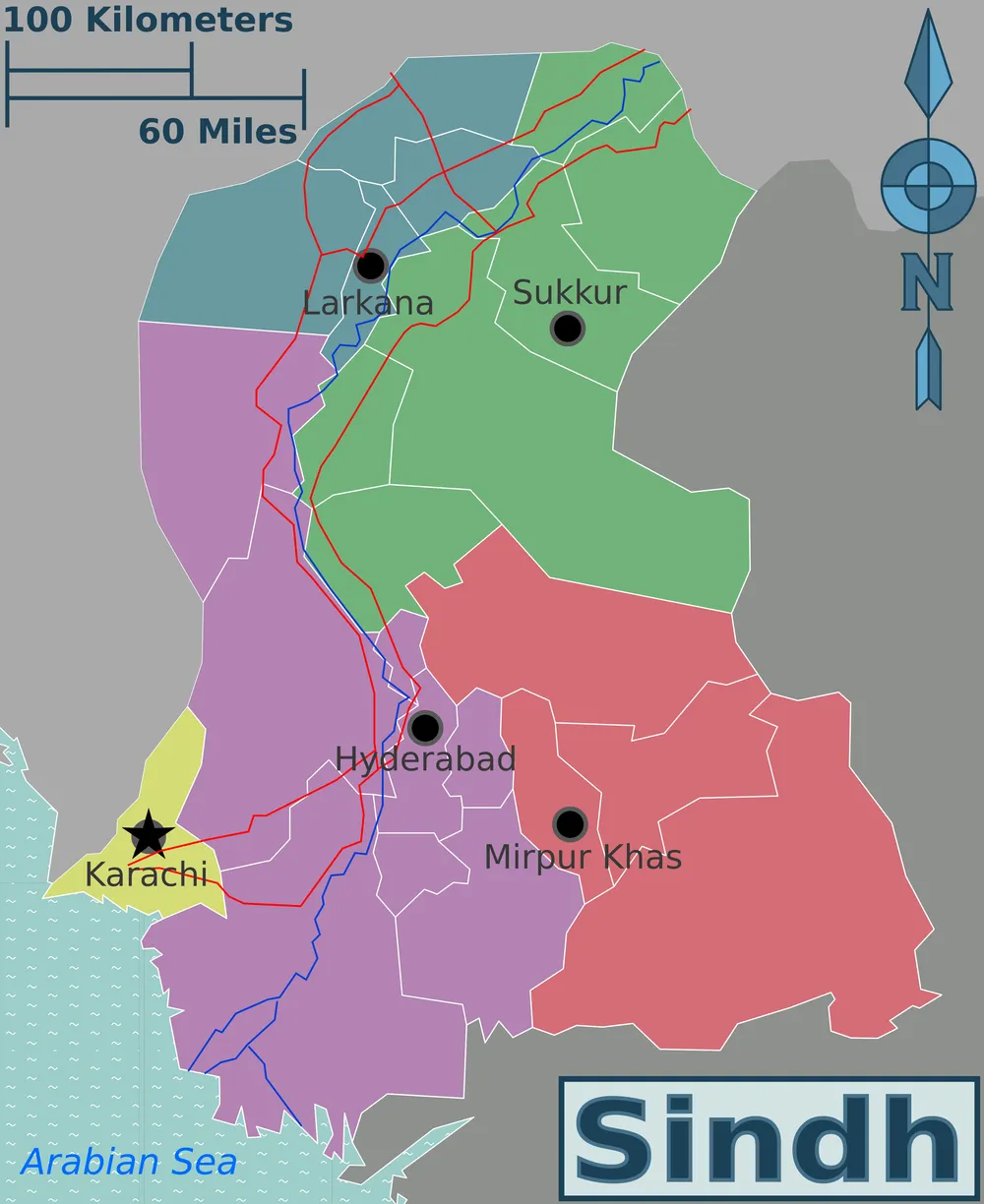
Sindh is bounded to the west by Balochistan, to the north by Punjab, the east by the Indian states of Gujarat and Rajasthan and to the south by the Arabian Sea. Many of the settlements in Sindh are located on, or close to the River Indus. This is similar to Egypt, where many settlements are located on the Nile. Sindh has strong Hindu influences and it is prominently featured in Hindu mythology. Even though many Sindhi Hindus migrated to India during the partition, the region still houses a large Hindu population and many of Pakistan's Hindus live here.
History Sindh is home to one of the earliest cities in the world, Mohenjo-daro which was one of the most advanced of its time, and one of the main cities of the Indus Valley Civilisation (IVC). IVC was one of the great civilisations of the ancient world, and one of the earliest Bronze Age civilisations. In 6th century BC, Sindh was conquered by Persian based empire Achaemenid Empire, also known as the First Persian Empire. Around the fall of Achaemenid Empire in the late 300s BC, Sindh was conquered by an army of Kingdom of Macedonia led by Alexander the Great. Sindh remained under the control of Kingdom of Macedonia till the death of Alexander. Sindh soon came under the control of the Maurya Empire. The Islamic era began when the Islamic forces under the leadership of general Muhammad bin Qasim entered Sindh in 711 AD, defeated the ruling Raja Dahir of Rai dynasty and conquered Sindh and neighbouring regions along the Indus River for the second Islamic caliphates Umayyad Caliphate. Umayyad Caliphate was the second of the four major Islamic caliphates established after the death of Muhammad and at its greatest extent, was the largest empire in the world at that time. Sindh was made easternmost province of the Umayyad Caliphate and Mansura, which lies some 70 km north-east of Hyderabad was established and made the regional capital. The conquest brought South Asian societies into direct contact with Arabs and Islami
Getting there
By plane Most visitors to Sindh arrive at Jinnah International Airport, in the southern city of Karachi. The airport is the country's largest and busiest and works as the main gateway to Pakistan. It is served by many international airlines such as Air Arabia, Air China, Cathy Pacific, Etihad, Emirates, Gulf Air, FlyDubai, Iran Air, Oman Air, Qatar Airways, Saudia, SriLankan Airlines, Thai Airways, and Turkish Airlines. The airport is the main hub of the national flag carrier Pakistan International Airlines and other local airlines of Pakistan such as Air Blue. Sukkur Airport in the northern part of Sindh handles only domestic flights, but can be useful when coming into northern Sindh.
By train Sindh is well connected with the rest of the country by Pakistan Railways. The busiest railway station is in Karachi in southwest Sindh and plenty of trains (both economical and air-conditioned class) bound for Karachi originate daily from major Pakistani cities such as Lahore, Rawalpindi, Quetta and Peshawar. Karachi railway station, more commonly known as Cantt. station, is the final destination station of virtually all trains travelling into Sindh, while Hyderabad and the northern railway station of Rohri near Sukkur are important railway junctions where the majority of the trains make brief stops. Mostly people travel to Karachi and trains for Karachi are abundant so you should have no difficulty to find one that suits you. For travellers from Punjab, the air-conditioned accommodation class trains Tezgam or Shalimar Express are preferred. Tezgam originates from Rawalpindi, and travels via many major cities of Punjab such Gujranwala, Lahore, Multan and Bahawalpur. Shalimar Express originates from Lahore and via Faisalabad, Multan, and Bahawalpur enters Sindh. Both travel to Karachi, stopping briefly at Rohri and Hyderabad. The Khyber Mail is recommended for the journey between Sindh and the north-western region while the Bolan Mail is the best choice for those travell
Getting around
By bus A large part of travel between cities in Sindh is by bus. Travel by bus is the cheapest, most convenient, and most common way to move from place to place. Buses and minibuses travel around Sindh but quality can vary a lot. You can find buses to all major cities and towns. Air-conditioned buses run between major cities of the Sindh while non-air-conditioned for both from the major cities to small towns but the only drawback is comfort in non-air-conditioned buses. Buses are the only cheap way of reaching places not covered by railway. The one-way fare on a Daewoo air-conditioned bus between Karachi and Sukkur is Rs. 1,500. The buses run throughout the day at one-hour intervals and the ride takes seven hours while the one-way fare on a normal air-conditioned bus for travelling between Karachi and Hyderabad is around Rs. 300.
By train Sindh has a good railway network by Pakistani standards, and it's more than adequate for travel between major cities and towns. Plenty of trains travel back and forth daily, stopping at many railway stations along the way. Although major cities are well connected, you will need to use buses, taxis or your own car to reach many of the attractive tourist sites. Awam Express and Khushhal Khan Khattak Express are economy class only trains but have a good network in Sindh. Awam Express runs on the main line (between Karachi and Rohri) while Khushhal Khan Khattak Express operates on the branch line (between Karachi and Jacobabad). Sukkur Express and Bolan Mail have air-conditioned class accommodations. Bolan Mail runs on the branch line, while Sukkur Express on the main. Sukkur Express is the only regional train, and travels through many major cities and towns of Sindh. It runs on the main line until Rohri but later changes onto a branch line for Jacobabad. Marvi Passenger and Saman Sarkar Express travel from east to west and back in the southern part of Sindh. Badin Express travels between Hyderabad and Badin.
By car Sindh has a
See
Sindh has numerous tourist attractions, with the most celebrated ones being ruins of archaeological sites and the country's most popular beaches. Most visitors to Sindh end up in Karachi, a real mega-city, home to 23 million people. Karachi is a modern, bustling and multicultural metropolis and as the country's most developed urban area, provides a glimpse of modern life in Pakistan. It offers a remarkable variety of attractions and has a collection of beautiful buildings of varied architectural styles largely dating back to the British period. However, Sindh has much more to offer to its visitors than just a great city.
Cultural Home to the ancient Indus Valley Civilisation and its heritage, Sindh is dotted with well-known archaeological and historically significant sites which, despite extensive neglect, have been surprisingly well preserved. The most prominent are the ruins of earliest advance urban city of Mohenjo-daro and historical monuments at Makli, which is one of the world
Overview adapted from Wikipedia, travel guide fromWikivoyage (CC BY-SA). Photography via Wikimedia Commons.