
San Miguel de Allende
Mexico · Americas
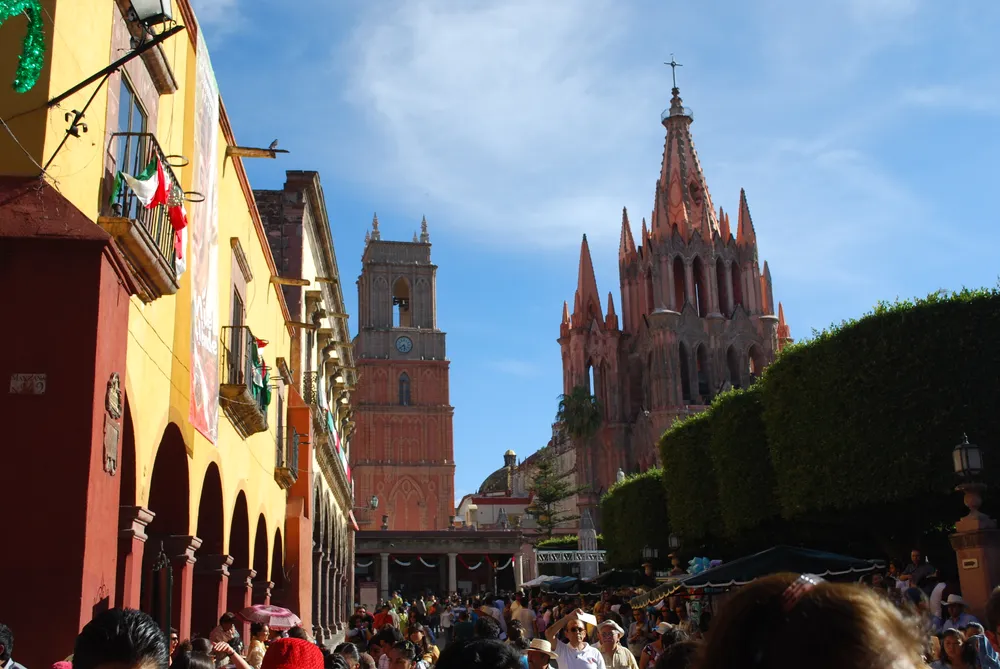
About San Miguel de Allende
San Miguel de Allende is a colonial city in the state of Guanajuato in the Bajio mountains of central Mexico, about 270 km (170 mi) northwest of Mexico City. In 2020, the town had 72,000 residents, in a metropolitan area of 160,000.
It's a tourist destination, an art colony, and a retirement community for 20,000-25,000 foreigners – mostly Americans, Canadians, and Europeans. In spite of the increased number of foreigners over the past decades, it still is charming enough that many Mexicans visit for special holidays, and there are more than a few visitors who buy a house within a few days of their first arrival.
San Miguel de Allende travel guide
Understand
San Miguel is, first and foremost, a city built for relaxing. It is a Spanish colonial town of 72,000 people (2020). The urban area has 160,000 people. It is a heritage site protected by the Mexican government in order to maintain its character. In 2008 it was designated a UNESCO World Heritage Site. Founded as "San Miguel el Grande" in 1542 by the Franciscan monk Juan de San Miguel, it became a centerpiece in the war for Mexican independence from Spain. After the war, in 1826, San Miguel was given city status and renamed San Miguel de Allende after Ignacio Allende, a hero of the independence movement, the "first Mexican soldier" and a native of the city. In danger of becoming a ghost town in the early 20th century, the town was declared a national monument in 1926 and building became heavily restricted in the town's historic centro district, allowing the city to keep the colorful native facades that have become the backdrop of many famous works of art and even modern motion pictures. A series of artist colonies were founded in San Miguel in the 1950s, including the famous Instituto Allende, and many American ex-soldiers moved their families here following World War II either to attend one of these colonies or to escape the polio scares raging through many U.S. cities. The result was a healthy American expatriate population that exists today mostly as elderly retirees and second-generation business owners. This population, combined with wealthy Mexicans (especially actors and politicians) that have rediscovered San Miguel as a Malibu-like retreat from Mexico City, has created an eclectic mix of Old World Mexican charm, American hospitality, and a party atmosphere that makes San Miguel a world-class destination for adventurous travelers.
Climate
San Miguel's weather is typical of central mountainous Mexico. It varies little, and even in the hottest months (May and June) when daytime temperatures can reach 35°C, the dry air makes it tolerable and cool mountain br
Getting there
By plane
From the León (BJX) and Querétaro (QRO) airport The closest airports to San Miguel are the Aeropuerto Bajío/León (BJX IATA), about 95 km (55 miles) west of San Miguel de Allende and Aeropuerto Querétaro (QRO IATA), about 90 km (50 miles) southeast of San Miguel de Allende. Arriving at either of these airports will reduce your final journey to a relatively inexpensive hour shuttle or cab ride into town. Aeromexico Connect, Viva Aerobus, and Volaris offer flights from Cancun, Chicago, Los Angeles, Mexico City, Monterrey, Puerto Vallarta and/or Tijuana to the region in addition to United Express and American Eagle with flights from Houston Intercontinental and Dallas/Ft Worth respectively.
Rides from the two airports When taking a taxi from one of the two airports, make sure you use an approved taxi service (the green and white cars are official taxis). Uber and Didi drivers may be willing to try picking you up, but risk being pulled over by the police and ordered to turn around and take you right back. Even still, if you don't know San Miguel that well, you may want to consider calling ahead to your hotel or B&B and having them provide transport. This will almost always be cheaper than taking a taxi from the airport. Regional taxis may know how to get you to San Miguel, but only a taxi or car sent by your lodging will know how to get you straight to them. The driver will meet you inside the terminal, in the area where you clear customs. You can arrange transportation through your hotel, etc., or book direct with one of the many shuttle services listed on San Miguel websites. From the Querétaro or León airports the company Bajiogo offers a shuttle for around M$500-600 (Jan 2024), and will drop you off to your exact location. This is a good deal if you're by yourself, but maybe be similar to the price of a taxi if you have two people.
By bus from the two airports From the Querétaro airport to the Querétaro bus terminal, it's convenient to take a tax
Getting around
On foot Maybe 90% of San Miguel's attractions are within walking distance. Just keep in mind that because San Miguel was built into the side of a mountain, it can turn out to be difficult to traverse, some inclines are 15 or 20 degrees. Furthermore, the streets are cobbled and narrow – some were nothing but goat tracks before they were paved – and many have fallen into disrepair. Curbs are often a high step away from the road. All in all, the town can be unforgiving to an inexperienced walker. For this reason, it is advisable to bring comfortable shoes.
By e-hailing Uber and Didi cover the city.
By bus San Miguel has its own pleasant and reliable bus system that serves the entire town, including out-of-the-way places like the Luciérnega Shopping Center. Buses are called urbanos and run from 07:00-21:00 daily for a flat rate of M$8 (Dec 2021) inside the city center (single ride; no transfer; driver gives change). The schedule is every 15-20 minutes in the central city; every 1-2 hours to and from outlying areas in the municipality. Routes are never referred to by their number but by the name of the destination. There is no route map. Destinations are generally marked or painted on the side or on the windshield. Centro means downtown and Central means bus station. Buses are white with color-coded trim. All the blue-white and orange-white buses pass the stop opposite the Oratorio de San Felipe Neri downtown. Yellow-white buses make a circle around town passing near Centro and Central. All red-white, green-white, purple-white buses and some yellow-white buses connect to the outlying suburbs and are boarded at various stops located several blocks outside the center of town.
By taxi Catch a taxi to any destination within central San Miguel for M$35-40 (2016), and M$40-50 after dark. In-town taxis are abundant and a great option after an afternoon of shopping. Taxis do not use meters and the price should be confirmed first. Taxis in front of the bus station a
See
Architecture 1 Parroquia San Miguel Arcángel, Plaza Principal s/n (by the Jardín), ☏ +52 415 152 4197. Daily 08:00-20:00. The marvelous pink granite parish church, looking like an ornate candy sculpture. The building itself dates from the 16th century, while the façade was designed in the 19th century by self-taught indigenous architect Zeferino Gutíerrez, who is said to have been inspired by a postcard depicting a European Gothic cathedral. 2 Templo de la Inmaculada Concepcíon (Las Monjas), Canal y Hernández Macías s/n, ☏ +52 415 152 0688. Daily 09:00-18:00. Next to the Bellas Artes and part of the former convent, this church was constructed in the mid-18th century. The massive dome is said to be a copy of Les Invalides in Paris. 3 Oratorio de San Felipe Neri, Insurgentes s/n, ☏ +52 415 152 0521. Daily 09:00-18:00. Completed in 1714, the church features a delicately-carved pink sandstone façade. 4 Templo de Nuestra Señora de la Salud (Church of Our Lady of Health), Plaza Cívica s
Overview adapted from Wikipedia, travel guide fromWikivoyage (CC BY-SA). Photography via Wikimedia Commons.