
Punta Cana
Dominican Republic · Americas
About Punta Cana
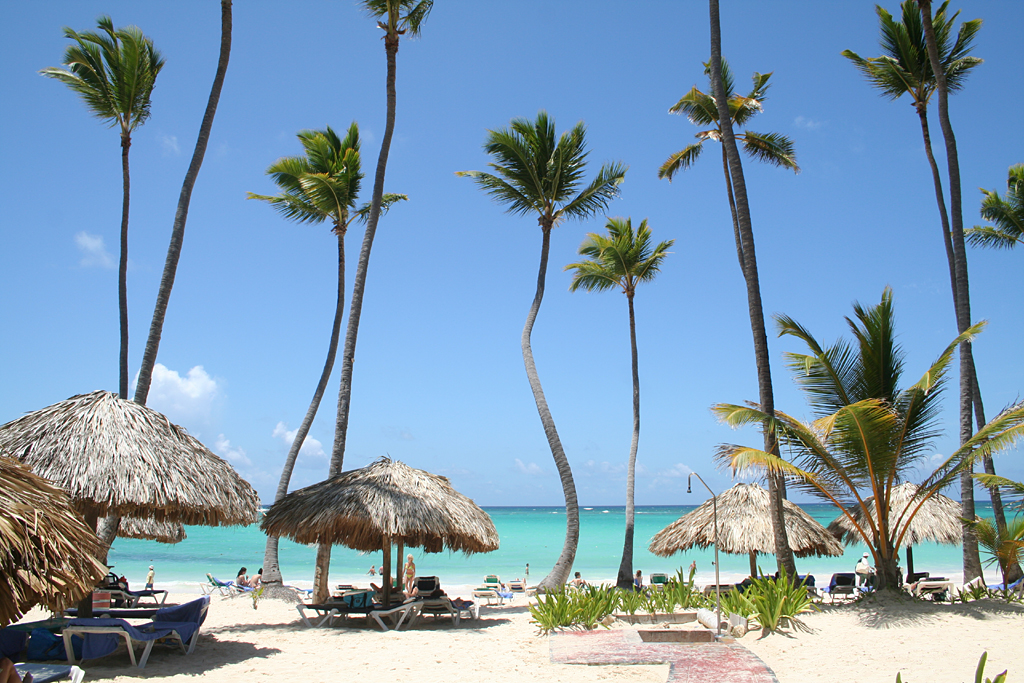
Punta Cana is a town and tourist region at the easternmost tip of the Dominican Republic. The region, covering about 420,000 m2 (4,500,000 ft²), is home to a coastline of sandy white beaches. It is a popular spring break destination.
Punta Cana travel guide
Understand
In the province of La Altagracia with a population estimated at 100,000, the region borders the Atlantic Ocean to the east. To the north, it borders Bávaro and El Cortecito. It also borders Cabeza de Toro, Cabo Engaño and further west, Juanillo. Peak season in Punta Cana tends to run from December-April. Prices in both airfare and hotel increase dramatically during these times, while dropping in the summer and early fall months. Punta Cana has a tropical climate. Although it is mildly windy, the ocean in the area is mainly shallow, with several natural marine pools in which visitors can bathe. The weather is fairly constant, with an average temperature of 26°C. The hottest season lasts from April to November, and during the day temperatures might reach 32°C. From December to March, temperatures during the evening are around 20°C. Very little rain falls around the area, mostly because of the flat landscape. The summer months tend to be very warm and very humid. It is suggested you wear loose fitting, cotton clothing, so pack light. Punta Cana was founded as a tourist resort and tourism still is 100% of the local economy. Prices are much higher than in the rest of the Dominican Republic and within the area prices in the resorts are higher than outside (up to 300% for postcards; cigars and souvenirs). Therefore lots of resorts employ the tactic of scaring their visitors from venturing outside by propagating stories of robberies, murders and rape. These have to be taken with a grain (or a pound) of salt; people tend to be very friendly and helpful. Still, flashing jewellery, expensive gadgets or lots of money is not recommended.
Getting there
By plane 1 Punta Cana International Airport (PUJ IATA). Several US carriers have scheduled flights including: JetBlue, American Airlines, Frontier Airlines, United, and Delta. Air Canada offers flights from Halifax and Ottawa. WestJet also offers scheduled service from Toronto. Rossiya Airlines, Azur Air and NordWind offers service from Moscow. Charter airlines include Air Transat, and Sunwing departing from many larger Canadian cities seasonally. (updated Apr 2025) Most people going to Punta Cana are staying at a resort. With a resort package most hotels will have airport pick up arranged for you at the Punta Cana Airport. You will find this area to the right as you depart the final customs check area. Just look for your hotel name on a sign that many guides will have, and they will direct you to your bus. Private taxis are also available at fixed prices. In fact, Punta Cana has one of the busiest and best connected airports in the region being at times reported as one of the busiest airports in the entire Caribbean, and usually receiving more flights than the Aeropuerto Internacional de Las Américas, in Santo Domingo (about a three-hour drive). The Punta Cana Airport has a beautiful thatched roof and is an open-air design, also meaning that few areas of the airport have air conditioning. Upon arriving at the Punta Cana airport, each passenger is required to purchase a USD10 tourist card before entering immigration, often included in your documentation upon departure or issued on the flight (unless you have a Dominican passport; a cedula residence card or your foreign passport shows that you were born in the Dominican Republic). After retrieving luggage and clearing customs, arriving passengers will be greeted by their tour company representative to the right and directed to board the correct bus for transfer to their resort. Do not venture out looking for your bus without first checking in at the counters. The buses are numbered, thus you will not know which on
Getting around
Tour operators: Most passengers arriving in Punta Cana International Airport have prearranged local transportation through a tour operator. These companies have representatives at the airport to guide guests to vehicles waiting to take them to the reserved resort. If you are travelling with a tour operator it is highly recommended that you attend any welcome meetings and orientations offered by your tour operator. In these meetings you'll receive important information regarding your hotel and immediate area information, activity and excursion options, and departure information. Taxis: If you are not travelling with a tour operator, a number of taxi drivers are available just outside the Customs area to provide you transportation to the place of your choice. All taxis operate with standard rates; most drivers carry a copy of these. The best thing to do when hiring a taxi is to clarify your destination and the price in advance. You pay upon arrival at your destination. Most hotels have taxi stations on or near their property; in most cases a bellman or front desk clerk can order a taxi for you. Taxi drivers accept dollars, pesos, and euros. Local buses: For the more adventurous, the local bus lines operate on most of the roads of the area, for a minimal cost. The downside to public transport in the Dominican Republic is irregular bus schedules, crowded vehicles, and potentially unsafe vehicles (689 casualties in 2007), drivers, or passengers. Although for the most part it is a safe and effective means of transportation, it is generally recommended to use one of the more frequented means of getting around. Rent-a-car: A number of car rental agencies like Europcar, Budget, and Avis offer service in the area of Punta Cana and Bavaro. Many hotels have car rental concessionaires on their properties. Driving laws, habits, and conditions may be different from the ones you are used to. When renting a vehicle always take the maximum available insurance, keep a map of the
See
1 Altos de Chavon. A modern-day artist's village resembling a 16th century Mediterranean town. It is set upon a spectacular hillside cliff overlooking the winding Chavon River. It is home to a 5,000 seat amphitheatre, an archaeological museum, craft workshops, artist's studios and an assortment of galleries and restaurants. 2 Juanillo. One of the most beautiful beaches in the Dominican Republic. Until a few years ago it was a very small village of fishermen a few miles from the Punta Cana Airport. The entire village was purchased as part of a very large project called Cap Cana. In return for giving up their rights to occupancy, the residents were offered alternative housing, money, and jobs. While Juanillo was at one time accessible to the public, it is now only accessible to people staying at one of the Cap Cana hotels and to property owners within the Cap Cana project and their guests. Saona Island. Take a day trip to this spectacular island set in the natural reserve of The Parque Nacional del Este. Relax on powder white sands, where palm-studded beaches meet the soft surf of the Caribbean waters, and sometimes even dolphins swim alongside your catamaran.
Do
1 Corales Golf Course, [email protected]. Designed by Tom Fazio, Corales is an 18-hole course with six seaside holes. Designed along the natural cliffs, bays, oc
Overview adapted from Wikipedia, travel guide fromWikivoyage (CC BY-SA). Photography via Wikimedia Commons.