
Punta Arenas
Chile · Americas
About Punta Arenas
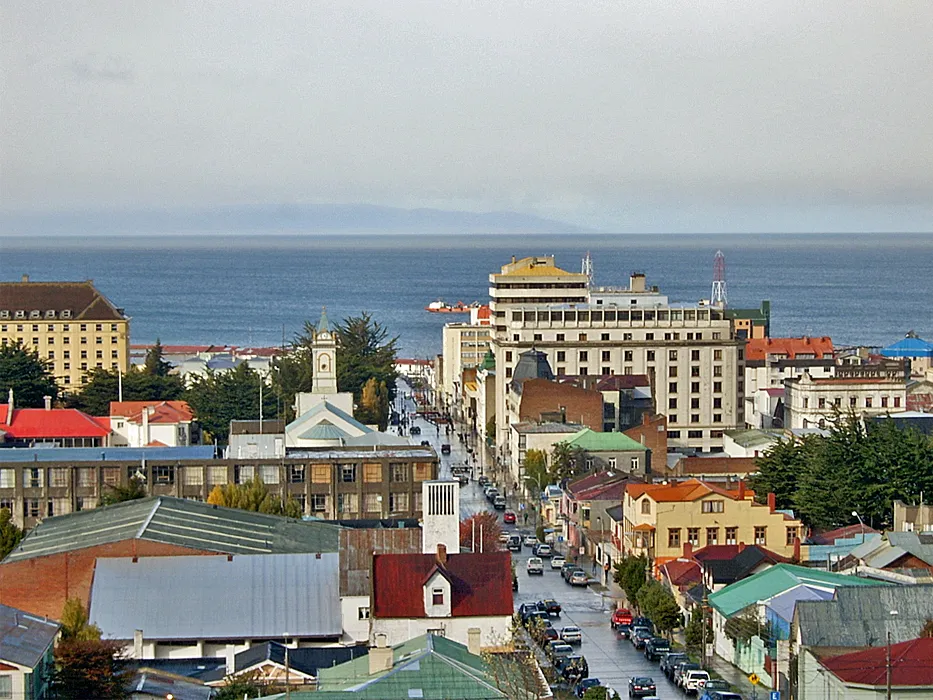
Punta Arenas is the regional capital of the Magallanes y Antártica Region, in Chilean Patagonia, one of the southernmost cities in the world. It's the largest city in Chilean Patagonia, and has developed into a tourist center in far southern America rivaling Ushuaia in Argentina. It's an important starting point for trips to Antarctica and the Falkland Islands.
Punta Arenas travel guide
Understand
Punta Arenas (formerly Punta Arenosa; "Sandy Point") is located on the Brunswick Peninsula and was founded in 1848 by José de los Santos Mardones. With a population of around 125,000 (2015), it is the largest settlement on the Strait of Magellan and is 1418 km from the coast of Antarctica. The history and economic growth of the city is based on maritime commerce, oil extraction, and sheep breeding. The city has all kinds of facilities, in particular an abundance of banks, shops, supermarkets, pharmacies, hiking gear shops and a duty free zone called "Zona Franca". Don't trust the weather forecast, usually you can get rain, wind, and sun all in the same day. Snow is always expected to fall in the winter. Punta Arenas is on the Brunswick Peninsula on the shore of the Magellan Strait connecting the Atlantic and Pacific Oceans and separating the South American mainland from Tierra del Fuego. A city of 140,000 inhabitants, it was founded by immigrants both from Europe and Chileans from further north. It boasts many grand buildings from the late 19th and early 20th centuries, the golden age of the city.
Geography and climate
Punta Arenas is in the Magellanic pampa (pampa magallánica), that is, steppe with low hills. As such sheep grazing is the main agricultural business. West and south of the city the terrain gets more forested and mountains higher, this is the southern end of the Andes and where it "sinks" into the ocean with summits forming islands. South of the city is also Cape Froward, the southernmost point in mainland South America. The climate is Subantarctic: cold and rainy. The cold Humboldt current, as well as chilly, strong winds influence the local climate, so while Punta Arenas is at a comparable latitude to Manchester, it's much colder. The summer from December to March is the best time to visit, it's windy but the average temperature is around 9 °C (48 °F). During winter it's less windy but average temperatures are below freezing, and nighttime lows o
Getting there
Punta Arenas can be reached by air, land, or sea.
By plane 1 Presidente Carlos Ibáñez del Campo International Airport (PUQ IATA), Presidente Ibanez Apo (20 km north of city), ☏ +56 61 - 219131. Due to its remoteness, plane is the main way for getting to Punta Arenas. The airport, used both by civilian and military aircraft, is about 20 km north of the city and is the main airport of Chilean Patagonia. The airport is served by LATAM Chile, Aerovías DAP, JetSmart and Sky Airline, and there are flights from Santiago de Chile (your best option for coming from the rest of the world), minor airports in southern Chile and Argentina, and the Falkland Islands. There are also charter flights to Antarctica. (updated Feb 2017)
By car Punta Arenas doesn't have a road connection to Chile north of Patagonia (road construction is impossible due to the icefields), so you need to cross through Argentina. From northern and central Chile, the most common route goes via Osorno, turning east into Argentina, to San Carlos de Bariloche from where you continue by Ruta 40 southwards. Alternatively you can continue along Carretera Austral on the Chilean side and cross the border as far south as near Coyhaique. In Argentina, Ruta 40 follows the Chilean border, and near Puerto Natales you can cross back into Chile. Alternatively you can continue all the way to Río Gallegos on the Atlantic coast.
From Puerto Natales
Crossing at Río Turbo near Puerto Natales, you will travel past some of the most impressive parts of Patagonia on both sides of the border; the Perito Moreno Glacier and Torres del Paine National Park. From Puerto Natales, the drive along Ruta 9 takes about three hours; the road is in a good shape and the landscape is pretty flat. A little before Punta Arenas, the road merges with the road from Río Gallegos.
From Río Gallegos If you've started your roadtrip in eastern Argentina (e.g. Buenos Aires), followed Ruta 40 to the end, or crossed Argentina to the Atlantic coast
Getting around
The city is built around its main square "Plaza de Armas" where the imposing monument of Hernando de Magallanes is located. There is also a monument of a Magellan native, or Ona, that according to local legend if a tourist touches his foot it will return once again to the city. Another local legend to come back to the city is to eat Magellan Barberries (calafate), similar to blueberries.
Many of the main public buildings such as the town hall or the Union Club (Club de la Union) are found around Plaza de Armas. In general, Punta Arenas is compact and walkable, but it can get really windy. You will only need transportation for lengthier trips outside of it. For these trips, you can ask for a cab (taxi), a minivan (minibus), or a collective taxi (colectivo).
By bus There's a public bus system, Movigas with 4 lines. Lines star out from downtown to the suburbs, and therefore not so good for getting around the central parts of the city, where most points of interest are.
By taxi Taxis are readily available and fares are affordable. There are also colectivos (route taxis).
By car To get to attractions outside the city, consider renting a car. Popular tourist attractions outside the city can also be accessed by tour.
See
1 Cerro de la Cruz. A 10-minute walk from the Plaza de Armas, the Hill of the Cross viewpoint (Cerro de la Cruz) gives a panoramic view of the city. (updated Apr 2020) 2 Austral Brewery (Cerveceria Austral), Patagonia 508, ☏ +56 61 245727. Learn about and enjoy the traditional production process and a beer-tasting session at the southernmost brewery in the world. Call ahead for tour times and availability (minimum 2 people). Lasts 60-90 minutes and tastings are generous with their measures. 4,000 pesos. 3 Museo Regional de Magallanes, Hernando de Magallanes 949. Regional museum, with historical artifacts and part of the Braun-Menéndez Mansion. (updated Apr 2020) 4 Museo del Recuerdo, Avenida Bulnes 01890, ☏ +56 61 207056. M-F 08:30-11:00, 14:30-18:00. Houses an outstanding collection of old steam engines, horse carts, cars, historic houses furnished in the 1870s and farm implements. Visit the numerous lighthouses in and outside of the city, such as Faro San Isidro and Faro Punta Dungeness. 5 Museo Maggiorino Borgatello (Maggiorino Borgatello Museum), Avenida Bulnes 336, ☏ +56 61 221001. Tu-Su 10:00-12:30, 15:00-18:00. A Salesian Society museum of natural history and pre-Colombian ethnic groups. 7,000 pesos. (updated Nov 2024) 6 Punta Arenas Cemetery, ☏ +56 61 212777, fax: +56 61 218418, [email protected]. Daily 07:30-20:00. Famous for its magnificent mausoleums, architecture, and shaped pine trees, the municipal cemetery dates back to the 1840s and is blessed with the remains of many local aristocratic families, as well as English and Croatian immigrants. 7 Museo Nao Victoria (Museo Nao Victoria), Km 7.5 Norte (in Sector Humedal de Tres Puentes), ☏ +56 9 96400772, [email protected]. Daily 09:00-19:00. A nautic
Overview adapted from Wikipedia, travel guide fromWikivoyage (CC BY-SA). Photography via Wikimedia Commons.