
Punjab
India · Asia
About Punjab
The Punjab is a populous and prosperous area of the Indian subcontinent.
The name comes from the Persian words panj (five) and āb (water), thus the (land of) five rivers. Four of them – Jhelum, Chenab, Ravi, and Sutlej – are tributaries of the mighty Indus and the fifth, the Beas, is a tributary of the Sutlej. The Indus River runs along the western edge of the area, in places forming the border between the Punjab and Khyber Pakhtunkhwa.
Punjab travel guide
Understand
History Punjab’s story begins among the earliest settled cultures of South Asia. Much of the region formed a heartland of the Indus Valley Civilisation, whose cities flourished along the Ravi, Chenab, and Sutlej rivers around 2600 BCE. Harappa and other sites reveal a sophisticated urban world with long‑distance trade and skilled craftsmanship. After the civilisation’s decline, Indo‑Aryan communities gradually shaped the Vedic culture that took root here, giving the region its enduring identity as the “land of five rivers.” For more than two thousand years, Punjab stood at the crossroads of Central Asia and the Indian subcontinent. Persians, Greeks, Scythians, and Kushans all passed through or ruled parts of it. Alexander the Great’s campaign reached the region in 326 BCE, where he fought King Porus near the Hydaspes River. Though victorious according to Western books, the resistance he encountered contributed to his army’s refusal to push further east – and Punjabis believe he was defeated in battle. In the centuries that followed, Punjab came under the Mauryans, Indo‑Greeks, and later the Kushans, each leaving behind artistic and religious influences visible in archaeological remains across both sides of the modern border. By the medieval period, Punjab had become a key frontier of the Delhi Sultanate and later the Mughal Empire. Under Mughal rule, cities such as Lahore grew into major centres of architecture, learning, and trade. Mughal gardens, mosques, and forts still stand as reminders of this era of cultural flourishing. In the late 15th century, a new religious tradition emerged that would profoundly shape the region. Guru Nanak’s teachings laid the foundation of Sikhism, which developed through the guidance of nine successive Gurus. Over time, the Sikh community formed its own institutions, script, and martial identity. As Mughal authority weakened in the 18th century, Sikh misls gained control over much of Punjab, eventually uniting under Maharaja Ranjit
Getting there
There are six international airports in the Punjab: five in Pakistan and one in India. The Grand Trunk Road connects the Indian Punjab with the Pakistani Punjab. The road's complete course is from the Bangladeshi city of Chittagong to the Pakistani city of Peshawar.
See
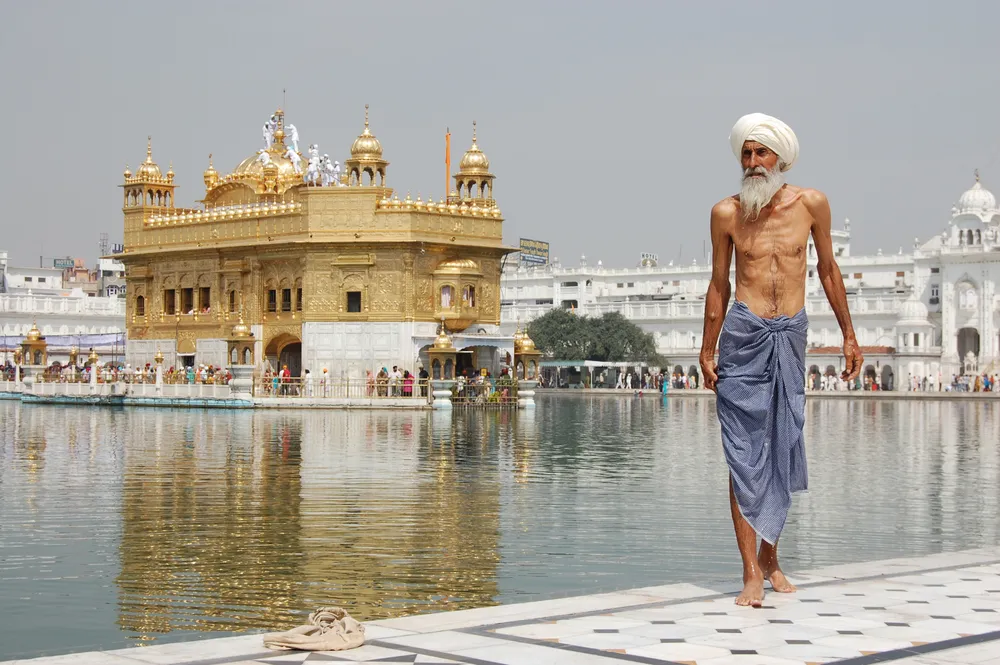
The Punjab is home to many well-known historical sites including the Shalimar Gardens, the Indus Valley Civilisation and the Taxila University. Amritsar is famous for its Golden Temple and the Jallianwala Bagh incident in 1919. Chandigarh is the first planned city of India designed by a Swiss-French architect. Wagah is a town situated at the border of India and Pakistan, which is regularly open for foreigners.
Drink & nightlife
Tea (called chai in both India and Pakistan) is popular throughout the region. It is more popular than coffee. Lassi is a traditional North Indian beverage, made by blending yoghurt with water, salt, and spices until frothy. Traditional lassi is sometimes flavored with ground, roasted cumin. The Lassi is sometimes made with a little milk and is topped with a thin layer of malai, a clotted cream, also known as Devonshire cream. Lassis are enjoyed chilled as a hot-weather refreshment. With a little turmeric powder mixed in, it is also used as a folk remedy for gastroenteritis.
Overview adapted from Wikipedia, travel guide fromWikivoyage (CC BY-SA). Photography via Wikimedia Commons.