
Puʻuhonua o Hōnaunau National Historical Park
United States · Americas
About Puʻuhonua o Hōnaunau National Historical Park
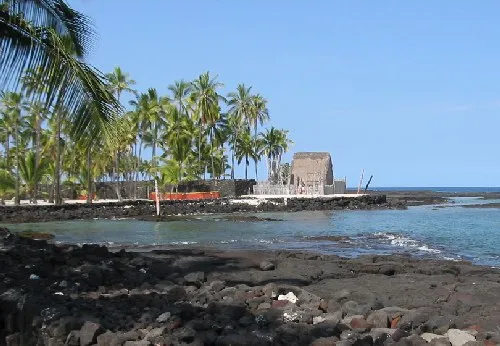
Puʻuhonua o Hōnaunau National Historical Park is a United States National Historical Park on the Big Island in the state of Hawaii.
Puʻuhonua o Hōnaunau National Historical Park travel guide
Understand
The park is open 7AM-8PM daily.
Visitor Center, +1 808 328-2326. 8AM-5PM daily. Staffed for park orientation, books and videos for sale.
History
The Hawaii of old was an organized into a social structure including chiefs, priests, skilled laborers and commoners. Strict laws or "kapu" existed for each of the separate divisions. Death was the penalty for breaking the law. One's only option for survival was to elude your pursuers and reach the nearest pu'uhonua, or place of refuge. The Royal Grounds adjacent to the pu'uhonua were a favored residence of Hawaiian chiefs. Hale-o-Keawe acted as the royal mausoleum and held the remains of 23 chiefs. It was surrounded by carved wooden images (ki'i) of the gods. The mana (spiritual power) of the remains bestowed sanctity upon this sacred area. This temple was constructed in honor of Keawe'ikekahiali'i o kamoku, the great-grandfather of Kamehameha I.
Landscape
Flora and fauna When the first Polynesians came to Hawaii, they brought with them the plants and animals they would need to make a start in the new world. In the park you can spot the shiny-leafed noni, with its pale yellow fruit. Noni was used as a tonic to treat many different ailments. You may also notice several stone planters found around the Hale Ho'okipa Visitor Contact Station. In this dry side of the island, the planters were used to raise crops. The stone walls protected the plants from the wind and coconut husks soaked in water were placed around the growing plants to keep the soil moist. The fragrant pua maia with its white flowers is a native species. It was used for medicine and to help set broken bones. Growing along the lava, you may spot the lavender pohuehue, a native beach morning glory. Walk under the shade of the hala tree, whose leaves are used to weave mats and baskets. Many plants found in the park are invading the native ecosystem, choking out the native vegetation and damaging archeological sites. Non-native red mangrove has aggres
Getting there
From Kailua-Kona, travel south towards Volcano on Highway 11. Turn right towards the ocean on Route 160 at the Honaunau Post Office. Watch for the park sign on the left as you drive towards the ocean. Public transportation is available along the highway, but not directly to the park.
See
The Puuhonua (Place of Refuge). This area was sanctuary from death sentences. A great wall marks the boundaries between the royal grounds and the sanctuary. Many ki'i (carved wooden images) surround the Hale o Keawe, housing the bones of the chiefs that infuse the area with their power or mana. If you reached this sacred place, you were saved. The Royal Grounds. In the past, chiefs entered the royal grounds from Keone'ele Cove by canoe. The pu (conch shell) was sounded to warn of their coming, for it was forbidden for others to look upon or even cast their shadow on the ali'i (chiefs). As the canoe landed, other members of the royal court stroll past the royal fishponds, looking for a choice fish for dinner. Other chiefs engaged in a game of konane. The beauty, splendor and history of the royal grounds at Pu'uhonua o Honuanua are still felt. Take a self-guided walking tour along the trails once reserved for Hawaiian royalty. Ki'ilae Village. Offers a glimpse into the past, when Hawaii was changing rapidly but still supported traditional aspects of daily life. With the arrival of Europeans in the Hawaiian Islands, many things changed. New plants and animals were introduced and settlements began moving away from the coastal villages to the more fertile uplands and larger harbor cities. What remains in Kiilae today are abandoned heiau (temples), agricultural features and holua slides where the chiefs once rode narrow sleds at great speeds down steep slopes. Animal pens, salt vats and church foundations can be seen from more recent times. Cultural demonstrations. Watch demonstrators practice traditional techniques, weave baskets from lauhala, make lei, carve a dugout canoe, or play Hawaiian games. These are just a few of the activities performed by cultural demonstrators in the park. Tidepools. The lava outcrops extending into the sea contain many pools of different depths and sizes that form habitats for a variety of marine organisms. In the tidepools y
Do
Hiking A 2-mile (3.2-km) (round trip) backcountry hike along the 1871 trail through the agricultural areas that surround the park. Along the trail are Hawaiian temples, holua sled courses and the dramatic Keanae'e cliffs. This ancient trail existed long before Europeans arrived in Hawaii and originally connected coastal villages along the South Kona Coast. In the 1800s the trail was widened for travel in horse-drawn carriages. A snorkeling area lies adjacent to the park among the coral gardens of Honaunau Bay. There are lots of sea turtles in the area. The snorkeling in this area is only for those with strong swimming skills and those comfortable with swimming in deep water. Limited parking. Picnic A picnic area with tables and grills is available on a first-come basis.
Buy
Books and videos are available in the gift shop at the visitor center.
Drink & nightlife
A drinking fountain is available. Bottled water is available at the gift shop.
Sleep
Lodging No lodging is available in the park and camping is not permitted. Several bed & breakfasts are located within Honaunau and neighboring towns. Hotels are available in Kailua-Kona, approximately one half hour from the park.
Backcountry No camping is permitted.
Overview adapted from Wikipedia, travel guide fromWikivoyage (CC BY-SA). Photography via Wikimedia Commons.