
Preah Vihear Temple
Cambodia · Asia
About Preah Vihear Temple
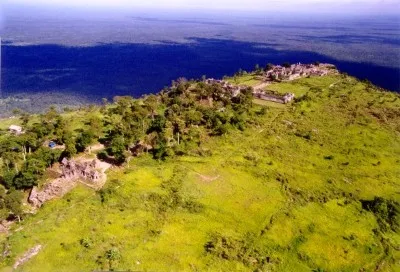
Prasat Preah Vihear (ព្រះវិហារ) is a Khmer (Cambodian) temple crowning a 525-m cliff in the Dângrêk Mountains in Cambodia, across the border from Si Saket and Kantharalak in northeastern Thailand. It is also the name of the surrounding province.
Preah Vihear Temple travel guide
Understand
Preah Vihear is perched on a hilltop with a commanding view of its surroundings. Predating Angkor Wat by 100 years, the history of the temple and fortress is somewhat unclear, but it is known to be dedicated to the god Shiva and thought to have been constructed in the reign of Suryavarman I (1002–50), with further significant additions by Suryavarman II (1113–50). Unlike most Khmer temples, the temple is constructed on a long north–south axis, instead of the usual rectangular plan facing east. Though at the edge of a cliff whose top mostly belongs to present-day Thailand, and for some years occupied by that country, the temple was nonetheless claimed by Cambodia on the basis of a map prepared during French colonial times. In 1959 Cambodia brought the dispute to the International Court of Justice, which in 1962 ruled that, because Thailand had for years accepted this map, Cambodia had sovereignty over Preah Vihear. Soon afterwards Cambodia was plunged into civil war. The temple remained open to the public from Thailand (although unreachable from Cambodia) until 1975, when it was occupied by the Khmer Rouge, whose rusting artillery guns still litter the area. It was re-opened from the Thai side in 1998, and in 2003 Cambodia completed the construction of a long-awaited access road allowing Cambodians to visit the temple. In 2008, after a contentious nomination process, the temple was listed as a UNESCO World Heritage Site.
Getting there
The temple is in Cambodia. Access to the temple was possible from Thailand in the past, with no Cambodian visa required, but has been closed for some years (as of 2020), and is not expected to be re-opened soon.
From Cambodia The road from Siem Reap to Anlong Veng is fully paved, and so is the road from Anlong Veng to Preah Vihear. As of April 2014 it was one of the better roads in the country. While a 4x4 is not necessary to make it to the base of the hill on which Preah Vihear is located, a 4x4 or motorbike will be required to scale the steep road going up the hill. A small 125cc automatic scooter can climb the access road but only with one person per bike and no heavy packs. Geared bikes of the class the locals use are no problem. G.S.T. (air-con) bus from Phnom Penh leaves at 07:30; 8 hr, US$7. You can also reach the place on a three-day motorbike trip from Kompong Thom. A 12-hour long day trip to Preah Vihear by can be arranged from Siem Reap. In January 2023, the cost was US$160. Preah Vihear can be visited by tourists, but there is a strong military presence on the way up the hill, and around the temple. Previous reports have mentioned bribes to drive up the access road, but as of January 2023 there were no roadblocks. As of January 2023, admission to the temple is US$10. Identification is needed. A further US$5/$25 fee at the ticket office gets you a motorcycle/pick-up truck with driver to take you up to the top, and back down the hill. It's best not to sit unsecured on the bed of a pick-up, as the road is very steep in places.
From Thailand
The nearest significant Thai town is Ubon Ratchathani. The temple is at the end of Rte 221, but public transport options are limited and the easiest option is to charter a car for the day (1; 000 baht and up; plus gas). The roads are surprisingly good and, depending on how hard your driver hits the gas pedal and/or how many water buffaloes decide to cross the road along the way, you can get there from Ubon in an
Getting around
The only way to get around (once you reach the top of the plateau) is on foot. The 500-m elevation and the resulting breeze provide some relief, but it's still a hot and sticky 120 m (vertical) trail up the hill. Even if you hire a motorbike-taxi to foot of the temple, but yoy will still have to climb up the stairway yourself.
See
All access paths (the Thai side is closed as of 2020) join together at the bottom of the slope (lower end of the adjacent map), and from here the only way is up.
The fun starts with 162 stone steps (#1), a fairly steep climb that will get you warmed up nicely. Your reward is a short set of stairs decorated with nagas and Gopura I (#3), a solitary pavilion with a fluttering Cambodian flag. A 500-metre gently climbing avenue leads up to Gopura II (#6), another smallish pavilion, and a large boray (water cistern; #4) to the left. Yet another avenue (somewhat shorter this time) leads to, yes, Gopura III (#9), but also the first courtyard of the temple and the first point where visitors to Angkor Wat will start feeling a sense of deja vu. Make a detour to the left side of the gopura to see relics of a more modern era, in the form of a rusting artillery gun and a few bunkers. A short causeway decorated with nagas leads to the inevitable Gopura IV (#14) and behind it the second courtyard. On the other side of the courtyard is Gopura V aka the Galleries (#17), and beyond it the Main Sanctuary (#18), the centrepiece of the site which now houses a miniature Buddhist temple. What makes the effort worthwhile lies just outside, so sneak out the left side to find yourself at Pei Ta Da Cliff, with a sheer 500-metre drop and a jaw-dropping vista of the Cambodian jungles below. To contemplate the view without getting sunstroke, locate the crevice that leads into a little cavern of sorts, with shade provided by the tip of the cliff overhead and, some barbed wire to spoil your pictures (and stop you from falling off). There are several other minor sights in the area, accessible only from the Thai side:
Pha Moh I-Daeng, clearly signposted from the parking lot and only a few hundred metres up the hill, is the present Thai border and the new home of the flagpole that previously fluttered on Pei Ta Da. There are more stunning views of Cambodian jungle here, including a side view
Buy
There are ramshackle assemblages of shacks at the Thai parking lot and at the Cambodian base of the hill, as well as all the way along the path up the hill in the temple area. These sell the expected T-shirts, postcards, cans of Pepsi, and premium cognac and cigarettes by the carton. It's tax-free shopping for Thais. As foreign visitors are few, expected to be besieged by little boys and girls shouting "hello" and hawking postcards, but they usually take the hint after a couple of "bye-byes".
Eat
Places to eat are rarer on the ground than drink stalls, although there are some pretty basic grill stalls towards the end of the Thai parking lot shopping shacks. For more selection and a semblance of hygiene, there are a number of roadside restaurants on the Thai side before the park entrance, along the road from Kanthara. Cambodia: The nearby town of Sra Ehm (20 km) provides few options for food, but quality is reasonable. Most rice restaurants are near the main roundabout. There is a boutique hotel that can be reached from both road 2965 and 62, and has a Western menu and English-speaking staff.
Drink & nightlife
Drink stalls are ubiquitous along the trail.
Sleep
There are only very basic accommodation options in the immediate vicinity. Cambo
Overview adapted from Wikipedia, travel guide fromWikivoyage (CC BY-SA). Photography via Wikimedia Commons.