
Pioneer Square
United States · Americas
About Pioneer Square
Pioneer Square is Seattle's oldest neighborhood, showcasing a wealth of art galleries, bookstores, antique shops, cool restaurants, and buzzing nightclubs within easy walking (or bus) distance of Downtown. The classic red brick buildings, cobblestone streets and horse-drawn carriages are a reminder of life a century ago. Just to its east, the International District is Seattle's historic Asian neighborhood.
Pioneer Square travel guide
Understand
Pioneer Square The Pioneer Square neighborhood sits, from east to west, between 3rd Ave. and the waterfront; and between Downtown proper to the north, and the sports stadiums to the south. The square itself is nothing much — people talking about the square are referring to the area. Local lore holds that the term "skid row" originated in Pioneer Square, when timber would be slid down Yesler Way to a steam powered mill on the Seattle waterfront. By the late 1800s, it had developed into the original city center. The early structures were mostly wooden, and nearly all burned in the Great Seattle Fire of 1889. The architectural character of the neighborhood derives from the brick and stone buildings erected in their stead in the 1890s. The business district shifted northward to the present downtown, somewhat sparing the neighborhood from additional development.
Pioneer Square website
International District The International District is southeast of Downtown, loosely bounded by 4th Avenue S. and S. Dearborn Street.
The old Chinatown shops are concentrated west of the Interstate 5 freeway, especially along King St and Weller St. A few remaining blocks of Nihonmachi (Japantown) are on the north side of Jackson St and along Main St. The area east of I-5 is Little Saigon, centered on 12th and Jackson St. Along Rainier Avenue, the stores transition from Vietnamese to Cambodian as the neighborhood flows into South Seattle. Chinese immigrants have come to Seattle nearly since its founding. While there were earlier Chinese communities elsewhere in the young city, in the wake of the Great Seattle Fire of 1889, a stretch of King Street became an enduring Chinatown. By then, Japanese immigrants also began arriving, concentrating two blocks north on Main Street. (Unfortunately; most of the Japanese presence was lost during the World War II internment). During the 20th century, waves of Filipino, African-American and Vietnamese migration further shaped this small area.
Seatt
Getting there
From Downtown, the walk is short and not steep. There are a few pay parking lots, and limited street parking is available too.
By public transit Most buses traveling south through Downtown on 2nd, 3rd or 5th Ave will stop near Yesler Way or Jackson St. Ask the driver before getting on, as there are a few buses that turn before reaching the Pioneer Square/International District, and a few others that drive through without making stops. Link light rail, operated by Sound Transit, has two stops in the district:
1 Pioneer Square Station, James St and 3rd Ave (a few blocks north of the main neighborhood). (updated Dec 2025) 2 International District/Chinatown Station, Jackson St and 5th Ave. (updated Dec 2025) A train runs on each line every 8-15 minutes from 5:00 to midnight. $3
The 1 Line from Downtown Federal Way to the south via Seattle-Tacoma International Airport, Tukwila and South Seattle, and from Lynnwood City Center to the north via Mountlake Terrace, Shoreline, University of Washington, Capitol Hill and Downtown. The 2 Line from Downtown Redmond, Bellevue and Mercer Island to the east, and from Lynnwood with the same stops as the 1 Line. The 3 First Hill Street Car line runs along Jackson Street, connecting the district to First Hill and Capitol Hill via Jackson and then Broadway. The southern terminus in Pioneer Square is on S Jackson between S 1st Ave & Occidental (location of marker).
By train
4 King Street Station, served by Amtrak and Sounder, sits directly in the center of the area at 4th and Jackson.
Getting around
These two neighborhoods are compact, with small blocks built for getting around on foot. The neighborhoods are separated by King Street Station and the corresponding railroad between 3rd and 4th Avenues, with a bit of an incline and only a few crossings. Occidental Street (between 1st and 2nd Avenues) is closed to cars between Washington and Jackson Streets and forms a pedestrian mall lined with galleries and shops. It's typically faster to get around by walking than by driving through all the controlled intersections blocked by near-continuous foot traffic. This is especially true on game days for the two SoDo stadiums, which funnels thousands of cars through these streets on their way to events. On the flip side, there is readily available parking near the stadiums when there isn't an event.
See
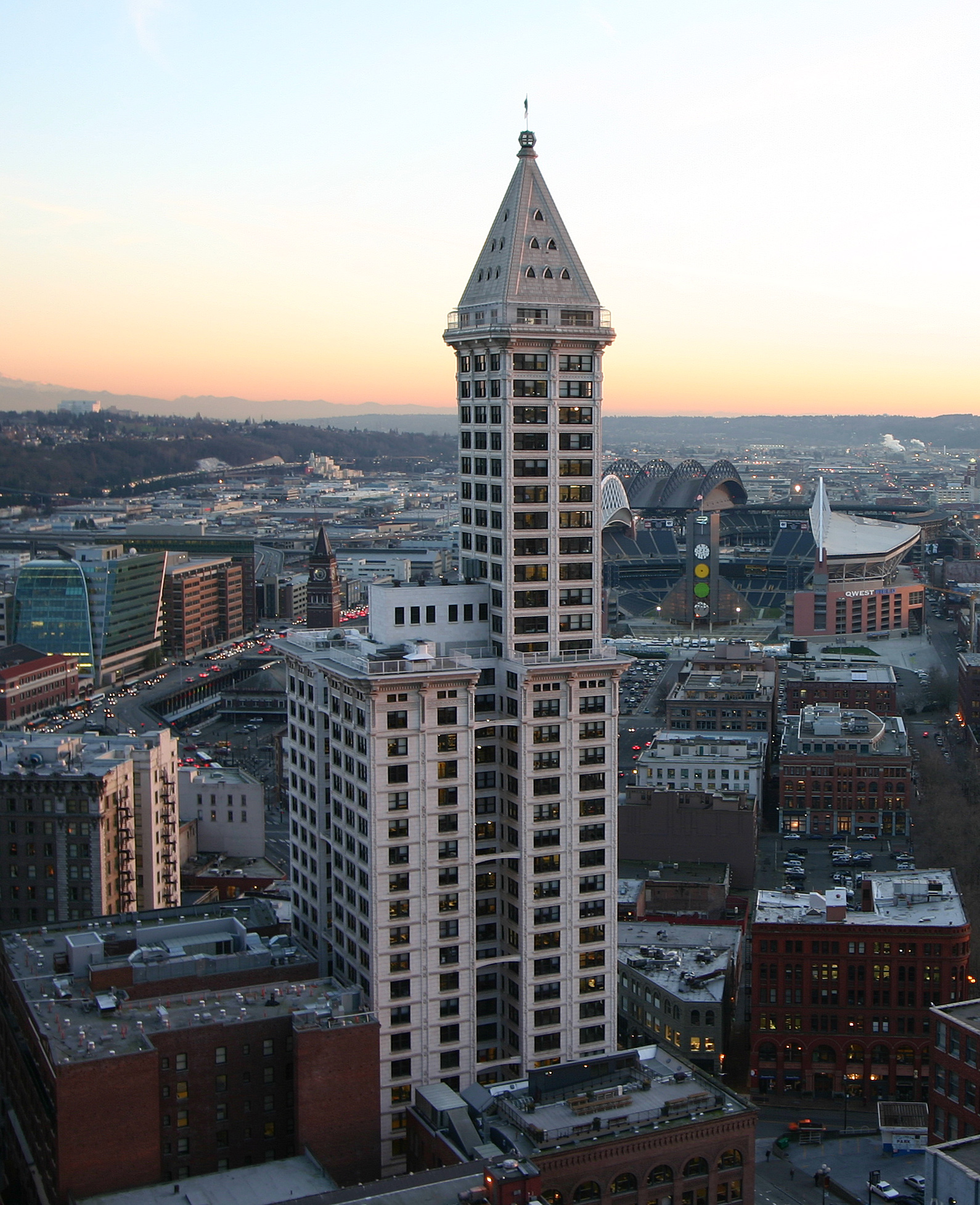
1 Grand Opera House, 213–217 Cherry St. Formerly the city's leading theater. Only its exterior survives as the shell of a parking garage. (updated Aug 2020) 2 Klondike Gold Rush National Historic Park - Seattle Unit, 319 2nd Ave S (at S Jackson St), ☏ +1 206- 220-4240. Daily 9AM-5PM except Thanksgiving, Christmas, and New Year's Day. A key attraction in the Pioneer Square area, this is the Seattle branch of the Klondike Gold Rush National Historical Park, the remainder of which is in Alaska. The site highlights the city's key role as the "Gateway to the Gold Fields" for most of the Klondike stampeders of 1897-1898. National Park Service Rangers and volunteers staff the museum and can provide information and perspective not only on the gold rush but also on Seattle's past. The museum contains many artifacts and historical photographs related to the Gold Rush, and movies about the gold rush and Seattle's history are shown upon request (except in summer; when they're shown on a regular schedule). Rangers also conduct free walking tours of the Pioneer Square area in the summer and demonstrate gold panning to school groups. Free. 3 Nihonmachi Alley (from Jackson St to Main St; between 6th Ave and Maynard Ave). Japantown (Nihonmachi) once stretched 20 blocks, but the residents were forced into internment camps during World War II, and Nihonmachi never fully recovered. This alley features murals and exhibits of four landmark businesses that persisted after incarceration. (updated May 2026) 4 Seattle Buddhist Church, 1427 S Main St (south of Yesler Way), ☏ +1 206-329-0800. In the summer the community hosts a Japanese bon odori festival on the street out front. 5 Smith Tower, 506 2nd Ave, ☏ +1 206 624 0414, [email protected]. M-W Noon-7PM, Th and Su Noon-8PM, F and Sa Noon-9PM. Built in 1914, the Smith Tower was Seattle's first skyscraper, and the tallest building on the West Coast for nearly half a century before being overtaken by the Space Needle. Uniformed attendants
Do
Art Walk. The Art Walk is almost synonymous with Pioneer Square and takes place on the first Thursday of every month. Galleries are open until 9PM. Show up early for the free wine and hors d'oeuvres. 1 Seattle Pinball Museum, 508 Maynard Ave S, ☏ +1 206 623-0759, [email protected]. Su-M noon-5PM, Th-Sa noon-10PM. A pinball machine museum where all the machines are on free play once you pay admission. There is soda and beer available. $13/adult, $10/child. 2 Theatre Off Jackson, 409 7th Ave S, ☏ +1 206-340-1049. A venue for cutting-edge theatrical productions. (updated Jan 2017)
Underground tours Seattle's oldest nei
Overview adapted from Wikipedia, travel guide fromWikivoyage (CC BY-SA). Photography via Wikimedia Commons.