
Petra
Jordan · Asia
About Petra
Petra (Arabic: البتراء, Al-Batrāʾ), the fabled "rose red city, half as old as time", is a well known ancient Nabataean city in the south of Jordan. Due to its breathtaking grandeur and fabulous ruins, Petra was recognised as a World Heritage Site by UNESCO in 1985.
Petra travel guide
Understand
Petra was the impressive capital of the Nabataean Kingdom from around the 6th century BC. The kingdom was absorbed into the Roman Empire in AD 106 and the Romans continued to expand the city. An important center for trade and commerce, Petra continued to flourish until a catastrophic earthquake destroyed buildings and crippled vital water management systems around AD 663. After Saladin's conquest of the Middle East in 1189, Petra was abandoned and the memory of it was lost to the West. The ruins remained hidden to most of the world until the Swiss explorer, Johann Ludwig Burckhardt, disguised as an Arab scholar, infiltrated the Bedouin-occupied city in 1812. Burckhardt's accounts of his travels inspired other Western explorers and historians to discover the ancient city further. The most famous of these was David Roberts, a Scottish artist who created a number of accurate and detailed illustrations of the city in 1839. The first real excavations of the site were in 1929 after the forming of Trans-Jordan. Since that time, Petra has become by far Jordan's largest tourist attraction, partially due to the exposure by the Steven Spielberg movie, Indiana Jones and the Last Crusade, in 1989. Due to the fantastic engineering accomplishments and the fact of its being well-preserved, the archaeological site was chosen in July 2007 as one of the New Seven Wonders of the World. Petra is the archaeological site and Wadi Musa is the city nearby.
Getting there
Hours Petra is open to visits 06:00-17:00 in winter, and 06:00-18:00 in summer, daily throughout the year.
Entry ticket What may be one of the most expensive admissions to any archaeological site in the world. The entry ticket to Petra costs 90 JD for one day visitors to Jordan (i.e.; those that have arrived in Jordan from some other country; e.g. Israel; on the day of the visit and will be returning there for the night). Tourists that overnight in the country or on a cruise ship pay 50 JD for 1 day, 55 JD for 2 days or 60 JD for 3 days. Bring your passport to prove you entered Jordan at least one day before. If entered the same day, your room key will be asked by the ticket seller. Students have to pay the full price, except those who enroll in a Jordanian university, for whom the admission price drops sharply to 1 JD. Do not attempt to purchase tickets from dubious scalpers around town! Time permitting, the two-day pass is recommended, as there is much to see and do in Petra. For more than one day, the ticket office can ask for your passport as the ticket has your first name on it. The Jordan Pass (purchased online before coming to Jordan) gives you access to over 30 sights and attractions in Jordan, including Petra, Wadi Rum Protected Area and Jerash. And the fee on the regular 40 JD visa is waived when entering Jordan, if you stay at least four days in the country. (If you leave before; you will have to pay the 40 JD at the border when exiting.) There are three different types available, depending on the length of your stay in Petra: 70, 75, or 80 JD for one, two, or three days in Petra. Also read Jordan#Jordan Pass. Children under 12 years can enter the touristic sites for free when accompanied by their parents.
By bus JETT buses, both ordinary and all-inclusive guided tour, connect to Amman and Aqaba via the fast (but boring) Desert Highway. Other tourists come with organized groups, including daily trips from Eilat, Israel. Tours to Petra from the Egy
Getting around
Wadi Musa to Petra Many hotels organise free transport to and from the entrance to Petra. Otherwise you can either walk downhill along Tourist Rd. for about 15 minutes, or take a taxi for 1-2 JD.
Within Petra
The only modes of transport allowed within Petra are on two feet or four (camel; donkey; or horse). There are 4 segments within Petra with 4 possible types of transport: from the entrance to the Siq (by foot or horse), from the Siq to the Treasury (by foot or cart), from the Treasury to the stairs of the Monastery (by foot; donkey or camel), the 800 stairs of the monastery (by foot or donkey).
Animal transport When entering Petra, there is a brief hike down towards the Siq. Horses will be available for travel to the entrance of the Siq. The prices for such rides are not set and are extremely negotiable, depending on one's bargaining abilities. Although the horse guides will tell you that riding a horse to the Siq entrance is included in the ticket price, they will try to sell you a longer tour, and argue aggressively for a 'tip'. As the walk down to the Siq entrance is only 15 min, it's not really worth it. The horses have been treated so badly in the past that a clinic to treat and heal them from the bad treatments they receive has been opened left to the entrance. It's not uncommon to see wounded animals, especially those pulling the carts, to be put to gallop under 37°C. Donkeys are exploited by small groups of Bedouin youths who use 75 cm electrical cable sections to strike them all the way up to the Monastery. So if you can walk, it's better to spare the animals. The video in the Petra Museum (just past the security gate and the ticket sales booth) tells visitors not to ride the donkeys because:
The donkeys have wounds under their saddles from carrying excessively heavy loads (overweight tourists). The donkeys are beaten by the owners (you'll see this; they do it in front of you). Many of the owners are children that would otherwise be in school
See
Guides can be hired from about 25 JD and up (depending on what you want to see) at the Visitors Center. Many of them were born and raised in Petra, and will gladly share their knowledge with you. Major hotels can rent you a portable Easyguide audio guide (10 JD/day) for commentary in English, Arabic, French and Spanish. Easyguide is also available as a mobile phone service on all Jordanian mobile phone networks; a map is needed to use this service.
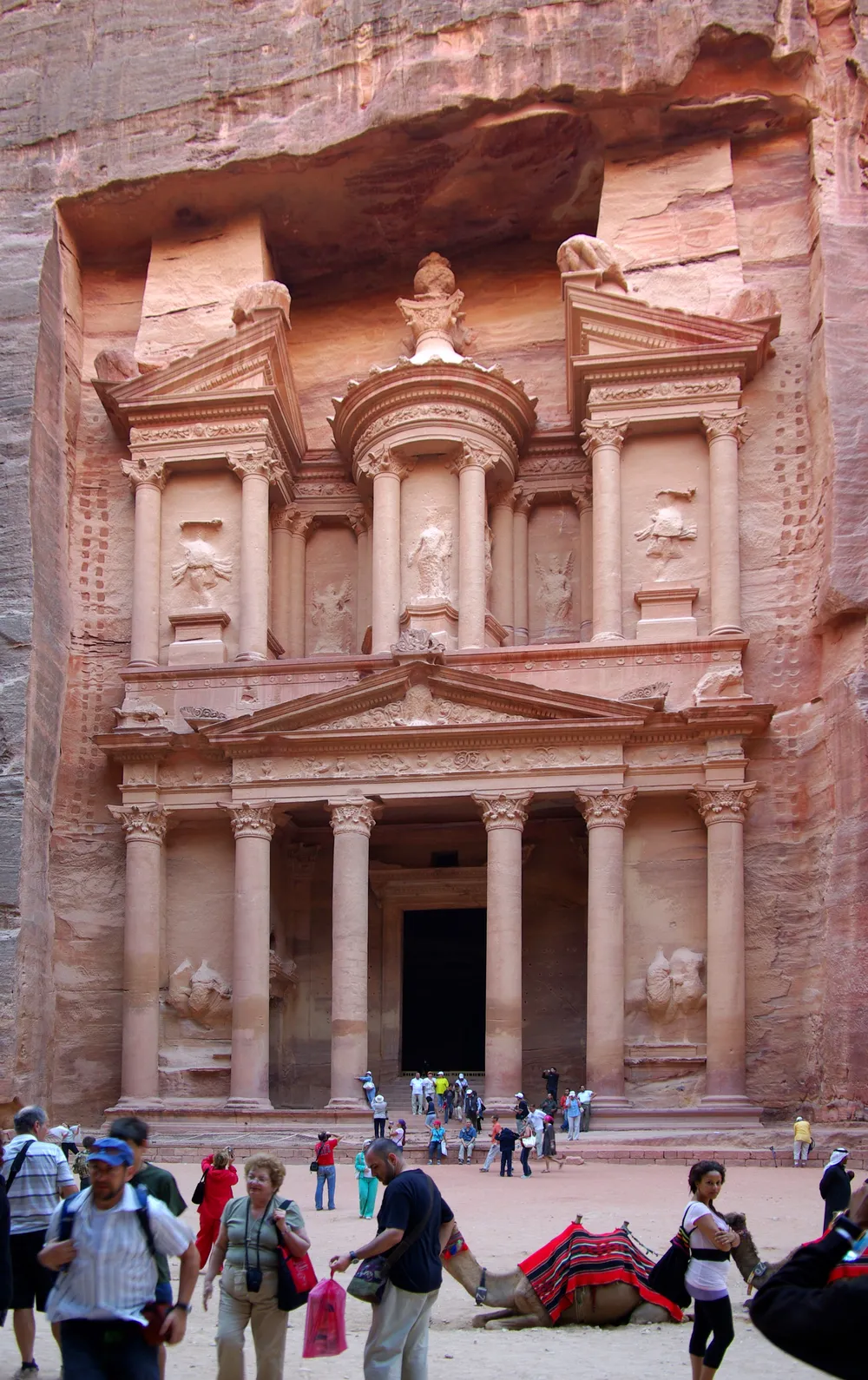
1 Siq. The entrance to Petra is a long, winding sandstone canyon (about 2 km). There are minor carvings spotted here and there throughout the Siq, but the most impressive sights are the colorful and unusual sandstone patterns in the rock walls. There are also remains of terracotta pipes built into the sides of the canyon that were used in Roman times to carry water. 2 Treasury (Al-Khazneh in Arabic). Upon exiting the Siq, visitors can view this jaw-dropping grandeur. Be sure to note the urn atop the Treasury structure, it has been rumored that the urn contained a Pharaoh's hidden treasure, and the urn bears the bullet pock marks where Bedouin travellers throughout the years have tested the theory. Get there when the park opens at 06:00 or 06:30 (depending on the season) and you may have the Treasury all to yourself or with fewer than 5-10 people around and no vendors. 3 Street of Facades. Past the next bend is this part also sometimes called outer Siq, a large canyon lined with the facades of various tombs. 4 Nabatean Theatre. At the end of the Street of Facades is the 70
Overview adapted from Wikipedia, travel guide fromWikivoyage (CC BY-SA). Photography via Wikimedia Commons.