
Pattani
Thailand · Asia
About Pattani
Pattani (ปัตตานี), also spelled Patani in Malay, is the capital of a province of the same name on the Southern Gulf Coast. The population of the city is a little over 40,000 and is a mix of Malay, Thai and Chinese ethnic groups and Muslim and Buddhist religions. The majority of the population are Malay-Muslim, with Thai-Buddhists and Chinese forming large minority groups.
Pattani travel guide
Understand
For several years, Southern Thailand has been experiencing violence linked to a complex and long-running conflict. Foreign governments frequently issue travel warnings for the region, and parts of the area can indeed be quite unsafe. Independent research into the situation is therefore an absolute necessity before heading to the region. Pattani provides a wonderful example of how people can continue to live their lives under difficult conditions. If only because of this, Pattani would be well worth a visit. But of course seeing life under conflict is not the only reason to visit. The city has a unique and vibrant culture, and the wider region has beautiful and interesting nature spots (including the beaches of Pattani Bay; which are not safe to visit). If not for the on-going violence, the entire region could be quite attractive for tourists. But the conflict is there, and so the tourists aren't. This means that you will get a lot of attention, especially if you don't look Southeast Asian. Children are likely to stare and point, adults will smile to you and even greet you on the street. It's possible to get tired of this, but take it as it is: people are simply happy to have you there. If you stay safe from attacks, the way you are most likely to notice the security situation is the heavy military and police presence. Sandbag bunkers (often "disguised" to look like wooden sheds) are located at sensitive points in the city, as are security cameras. Military vehicles tour the city constantly, including Hummvees. This is not likely to affect you in any significant way while you're in the city, but when travelling between towns there are checkpoints with regular intervals. It's quite possible that you will be asked for ID, so carrying your passport at all times is recommended.
History Pattani has its origins in the ancient Hindu Malay kingdom of Langkasuka. Later it became the center of an eponymous kingdom, the Kingdom of Pattani. This kingdom was for a long time a
Getting there
By car Pattani is about 1,055 km from Bangkok. Visitors can use Hwy 35 (Thonburi-Pak Tho) for about 90 km, then turn left to Hwy 4 to Chumphon for about 460 km. After that, use Hwy 41 or 42 passing Surat Thani, Nakhon Si Thammarat, Songkhla, and Pak-nam Thepa to Pattani. The total distance is around 505 km.
By plane There is no direct flight to Pattani. Visitors need to travel to Hat Yai airport which is served by: Thai AirAsia, Thai Lion Air, Nok Air, Bangkok Airways, Thai Airways and Thai Vietjet Air from Bangkok. There are also flights from Singapore (Scoot), Kuala Lumpur (AirAsia) and Chiang Mai (AirAsia). Thai Airways provides a round-trip shuttle bus (Hat Yai-Pattani) twice daily free-of-charge for passengers who make the reservation in advance. It is also possible to first take the bus from the airport into downtown Hat Yai, find your way to Hat Yai bus station (a tuk-tuk should be able to get you there) and from there catch a minibus that will take you to the door of a hotel of your choice. This takes about an hour and a half. Flight information can be requested at Tel: 1566, 0 2280 0060, 0 2628 2000 or at Pattani Office Tel: 0 7333 5938. It is also possible to get in by flying to Narathiwat with Air Asia and then taking a bus or taxi to Pattani.
By train There is no train station in the city of Pattani, but the Southern Line service of the Thai State Railways has two stops around 30 km from the city.
Pattani station, so called on official train timetables, is in fact a very small train station located in Khok Pho district, Pattani province. From there, buses and taxis are available to the city of Pattani, a distance of 29 km. Yala station is the next stop on the line, in the neighboring city of Yala, 35 km from Pattani city. This is a much larger station. Exiting the train station, turn right and walk to the end of that street. If you then go just around the corner you will see red buses that take you to Pattani for 23 baht. You can of course al
Getting around
The preferred way of getting around for locals is by motorcycle. The easiest way to get around, for tourists, is to do the same. Motorcycle taxis are available around the city. Just look out for the men in green vests, either driving around trying to find somebody to pick up or waiting at specific locations. For example, you can be pretty sure to find a driver or two outside most hotels, outside the hospital, by the market and so on. You can expect a ride to cost between 10-40 baht, depending on distance. Tuk-tuks of the four-wheeled variety are also common. Taking a tuk-tuk is more expensive than taking a motorcycle taxi, but also more comfortable, especially if you have luggage. Pattani is not a very large city, and most distances can easily be covered by foot. Walking right across town might take about 45 minutes. Indeed, walking may be the best way to orient yourself and understand the city. However you must realize that walking is not a very common means of transportation in Pattani and the pavement is used for pretty much everything other than walking. You will be weaving your way between stalls, tables, motorcycles, and even people's pot-plants - and you will regularly have to walk on the road.
See
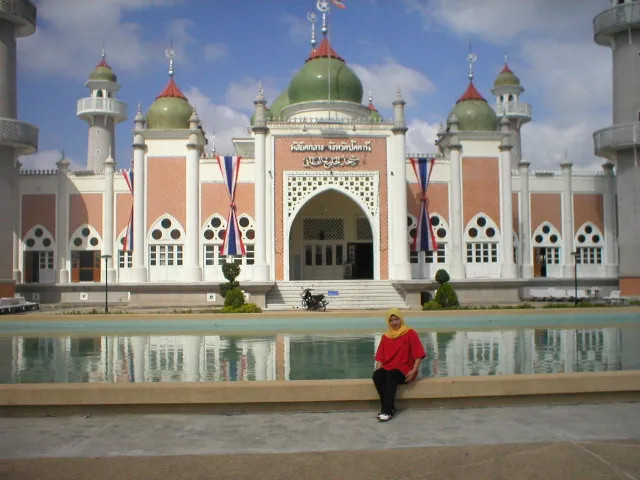
Matsayit Klang - built in the early 1960s, this traditional green-hued structure is probably south Thailand's most significant mosque San Jao Leng Ju Khieng Shrine Wat Changhai Wat Saikow Wat Si Mahapo
Do
Chak Phra Festival (ประเพณีชักพระ) This annual festival commemorates the return of Buddha from heaven. Buddhists accompany a decorated boat procession from all temples. Activities include dancing and offering food to Buddhist monks at the district office for five days and nights. Chao Mae Lim Ko Niao Fair (งานสมโภชเจ้าแม่ลิ้มกอเหนี่ยว) This fair is celebrated annually 15 days after Chinese New Year. Highlighting the event is the procession to carry the wooden sculpture of Chao Mae Lim Ko Niao, a goddess which is respected by the citizens of Chinese ethnicity in Pattani. This annual fair features extraordinary arts of endurance such as fire walking. Before joining the festival, for seven days participants need to be vegetarians. Sport Fishing in Sai Buri (งานแข่งขันกีฬาตกปลาสายบุรี) A competition is annually held on the second weekend of May at Hat Wasukri, Amphoe Sai Buri. 1 Hat Sakom (หาดสะกอม), Thepha (เทพา) (on the Songkhla-Chana-Thepha Hwy). The beautiful beach is sandy white, suitable for recreation. There are food stalls and lodging. One can hire a fishing vessel to Ko Kham where fish is plentiful and suitable for sport fishing. The island is about 2 km offshore.
Buy
Pattani is definitely not a place that tourists flock to for its shopping potential. Souvenir shops are non-existent (not surprising; seeing as there are almost no tourists to shop in them anyway), and the town has very little in the way of shops selling either local handicrafts or fashion. For your day-to-day needs while staying there, however, you should have no problems finding what yo
Overview adapted from Wikipedia, travel guide fromWikivoyage (CC BY-SA). Photography via Wikimedia Commons.