
Palmyra
United States · Americas
About Palmyra
Palmyra is a village and surrounding town in the Finger Lakes region of New York. In the nineteenth century, it was a center for religious revivalism, but today it's one of the most-visited villages along the Erie Canal. Palmyra is the birthplace of the Church of Jesus Christ of Latter-Day Saints (also known as Mormonism) and claims to be the only community in the U.S. that has a four-corner intersection with a church at each one.
Palmyra travel guide
Understand
In the late 1780s, a group of settlers from Connecticut tried to stake the state's claim to land in Northeastern Pennsylvania, due to overlapping provincial charters. Among those Connecticuters was one John Swift, a Revolutionary War veteran. In 1789, with the venture in Pennsylvania bearing little fruit, Swift decamped for Western New York, where the Phelps and Gorham Purchase had large tracts of land for sale. He purchased a tract (as did his fellow John Jenkins, though Swift soon bought him out) and in 1790 became the first permanent resident of what is now the Town of Palmyra. Swift's land was centered on Ganargua Creek, and the community that sprouted up was known as Swift's Landing. After a brief period as Tolland, Swift's brother-in-law proposed the name Palmyra, and that is how the town was incorporated in 1796. The town center grew slowly until 1825, when the Erie Canal opened. The canal's route took it right through Palmyra, necessitating an aqueduct over Ganargua Creek. Energized by the new waterway, the village was quickly incorporated, in 1827. During the period in which the Canal was built, at the height of the Second Great Awakening, the area between Rochester and Syracuse became a hotbed for religious fervor, known as the Burned-Over District. Palmyra was a particularly prolific source of the newly devout. In the mid 1820s, a local young adult named Joseph Smith (whose family lived just over the county line in nearby Manchester) claimed to have been visited by an angel, and directed to a set of buried artifacts on Hill Cumorah. Among those artifacts, it is claimed, was a set of golden plates, which Smith alone could translate. His translation became the Book of Mormon, which was published for the first time in Palmyra in 1830. Despite that milestone, the area never embraced Smith's nascent religion (he had moved away in 1827 and never returned), and it wasn't until the year 2000 that the Church of Jesus Christ of Latter-day Saints built a t
Getting there
Although RTS—Rochester's municipal bus system—does run a bus out to Palmyra twice daily on weekdays, it's timed for commuters, not tourists. You'll most likely be taking a car. As it does throughout Western New York, New York State Route 31 parallels the Erie Canal through Palmyra, making it your best option for arriving from the east or west. It enters from Lyons from the east and from Macedon from the west. From the north and south, New York State Route 21 will get you to Palmyra, connecting to Williamson and Marion northward and to Manchester and Canandaigua southward. If you're coming from farther afield, you'll want to take the east-west New York State Thruway (Interstate 90). Take Exit 43 and follow Route 21 north for about six miles. Once you're in town, free public parking is available in a number of lots along Route 31 (Main Street) and at the public parks. If you have a boat, you can take a scenic cruise into Palmyra along the historic Erie Canal, which runs right through town. Dock at the Port of Palmyra Marina, just east of the Division Street bridge.
Getting around
Palmyra's downtown area is quite walkable, and that's where you'll find most of the shops, eateries, and lodging. If you're exploring the canal, the Erie Canal Heritage Trail is great for walking or biking, though it's over a mile from the downtown/marina area to the far end of Aqueduct Park. If you want to head south to the Latter-day Saints sites, take your car or bike; they're two to four miles away, along country roads with no sidewalks.
See
The word "charming" is perhaps overused in tourism brochures to describe exactly the sort of village that Palmyra is. If you're easily charmed by such sites, then Palmyra won't disappoint. In truth, though, there's not a lot here that you can't find in other similar canalside villages throughout the region. Still, Palmyra's claim to be the Queen of Erie Canal Towns is not entirely unfounded. You can easily spend a day here browsing the shops, strolling the canal, visiting historic sites, and taking in the sights and sounds. Traffic is relatively light, and there are few cookie-cutter retail chains spoiling the atmosphere.
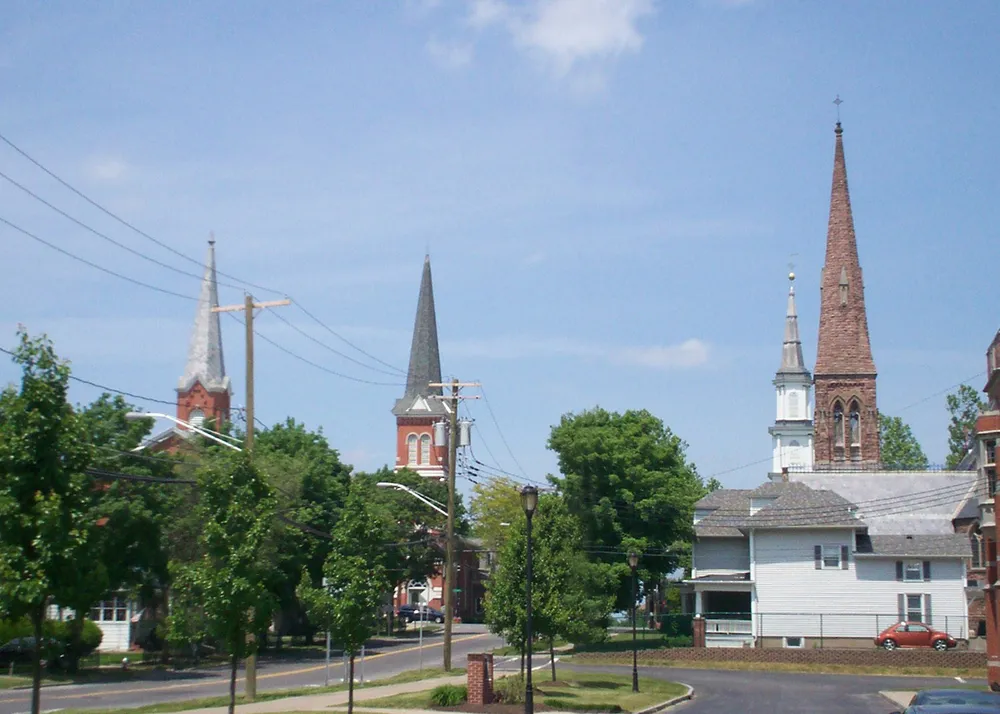
Four corners, four steeples, Main St at Church St/Canandaigua St. Hey, when you're in a small town, sometimes the most trivial things can become tourist attractions. There's one church on each corner of this intersection, and the village claims that no place else in the country can boast the same. The 1832 Western Presbyterian Church, 1867 First United Methodist Church, 1870 Canal Town Community Church, and 1873 Zion Episcopal Church aren't connected in any other way, and there's no tour or admission fee that lets you explore them all. But the sight is a popular one for photographers, if nothing else. Aqueduct Park (Rt 31 west to village line). 9AM-9PM. So named due to the still-standing aqueduct that carried the original Erie Canal—Clinton's Ditch—over "Mud Creek" (part of Ganargua Creek), Aqueduct Park is a treasure trove for Canal buffs. For starters, the aqueduct itself is quite a sight. Modern Lock 29 is also here, for those who like to watch boats lock up and down. There's a man-made waterfall where the modern canal spills over into the creek. Also here is the historic Aldrich Change Bridge; though it no longer crosses the canal, it was built when the original canal was widened in 1840 (the widened canal allowed no room for the south-bank towpath through the village of Palmyra, so the bridge was needed for the mules to change sides). Sw
Do
The highlight of the year in Palmyra used to be the annual Hill Cumorah Pageant, a spectacular recounting of the Book of Mormon, at the very location where it was first recorded. However it was discontinued by LDS directives. There are a few other annual events for locals and visitors to enjoy, but activities in Palmyra largely center on the Erie Canal: boating, fishing, hiking, and bicycling.
Curling on the Canal (Port of Palmyra Marina). February. Every February the Rochester Curling Club heads out on the canal, setting up houses and bringing rocks for the community to throw. Erie Canalway Trail. Daily Dawn-dusk. Stretching from Buffalo to Albany, the Canalway Trail offers hiking, biking, and cross-country skiing alongside the Canal. In Palmyra, the trail is well maintained, and allows inline skating in addition to the other modes of transportation. You can access the trail from Aqueduct Park or the Port of Palmyra Marina. Free. Wayne County Fair, 250 Jackson St. Mid-Aug. The county fairgrounds are in Palmyra, so every year there's a big agricultural fair, with all of the usual games, rides, and competitions. The event dates back to 1856. Ages 17+ $5, ages 6-16 $3, under 6 free; weekly passes $15/$8/$0.
Buy
Palmyra has a small but active business district on Route 31 (East Main Street) between Church Street and Clinton Street. Locally owned retail shops line both sides of the strip, with angled parking on both sides between William and Market
Overview adapted from Wikipedia, travel guide fromWikivoyage (CC BY-SA). Photography via Wikimedia Commons.