
Newcastle
Australia · Oceania
About Newcastle
Newcastle is a city at the mouth of the Hunter River, approximately 150 km north of Sydney in the Hunter region of New South Wales. The city is the focal point for the diverse Hunter region that encompasses beaches and mountains, restaurants and wineries. Newcastle is a great place for surfers, wine buffs, bush walkers, and anyone interested in Australian history.
Newcastle travel guide
Understand
The City of Newcastle has a population of 349,000 (2021), with the larger metropolitan area of Greater Newcastle consisting of 508,000 (2021), making it NSW's second population centre. Similar to its English namesake, Newcastle was an important centre for the coal mining and iron ore industries. Newcastle is Australia's oldest seaport and the world's largest coal exporting port. Many Novocastrians take an avid interest in sports, as participants, spectators or both. The local NRL Rugby League team, the Newcastle Knights are widely followed. Newcastle also hosts soccer, baseball, ice hockey, netball and various other sporting teams. Hunter New England Health and the University of Newcastle are the city's primary employers. To the north is Stockton Beach with kilometres and kilometres of uninhabited beaches that stretch up to Nelson Bay. Stockton Beach can be seen from Fort Scratchley, which was Newcastle's maritime defence during the world wars. Travel westward to the wineries and taste some of Australia's best wines. Barrington Tops National Park in the north west has beautiful fresh water rivers and rain forests, a good place to spot a platypus.
Visitor information Tourism website 1 Newcastle Visitor Information Centre, Honeysuckle Wharf, ☏ +61 2 4929 5948, [email protected]. M-F 9AM-5PM, Sa Su 10AM-3PM.
Getting there
By car The Newcastle area is at least two hours' drive north from the centre of Sydney on the Pacific Motorway (M1). This stretch of road is a major commuter route for traffic from the Central Coast and North Shore so travel time increases significantly in the peaks to and from Sydney. The Pacific Motorway is on the western side of Lake Macquarie. To travel up the eastern side of Lake Macquarie (through Swansea) then take the "Charlestown" exit (A43/Doyalson Link Road). This route is more scenic, more hilly, and less congested (though it takes a few minutes longer). If you follow this route you will eventually come to the Newcastle Inner City Bypass (A43) at Bennett's Green which you can take if you wish to head northwest (towards Lambton). Otherwise veer right to keep following the Pacific Highway until you reach Charlestown and then follow the signs to the city. Traffic during holiday periods and long weekends is also affected, with heavy northbound traffic at the beginning of the period as Sydneysiders flee the city for the weekend, and heavy southbound traffic as they return.
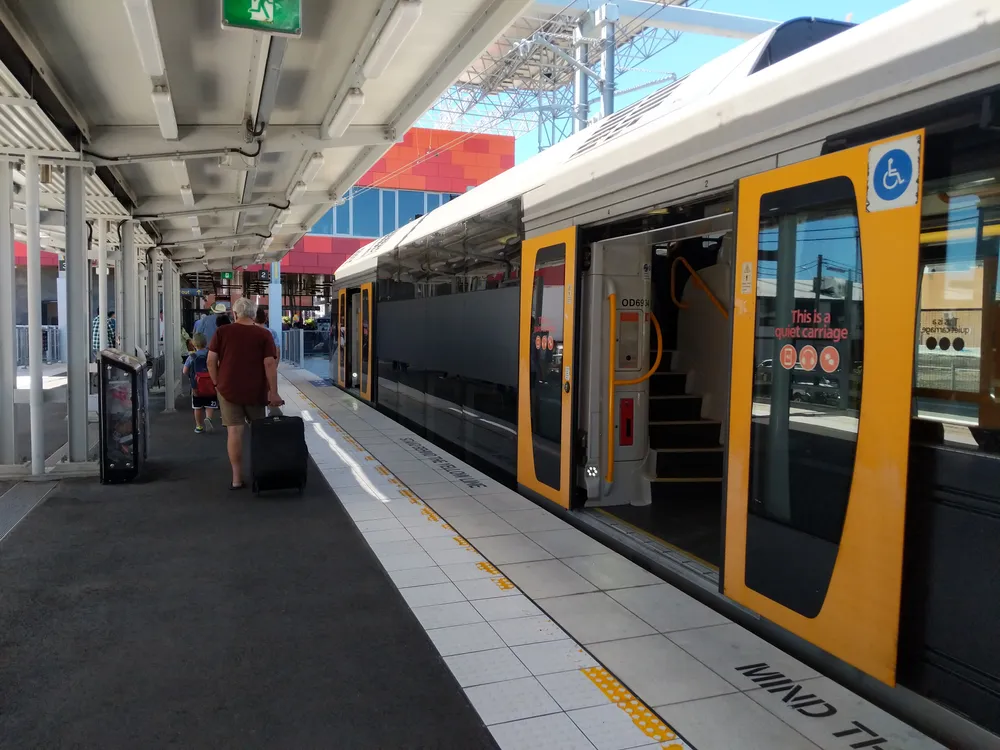
By train Sydney's Central, Strathfield, Epping and Hornsby stations have regular trains to 1 Newcastle Interchange via the Central Coast. Travelling time varies between 2 and 3 hours. This line uses the Opal card (the same as in Sydney) and trips from Sydney are quite comfortable and cheap at $8.30 peak and $5.81 off-peak. You can also use your contact-less credit card to at the Opal gates if you don't have an Opal Card. Trains terminate at Newcastle Interchange, where you can transfer to light rail to go to the CBD or beach. There is also a train service from Newcastle Interchange to various Hunter towns such as Maitland. Check the Sydney Trains website for trackwork along the Central Coast & Newcastle Line (CCN); when these occur, buses replace trains between stations and can add an hour to the trip. Several NSW TrainLink regional services pass through Newcastle's 2 Broadmeadow Stat
Getting around
The city centre is fairly walkable. Light rail and public buses are the best way to get around Newcastle city. The Sydney Opal card is used here, and used in exactly the same way. The shopping centres, John Hunter Hospital and the university are served by several bus lines. Newcastle Light Rail (NLR) connects Newcastle Interchange (connected to the train station in a seamless manner – simply walk straight ahead past the Opal gates from the platform) to Newcastle Beach passing Honeysuckle, Civic, Crown Street and Queens Wharf. Google Maps works for transit in Newcastle, as do several third party smartphone apps that Transport NSW recommend. There are taxis available, although you will likely need to call for one. Hamilton station has a taxi rank which often has a few taxis waiting for the Sydney train. Uber has some drivers here, and GoCatch has just a handful. Newcastle Taxi Co-operative can be reached under ☏ +61 13 10 08. There is a single ferry service between 4 Queens Wharf and 5 Stockton Wharf, costing $2.40 each way, also using Opal cards.
By bike
Riding a bicycle is possible, and infrastructure is slowly being built, but takes some time to discover. Select areas around Wickham, Islington, and along Honeysuckle Drive have some infrastructure, quiet streets, a gentle terrain along waterways that can be quite pleasant to ride through. Other areas which have some infrastructure are around Adamstown and Kotara Shopping Centre. It is possible to ride to and in the surroundings of the John Hunter Hospital, University of Newcastle but these are up significant gradients. Even so, much riding will occur on roads shared with motor vehicles.
Car hire Europcar, 66 Hannell St, Wickham, ☏ +61 2 4940 0053. Closest rental outlet to city centre and also has an outlet at the airport. Budget, 107 Tudor St, Hamilton, ☏ +61 2 4927 6375. Bit further out from the CBD (not far from the Broadmeadow Train Station) and also has an airport outlet. Thrifty Car Rental, 272 Pac
See
Landmarks 1 Christ Church Cathedral, 52 Church Street. See Newcastle's Cathedral. Tour the inside and climb the tower, with a guided map. $10. Heritage architecture. In and around the city. Notable buildings in the CBD area include the courthouse (top of Bolton St), former Customs House, Newcastle Railway Station, and Post Office (cnr of Hunter St and Bolton St). 2 Nobbys Head. Nobbys Island is connected to the mainland by a pier built using convict labour (completed in 1846). The pier is accessible to pedestrians, and is flanked by Nobbys Beach. It provides an excellent vantage point to take in views of the harbour and Stockton Beach across the water.
Museums and art galleries 3 Newcastle Museum, Workshop Way, ☏ +61 2 4974 1400. Tu-Su 10AM-5PM. Opened in 2011, this museum is spread across three historic railway workshop buildings with permanent exhibitions on local history, the BHP steelworks and coal mining, and interactive science. Free. 4 Fort Scratchley, Nobbys Rd, ☏ +61 2 4974 5005. W-M 10AM-4PM. A historic site which now houses a military museum. The fort defended Newcastle in 1942 when a Japanese submarine surfaced shelling the city. Fort Scratchley has been refurbished and is open to the public, great views to the north and over the city are a highlight as is the history. Just east of the fort is Newcastle ocean baths a great place to swim and meet some local characters. 5 The Lock Up Cultural Centre, 90 Hunter St, ☏ +61 2 4925 2265. W Th 10AM-4PM, F-Su 10AM-5PM. Incorporates a police museum and the John Paynter Gallery, which hosts resident artists all year round. Gold coin entry. 6 The Maritime Centre (Newcastle Mar
Overview adapted from Wikipedia, travel guide fromWikivoyage (CC BY-SA). Photography via Wikimedia Commons.