
Mohenjo-daro
Pakistan · Asia
About Mohenjo-daro
The ancient settlement of Mohenjo-daro is in Larkana District in the Sindh province of Pakistan. Listed as an archaeological site of immense historical significance on the UNESCO World Heritage List, it is one of the most important archaeological sites of South Asia, not to be missed if you are interested in archaeology or in the history of the Indian subcontinent.
Believed to have been built in about 2,600 BCE on what was then the west bank of the Indus river, the city had a population of 35,000 to 50,000 at its peak. It was one of the earliest cities in the world, one of the most advanced of its time, and one of the first to be a major centre of a Bronze Age culture, the Indus Valley Civilisation. The city was abandoned around 1,900 BCE, and the reason is not known for certain.
The town was buried underneath thousands of years of dirt and soil until it was discovered in 1911 and excavations started in 1922, while major excavations were carried out in the 1930s. After 1965, further excavations were banned due to fears of damage to the ruins; it is estimated that only one third of the site has been revealed thus far and some believe only 10 to 20 percent has been discovered.
The site is threatened by erosion and, despite conservation efforts funded by the Pakistani government and UNESCO, it is considered endangered. In 2012, Pakistani archaeologists said that the site could dis
Mohenjo-daro travel guide
Understand
Mohenjo-daro is the modern name; it translates as Mound of the Dead. Mohenjo-daro was one of the main cities of the Indus Valley Civilisation (IVC) which was one of the earliest Bronze Age civilisations and the first great civilisation of the Indian Subcontinent. The IVC is also known as the Harappan Civilisation after another major archaeological site at Harappa, also in modern Pakistan. The terms apply to several cultures over the period 3,300-1,300 BCE, and to over a thousand sites where their artefacts have been found. The peak was the Mature Harappan period, 2,600-1,900 BCE, when Mohenjo-daro was a thriving city. Ancient Mohenjo-daro seems to have been a socially classless society which focused on convenience of its citizens, in contrast to other ancient cities where vast resources were used to build royal palaces and giant tombs, solely to serve the rulers. Evidence suggests that Mohenjo-daro was ruled by an elected body of people who may have been religious leaders and traders. No evidence of warfare, invasions or weapons has been found in the area; the inhabitants of Mohenjo-daro seem to have been peaceful, though many contemporary societies were quite warlike.
Mohenjo-daro was abandoned around 1900 BCE and the whole IVC declined from about then until there was nothing left by about 1300 BCE. The reasons are not fully understood; see the Indus Valley Civilisation article for discussion.
Getting there
The site is not particularly easy or comfortable to get to since it is in rural Sindh, some 30 km from the nearest city, Larkana, and the region is extremely hot and dry. On the other hand, it is accessible by rail, road or air and it is certainly worth a visit.
By plane Pakistan's flag carrier Pakistan International Airlines flies from Karachi to Mohenjo-daro. Direct flights run three times a week and take around one hour. The outdated infrastructure of the Mohenjo-daro airport prevents the use of large, advanced aircraft so smaller prop aircraft such as the ATR 42 are used. A one-way ticket costs around Rs 6,000 to/from Karachi.
1 Mohenjo-daro Airport (MJD IATA) (adjacent to the archaeological site complex). A shuttle bus is available on flight days to drop you at the archaeological site entrance, or the distance can be easily covered on foot.
By rail The nearest railway station is some 11km away from the site in the outskirts of the nearby town of Dokri, but named after Mohenjo-daro. There's one train the Khushal Khan Khattak Express, each day run between Karachi and Peshawar, and makes a brief stop at Dokri early in the morning at around 6 AM. It has both air conditioned and non air conditioned coaches. The train leaves Karachi in the evening at around 9 PM, the journey takes approximately 9 hours and a non-air conditioned seat costs Rs 400 while Rs 1,000 for air-conditioned. If your train doesn't make a call at Dokri, you can opt to disembark at the larger nearby town of Larkana.
2 Mohenjo-daro railway station. (updated Jan 2021) From Mohenjo-daro railway station, a rickshaw for Mohenjo-daro archaeological site can be hired for Rs 200. Shared rickshaws are also available for Dokri for Rs 20 and from Dokri, you can hire a rickshaw for the archaeological site for Rs 150.
By bus Getting to Mohenjo-daro by public bus is a two-step process as there's no direct service to Mohenjo-daro. The nearest major city is Larkana, some 30km to the north, and one
Getting around
The archaeological ruins are scattered inside a large complex, surrounded by a protection wall and only accessible through a large main entrance gate. The complex can be covered on foot easily, and it is a pedestrians-only area; no other means of transport is allowed, not even bicycles. Pathways are constructed of bricks connecting the scattered ruins. Beware that walking can be quite exhausting, especially in the heat of summer. Make sure you wear proper and comfortable walking shoes and have a bottle of water with you when you explore the ancient city. It is also advisable to wear sunglasses and hats. Watch your step while walking through the ancient structure, as snakes have been sighted; they pose a hazard only if you disturb them. The archaeological site is divided into two sectors: a higher settlement to the west and a larger lower settlement to the east. Both settlement sectors are further subdivided into several areas, whose names are derived from the names of the archaeologists who excavated the ruins in the area. Everything is properly marked so it is quite easy to navigate and understand where you are and which structure is what. Facilities such as the museum, shops, park, canteen and resthouse are in a separate area a bit to the north, all near the entrance gate. The entrance fee for the complex is Rs 3,000 for foreigners, and Rs 20 for locals. This does include admission to the museum. The complex is open between 08:30 and 19:00 from April to September, and between 09:00 and 17:00 in winter from October to March.
Buy
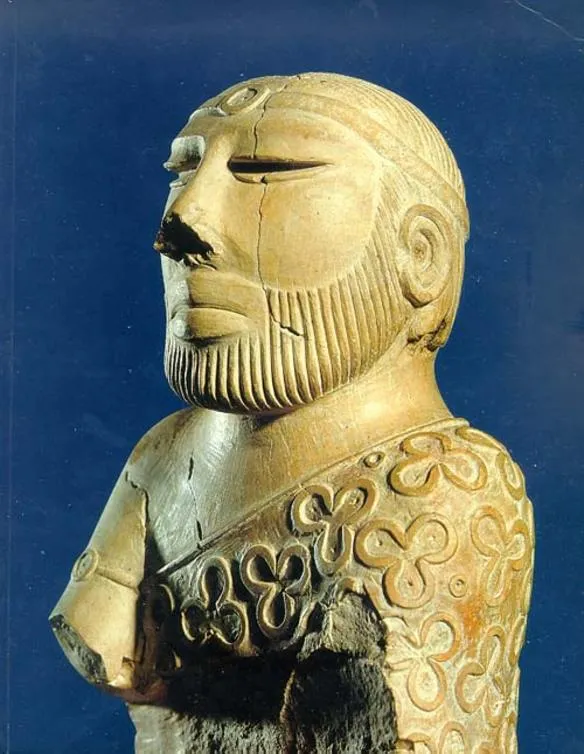
Among the most popular souvenirs are replicas of two famous pieces of sculpture found at Mohenjo-daro: the 'Dancing Girl', and the 'Priest-King' as well numerous seals and ancient jewellery. The 'Dancing Girl' is some 4,500 years old and was found in 1926; the bronze statuette is an image of a young dancer wearing nothing but bangles and a necklace. The 'Priest-King', was found in 1927 and has become symbolic of the Indus Valley Civilisation; the soapstone sculpture is of a bearded male believed by some to be a priest or monarch who had ruled Mohenjo-daro; however, there is no evidence that Mohenjo-daro was ruled by a priest or monarch. You'll find locals selling these souvenirs inside the Mohenjo-daro complex. There's a good gift shop adjacent to the site near the entrance gate where you can buy many kinds of souvenirs as well. Various stones, post cards, photographs and books on Mohenjo-daro can be purchased both from the gift store and local sellers. The museum also sells books and photo postcards of Mohenjo-daro.
Sleep
There is only one lodging facility in Mohenjo-daro, inside the complex and close to the archaeological site. Alternatively, there are a few good options to stay in the nearby town of Larkana. The PTDC Motel shown on the map was shut down in 2013 and remains so as of late 2014.
1 Archaeology Rest-house, ☏ +92 343 3847735, +92 313 3063317. Renovated accommodation is run by Pakistan's archaeological department is overall, ideal for a stay overnight and available at affordable rates. They can also provide pick and drop to/from Larkana or Badah station via car. The rest house has nine rooms with attached baths. Three air conditioned rooms, double bed, TV, and sofas are on the first floor while six non-air conditioned rooms with two single beds in each room on ground floor. Has a cafeteria, sitting area in lounge as well a big hall to accommodate large group of people for overnight stays. Cafeteria can prepare a meal according to your taste but may charge Rs 500 per person for lunch or a d
Overview adapted from Wikipedia, travel guide fromWikivoyage (CC BY-SA). Photography via Wikimedia Commons.