
Manuel Antonio National Park
Costa Rica · Americas
About Manuel Antonio National Park
Manuel Antonio National Park (Spanish: Parque Nacional Manuel Antonio) is a national park in the Central Pacific region of Costa Rica in the municipality of Manuel Antonio, 7 km (4.3 mi) south of Quepos.
Manuel Antonio National Park travel guide
Understand
The park is one of the most visited parks in Costa Rica as it is easily accessible from San José. Each year the park is visited by more than 150,000 people. With an area of only 16.24 km2 (6.27 sq mi) it is the smallest park in Costa Rica. It has an exceptional beauty and in 2011 the American magazine Forbes named it one of the 12 most beautiful parks in the world. However, other people say the park is overrated, overcrowded and overpriced. The visible bio-diversity is limited due to the many tourist strolling along the trails. Furthermore, the monkeys are so used to getting fed by the tourists that they become aggressive and do attack people with bags and backpacks. If instead you feel US$18 might just be a little too much, you are better off visiting Cahuita National Park instead, which is also more affordable and versatile to the naked eye.
History The park was created in November 1972, to an extent to protect it from development as the area's tourist industry began to boom.
Landscape The topography of the coastal area is rugged and has slopes of 20% or more. The altitude varies from 0 to 160 meters above sea level. Off the coast are small islands that are part of the national park. The forest-covered peninsula Punta Catedral was once an island and is connected to the mainland by sedimentation. As a result, a sandy strip has arisen, a phenomenon called Tombolo. The beaches, Playa Espadilla Sur and Playa Manuel Antonio, are among the most beautiful in Costa Rica. The beaches Escondido and Playita are outside the borders of the park and can be visited for free.
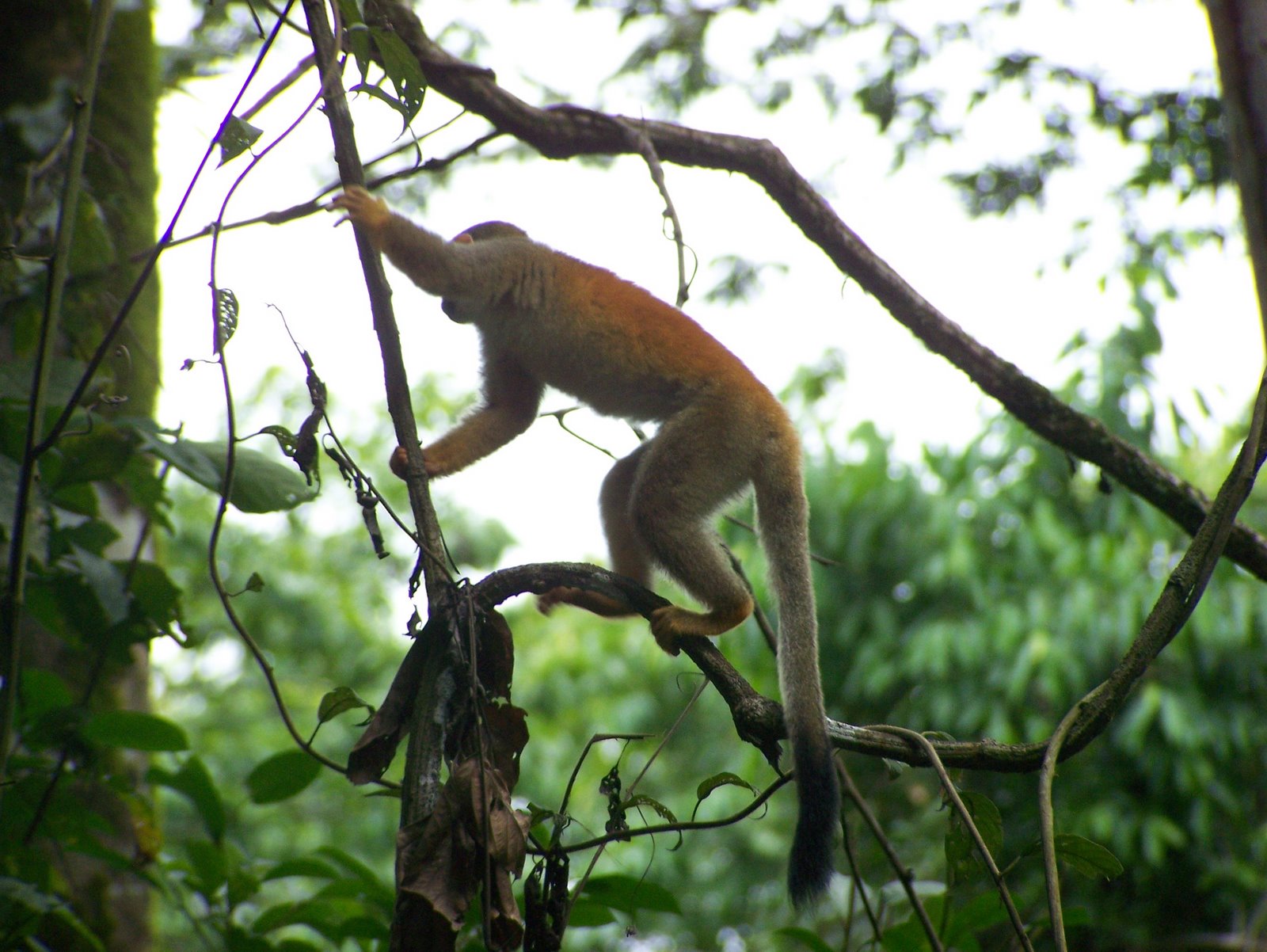
Flora and fauna Manuel Antonio National Park is rich in flora and fauna. There are 352 species of birds, 109 species of mammals and 346 species of plants registered. The ocean has a great diversity of marine fauna. In the area often birds like toucans, pelicans, ospreys, kingfishers and cayenne bosral (aramids cajaneus) are observed. Iguanas, lizards and snakes are common. Some of the most prominent
Getting there
By plane 1 Quepos La Managua Airport (XQP IATA). 8 km from Manuel Antonio near Quepos, a US$20 cab ride into town/Manuel Antonio Park. (updated Feb 2022)
By car On a paved road Manuel Antonio can be reached within 3 hours from San José via Jacó.
By bus There is a bus driving the route Quepos-Manuel Antonio that leaves every 30 minutes from 07:00-22:00. You can catch the bus at any of the many stops along the way. Fare ₡300 each way (☏ +506 777-03-18).
Getting around
Once close to Manuel Antonio, it is possible to walk from most hotels to the beach and to any restaurants or attractions in between. There is a public bus route which will take along the one road to the beach to the hotels and restaurants that service the tourist trade. Bus rides cost ₡315 and may not accept US dollars (will provide change). There are no street lights, and no side walks to the hotels, so carry a flash light to walk along the road. The park closes before dark, but walking between your hotels and restaurants will require a flashlight and in the raining season good quality shoes to avoid stepping in the mud and tripping over the rocks in the unpaved road. There is a small field, at the entrance to the park, where one can park their car for a high fee, and buy a fruit or soda before one enters the park. None are sold inside the park. Be sure to pack your trash, and take it out with you. The garbage barrels are few and far between and littering in the beautiful place is a mortal sin of a dozen major religions and over 50 minor ones. The Parque Nacional de Manuel Antonio can be reached quite easily by foot, but at high tide a ferry is (often) required to reach it, costing a nominal fee. The intrepid traveler could, of course, ford the waters by swimming it, but help the local economy and pay for the boat ride. At low tide the river is 15 cm (6 inches) deep and 1 m (3 feet) wide. This is a 650 m (1/2 mile) hilly long walk over uneven rocky surface. Shoes, not flip flops, are recommended. If you enter the beach from this entrance, the nicest beach is the first one encountered. If you have to cross the water the nicest beach will be the last one. At low tide the river is a meter and half wide (4.5 feet) and 20 cm (8 inches) deep, at high tide it is significantly wider and deeper. You would end up taking the boat. There are two row boats, 3 m and 4.5 m (10 and 14 feet) in length, and there is a small fee. There is another entrance that is a by passing the riv
See
The beach. The prettiest beach is the furthest from the park entrance by the cul-de-sac. You enter the park and walk past two beaches in the national park until you make the turn to the left. It is a white sand beach about 650 m (½ mile) in length, in a small crescent. The beach is about 12 m (40 feet) from the jungle to the water. The waves are gentle and the current is not strong. The beach is free of trash and litter, as are most beaches in CR. There is no lifeguard. Outside the National Park there is another beach, which you will pass on the way to the national park, it is free to enter. On this beach, one can rent chairs, surf and boogie boards, and purchase a massage. The waves are significantly larger. There is no lifeguard. There are no lifeguards at these beaches and one swims at their own risk. There are no marker buoys signaling how far it is safe for one to go. There is not a dangerous current, at Manuel Antonio, but visitors should familiarize themselves with how to swim out of a rip current when going to a new beach that has no lifeguard.
Do
Hiking in the national park. The trails are well marked and easily accessible. There are four short trails (1-3 km). Trail Perezoso leads to a panoramic view where you have a magnificent view over the bay. There is also a short trail on the peninsula Punta Catedral. You can do the most common one with a guide and then once your tour is over, take time to follow one of the other trails, and also go swim. Wildlife watching with guide. US$20 per person. Fishing Best place in the world to bend a rod. Huge sailfish and Marlin caught nearly every trip. (Quepos Fish Adventure is a good place to start). Relax at the beautiful beaches inside the park. Water is normally clear-blue in color. Park tour. With a guide. Nearly all of the guides have high quality optics. If you have a digital camera it will take a picture through a tripod mounted scope. You can get nice and close up. If you have a traditional film camera you should bring a telephoto lens for close up shots of the fast moving animals.
Buy
At Playa Espadilla and at the entrance of the park are souvenir shops. Regalame Art Gallery (part of Hotel Si Como No) has a great selection (expensive) quality souvenirs.
Eat
It is not possible to buy food or drinks inside the park, although just outside the park there are plenty of opportunities to do so. Take care not to allow your lunches to be infiltrated or stolen by the park's resident thieves, the coatimundi. While swimming in the ocean, make sure your backpack
Overview adapted from Wikipedia, travel guide fromWikivoyage (CC BY-SA). Photography via Wikimedia Commons.