
Kiryū
Japan · Asia
About Kiryū
Kiryū is a city in Gunma Prefecture in the Kanto region of Japan. Kiryū is the jumping-off point for trips to Mt. Akagi and to the Watarase River valley.
Kiryū travel guide
Understand
Kiryū lies about 90 km northwest of Tokyo (as the crow flies), and just across the Tochigi prefectural boundary from Ashikaga. During the Edo Era, Kiryū was known for its fine silks, an eastern match for Kyoto in western Japan. The lord of Kiryū supplied over 2,400 silk banners for the troops of Tokugawa Ieyasu in the battle of Sekigahara in 1600, and thereafter continued to pay the same tribute to the victorious Tokugawa Shogunate every year. It later became an important center for textile manufacturing during Japan's industrial revolution, and now is a manufacturing center for automotive parts and pachinko machines. Kiryū's international sister cities are also textile and manufacturing towns: Biella, Piemonte, Italy, and Columbus, Georgia, USA. Kiryū's Columbus Street features pink and white dogwood trees and azalea bushes reminiscent of its sister city Columbus, Georgia. The Kiryū School of Textiles, founded in 1915, has grown into Gunma University's School of Science and Technology, one of the largest in the country. Its website contains much useful information in English about the city and its history, and its many international engineering students lend Kiryū a more cosmopolitan flavor than many cities its size. In 2005, Kiryū doubled its size by incorporating a largely rural region across the upper Watarase River valley. But the most scenic gorges and valleys of the upper Watarase fall within the bounds of Midori, a separate jurisdiction, while the headwaters and the infamous Ashio copper mine fall within the bounds of Nikko city.
Tourist information site The local tourist association has a multilingual guide site.
Getting there
By train Kiryū lies about halfway between Oyama and Takasaki on the JR Ryōmō line, about 1 hour by local train from either end. About 30 trains per day pass through in each direction, and the fare runs about ¥1,000 each way. The Tōbu Isesaki line limited express train Ryōmō, which requires seat reservations, stops at Tōbu Shin-Kiryu station on its run between Asakusa and Akagi. It leaves Asakusa at 40 min past the hour, costs about ¥2,400, and takes about 90 min in either direction. The short local Tōbu Kiryu line stops at Shin-Kiryū on its run between Ota City and Akagi. The Watarase Keikoku (Valley) railway starts at JR Kiryū station and intersects the Tōbu Kiryū line at Aioi before heading up through the scenic mountains and gorges to the headwaters of the Watarase River valley. There are 18 trains a day each way between Kiryū station and Ōmama in Midori City, but only 11 that cover the full distance to Ashio and Matō, which are now administered by Nikkō. The first train leaves Kiryū at 06:36 and the last train leaves Matō at 19:46. The full-distance fare is about ¥1,110 each way. For travellers already in Maebashi, the tiny Jōmō Dentetsu line runs between Chūō Maebashi and Nishi Kiryū station.
By highway bus The Nihon Chuo Bus runs directly between Haneda airport and Kiryū twice each way daily for ¥3,400 (child ¥1; 700) one way. The trip takes between 2 and 3 hours, depending on Tokyo traffic. The same company runs overnight Sendai Liner which leaves JR Kiryū station South Exit nightly at 23:30PM, arriving at Sendai station at 18:00. It leaves Sendai station nightly at 23:00, arriving in Kiryū at 05:25. Adult fare one-way ¥5,900 (child ¥2; 950); round-trip ¥10,030 (child ¥5; 020).
Getting around
Orihime Bus This is the public city bus system. See this link for detailed information about the various bus routes, schedules and fares.
Mayu This is an electric free-of-charge sightseeing bus service in Kiryu. There are two routes: the Amusement Park - Yurinkan Route, and the Silk Heritage Route.
Rental bicycles Bicycles are available for rent at the Yui Office in JR Kiryu Station. See the Cycling section below for suggested routes.
Taxis Taxis available for hire have red signs lit on the dashboard. A green lights indicate the taxi has a passenger and will not stop. The left side rear doors open automatically. When entering a taxi, please stand free of the door. Stations have taxi stands; passengers can also call a taxi by telephone. It is not necessary to tip taxi drivers, however, there is a surcharge for service between 22:00 and 05:00
City taxi companies Kiryu Asahi Taxi +81 277-54-2420 Kiryu Godo Taxi +81 277-46-3939 Numataya Taxi +81 277-44-5242
Daiko service (taxi with two drivers) Since the laws regarding drinking and driving in Japan are extremely strict, using "daiko service" has become very popular. Under this system, a driver is provided to drive the customer's car, and the daiko taxi accompanies the customer to her/his destination where the customer's car is parked. The driver then returns with the daiko taxi.
See
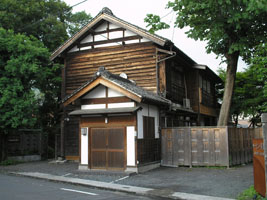
Because Kiryū was largely unscathed by World War II bombing, it contains one of the highest concentrations of prewar urban architecture in Japan: wooden-sided warehouses, sawtooth-roofed textile mills, merchant storehouses, and Meiji-era adaptations of Western buildings. The old urban core of the city is easily walkable.
1 Hikobe Manor (Hikobe-ke jūtaku), 6-877 Hirosawacho (15-minute drive from the Ota/Kiryu Exit on the Kita Kanto Highway), ☏ +81 277-52-6596. weekends 10:00 - 16:00 (reservations required for weekday tours). Closed on weekdays (unless you have a reservation.). A fully restored Samurai residence dating back over 400 years. Hikobe direct descendants still live on the property. Declared a National Important History Site. One of the oldest private homes in the Kanto region. adults: ¥500; elementary/jr high school students: ¥300. (updated May 2017)
2 Kiryu Meijikan, 2-414-6 Aioicho (10-minute drive from the North Exit of JR Kiryu Sta.; 5-minute walk from Watarase Keikoku Railways Aioi Sta.), ☏ +81 277-52-3445. Tu-Su 09:00-17:00. Built as the Gunma Prefecture Public Health Centre in 1878, it is a classic example of pseudo-Western architecture. Inside there are exhibition rooms and a coffee/tea shop featuring a nostalgic gramophone and music of the era. Adults: ¥150; elementary and jr high school students: ¥50. (updated May 2017) 3 Kiryugaoka Zoo (が), 3-8-13 Miyamotocho (15-minute walk from the North Exit of JR Kiryu Sta.), ☏ +81 277-22-4442. daily 09:00-16:30. Over one hundred exotic animals can be seen at the zoo, including lions, giraffes, zebras, flamingoes, and penguins. Admission Free. (updated May 2017)
Kiryu Club, 2-9-36 Nakamachi (10-minute walk from the North Exit of JR Kiryu Sta.), ☏ +81 277-45-2755. Please inquire. A notable social gathering place built in 1919. Interior decor is reminiscent of early 20th-century furnishings. Architecture is outstanding. (updated May 2017) 4 Yūrinkan, 2-6-32 Honcho (15-minu
Do
Kiryu Yagibushi Festival (まつり), streets in downtown Kiryu. first Friday, Saturday and Sunday in August. The festival is the largest event of the year in Kiryu. During the 3-day long event, more than 500,000 people from Gunma Prefecture and other parts of Japan vis
Overview adapted from Wikipedia, travel guide fromWikivoyage (CC BY-SA). Photography via Wikimedia Commons.