
Kathmandu Valley
Nepal · Asia
About Kathmandu Valley
The Kathmandu Valley is a region of 220 sq mi (570 km2) in central Nepal. It's home to three of the largest cities in Nepal, including Kathmandu itself, as well as hundreds of smaller towns and villages.
Kathmandu Valley travel guide
Understand
The Kathmandu Valley has 7 UNESCO World Heritage Sites with five of them either in Kathmandu or the near vicinity. All of them are worth visiting and spending time exploring. The Valley is the most crowded part of Nepal. In some parts of the valley, particularly the greater Kathmandu urban area, total population exceeds 2.5 million with a density approaching 3,000 people per square kilometre. Visitors to this part of Nepal will be immediately aware of the crowds and the associated vehicle traffic, especially motorcycles. As a general act of respect, don't take people's pictures without their permission.
Getting there
Most international travellers will be arriving by air. In this case you will be landing at Tribhuvan International Airport (KTM IATA) just east of Kathmandu. This is a convenient starting point for exploring all parts of the Kathmandu Valley. There are no other locations where international air passengers enter Nepal. Most bus connections from outside Nepal or other parts of Nepal will have Kathmandu as their main destination. Once you arrive in the city you can get oriented and arrange to visit other parts of the Valley as needed.
Getting around
It is entirely possible to trek from one village to another in the Valley (some examples below), otherwise it is easy to hire a taxi or take local buses to get around the Kathmandu Valley. From Kathmandu, buses to most parts of the Kathmandu Valley, with destinations such as Bhaktapur and Nagarkot, leave from the Ratna Park bus station.
See
The Kathmandu Valley has seven UNESCO World Heritage sites and you should make an effort to see as many of them as possible during your stay. In the following list, note that "Durbar" means "palace", being the place from where kings ruled. The World Heritage sites include:
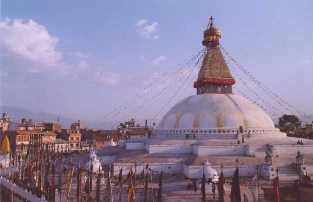
Boudhanath Stupa, the largest Buddhist stupa in Nepal with many monasteries in the area. Pashupatinath Temple, an extensive Hindu temple complex with cremation ghats. Swayambhunath, also called the "monkey temple". On the west side of Kathmandu, it has the oldest Buddhist monument in the valley; nice views out over the valley from the hill where the temples are located. Hanuman Dhoka in Durbar Square Patan's Durbar Square, featuring the palace and numerous temples Bhaktapur's Durbar Square, with its collection of temples and shrines in a city that does not allow motor vehicles. Changu Narayan Temple in the small village of Changunarayan has a traditional Newari settlement and a Hindu temple with inscriptions from the 5th century. Adinath Lokeshwar Temple in Chobhar is a temple that was built in the 15th century, and is sacred to Hindus and Buddhists. The Chobhar Caves are tectonic limestone formations over a kilometre in length - one of the longest caves in Nepal and in Asia.}} Chobhar Gorge is a gorge on the Bagmati River; there is a steel suspension bridge over the gorge which also offers views of the caves and a nearby shrine.
Do
The Nepal Environment & Tourism Initiative Foundation (NETIF) is working to develop cultural trails in the Kathmandu Valley. The Kathmandu Valley Cultural Trekking Trail begins in Sundarijal which can be reached in about 30 minutes from Kathmandu. It passes through part of Shivapuri Nagarjun National Park and connects the villages of Sundarijal, Chisapani, Nagarkot and Dhulikhel, continuing on to the villages of Balthali and Panauti. The entire route could be hiked in about 5 days, covering a distance of about 76 km. No single day is more than 18 km and all of the hike is at or below 2,500 m so there should be no problems associated with higher altitude.
Adventure sports Kathmandu is the starting point for numerous adventures in the rest of the country including trekking, rafting, jungle adventures, and more extreme sports.
Hiking / Trekking in the Kathmandu Valley - For more information, see Trekking in Nepal Nagarkot (2 days) - offers a great spot for watching surrounding mountain ranges at sunrise or sunset from atop the hill.
Parks Godavari Botanical Garden, Godavari, Lalitpur. Botanical Garden (updated Mar 2015)
Eat
In general, food in Nepal has been strongly influenced by India and Tibet. In the larger centres, such as Kathmandu, there is increasing interest in Western cuisine. As a consequence visitors can find many types of cuisine while wandering around Nepal. An exception is the large, North American fast-food chains which don't seem to have arrived in Nepal yet. Food is more traditional in smaller communities. Many meals tend to be rather bland but the Nepalese make use of green chili sauce, a variety of pickles and curries. Nepalis eat many vegetarian dishes (not necessarily vegan....). The most common examples would be dal bhat, pulao (a fried rice dish) and a variety of potato dishes. Beef dishes are almost non-existent in Nepal, given proscriptions against killing cows. Meat dishes tend to use chicken, pork, mutton or water buffalo (yak at higher elevations). A popular snack is a type of dumpling called momos, prepared either steamed or fried, and filled with either chicken, water buffalo meat (referred to as "buff") or vegetables. One traditional dish is thukpa. Since the left hand is considered "unclean", pass food with the right, eat with the right hand, avoid touching other people's food and stay out of the kitchen, especially if you are a non-Hindu in a Hindu home.
Go next
Pokhara - Popular lakeside tourist town 200 km west of Kathmandu. A good centre for trekking, most notably to the Annapurna area. Has great views of big mountain on the northern horizon, many shops and a good variety of restaurants. Khumbu - The region of villages and peaks leading to Mt Everest. There are many options for hiking and mountaineering..
Overview adapted from Wikipedia, travel guide fromWikivoyage (CC BY-SA). Photography via Wikimedia Commons.