
Kampong Cham
Cambodia · Asia
About Kampong Cham
Kampong Cham is the seventh largest city in Cambodia, but a relatively small city. It has yet to be heavily visited like Phnom Penh or Siem Reap. It carries with it plenty of colonial French charm, and has a genuine "wild west" feel to it. Most travellers who do find themselves in Kampong Cham are in transit to elsewhere in the country, but those who choose to spend at least a couple of days in the provincial capital will enjoy the laid back atmosphere and quaint charm.
Kampong Cham travel guide
Understand
It is the capital of the province of the same name. Most of the 41,000 residents of the city (2010) are ethnic Khmer, but there is a sizeable Cham minority in the province's towns, including a disproportionately high number of Muslims and Christians. Because there is little foreign investment and no large scale tourism, this city is very poor, with few modern buildings, though not lacking in French architecture from the colonial period. However, with the completion of a modern two-lane bridge across the Mekong, the city has begun a slow recovery from decades of decline. The people of Kampong Cham are, like all Cambodians, very friendly and open to engaging with tourists. If projects seem to be improving the state of things here (relative to other Cambodian cities), it may be because Prime Minister Hun Sen and former Phnom Penh Governor Chea Sophara came from this province and the current governor is the PM's brother.
Getting there
Kampong Cham has road links to major Cambodian cities, including Phnom Penh. The highway between Kampong Cham city and the capital Phnom Penh runs along the Mekong, and buses frequent this route daily, so you should have no trouble getting between the two cities.
By car Hwy 7 from Kampong Cham to Skun is in excellent condition and one of the best in Cambodia. Shortly after Skun however, the quality declines dramatically with frequent potholes and unpaved stretches. There is an alternative route to Phnom Penh east of the Mekong. When travelling from Siem Reap, it may be worth going via Skun due to the better quality of the road instead of the Rte 71 short-cut.
By bus To get from Phnom Penh to Kampong Cham, there are several bus options. The standard rules for buses apply here. Try taking an early bus, to avoid arriving close to or after dusk, when your choice of accommodation will be limited. The telephone numbers listed here are for locations in Phnom Penh.
Sorya, ☏ +855 23 210359. Approximately US$5, with buses leaving throughout the day at 06:45, 07:45, 09:00, 10:00, 11:30, 13:15, 15:00, and 16:00. Typically a 3-4 hr trip. GST, ☏ +855 23 335199. Also US$4.50, but only leaving twice daily, at 09:00 and 15:00 with a 3-4 hr trip. Capitol (air-con), 08:15 and 14:00, 3 hr, US$6 When departing from Kampong Cham, bus stations tend to be found near the roundabout on the main road in the city centre. One is southwest of the roundabout, on the right side. You buy your ticket at the counter.
Bus Hoh Wa Genting, ☏ +855 12 923551. Approximately 7,000 riel, with buses leaving throughout the day at 07:30, 08:10, 09:00, 10:00, 12:30, 14:00, 15:00, 16:00 for a 3-4 hr trip. GST Express, at the west end of the boulevard, Rith Mony, on Hwy 7 about 200 m from the Mekong bridge roundabout, has buses to a couple of destinations including Kratie and Phnom Penh. It is generally a bit cheaper than other bus companies but the buses are also a bit older. Capitol, US_4, runs two daily
Getting around
The city centre is easily walkable and is found north of the highway. A couple of hotels and Western-style restaurants cluster around the river front and couple of streets further east, is the central market area. Most of the sites worth seeing are however outside the city, so you're going to need some form of motorized transport.
By motorcycle An increasing number of visitors to Cambodia are buying their own motorcycles and then reselling them when they leave the country (or return home), and this is a great way to see Kampong Cham. Smaller 110 cc bikes are the ones seen driven by practically every Khmer in the city, while the larger 250 cc bikes are more often driven by foreigners or expats. The smaller bikes are cheaper, but less suited for long-distance travel and are more susceptible to theft. It's your call, though most travellers end up buying 250 ccs. If you choose to buy a 250 cc, expect to pay anywhere from US$500–2,500, depending on the age of the bike. Vietnam does not admit anything larger than 150 cc, but this will likely change in the near future. There are very few places to rent a motorcycle in Kampong Cham. A few are available from the Mekong Hotel (US$6) or Lazy Mekong Daze (US$5). Both are on the river front to the north of the bridge.
By taxi There are plenty of motodops offering their service for travel not only within the city, but to outlying areas of the province. For a scant US$4, you can be shown the temples at Nokor Wat, the endless jackfruit fields, and other attractions near the city. If your driver takes you to stalls or shops to purchase souvenirs, he will be receiving commission off of whatever you choose to buy. As usual, bargain with your driver. It's okay to set a price beforehand, but sometimes best to agree on the price afterwards. There are tuk-tuks in Kampong Cham, but as the city is not nearly as heavily visited as others in Cambodia, such as Phnom Penh or Siem Reap, there won't be many of these, but if you arrive by bu
See
Kampong Cham isn't chock full of tourist attractions, but its colonial charm and atmosphere will endear itself to you. There are a few temples to see in the area, and one of the country's mass graves.
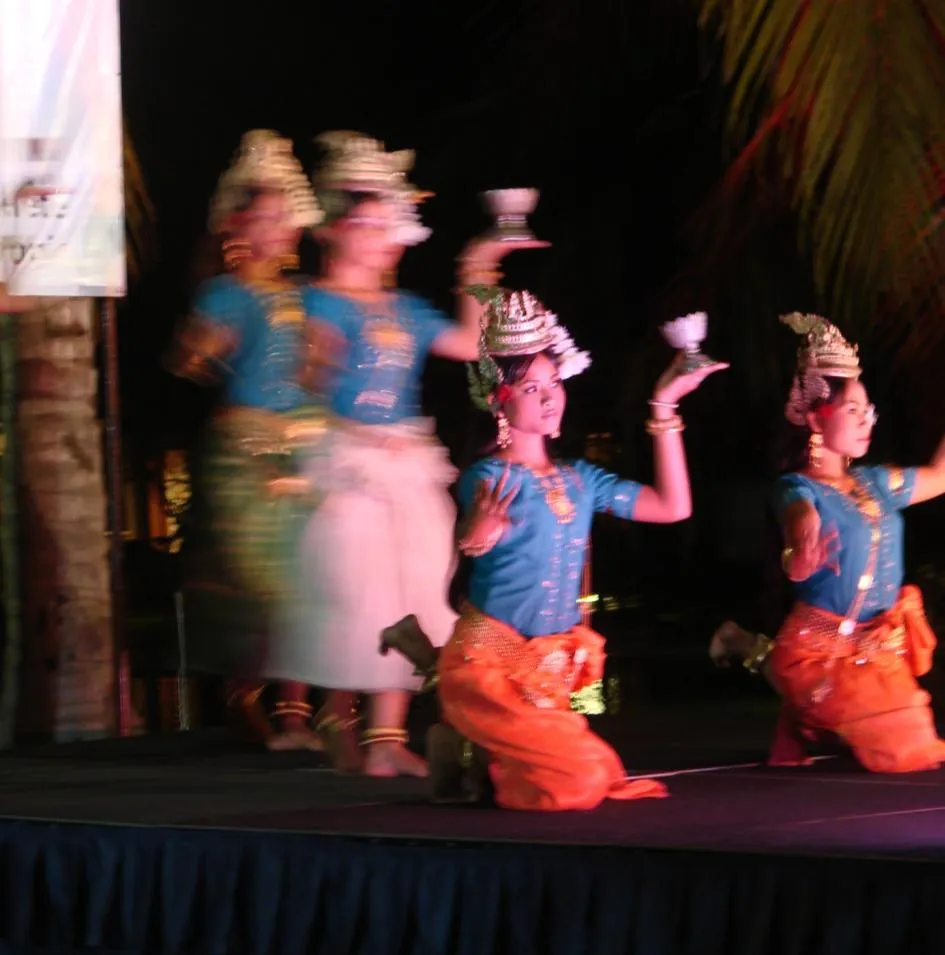
Abandoned US Airstrip (A short distance west of town. To get there take Hwy 7 to Phnom Penh for about 3 km. Just before the factory on the left hand side (looks a bit like a prison) there is a dirt road going to the right between street vendors and two red-white striped poles. Follow this road for about 2.5 km.). Formerly used by B52 bombers. There is not much left to see apart from the pavement of the airstrip and two decaying buildings next to it, a pillbox and the control tower probably. Leaving the airstrip on the left (west) will eventually lead to Mountain Pros and Srey. Going right (east) to the end of the strip and turning right again will lead you back to Kampong Cham. Apsara Dancing (Traditional Cambodian dances). There are occasional performances at 17:00, mainly on weekends and holidays, behind (east of) Wat Nokor (Nokor Bachey Temple) by the children and teenagers looked after and educated by BSDA, a non-governmental organisation (NGO) located at the temple site and managed by the monks. Entrance is free, donations are certainly welcome. Performances seem to be mainly on request, and the children and teenagers will be very happy to show off their talents. The Bamboo Bridge and Koh Paen (a few blocks south of the bridge spanning the Mekong). A solid bamboo structure built on Koh Paen Island across the Mekong. On the other side are Cham and Khmer villages, entirely mounted on stilts. This is a great place to drive along if you want to check out the people. The bamboo bridge can even withstand trucks, so don't worry about whatever you're taking, just be careful not to fall into the river. The bridge is washed away as the river rises in the wet season, and access to the island is only possible by boat, but it is rebuilt again every dry season.Sometimes t
Do
Kampong Cham is a sleepy provincial capital, and as such there isn't a
Overview adapted from Wikipedia, travel guide fromWikivoyage (CC BY-SA). Photography via Wikimedia Commons.