
Jangheung-eup
South Korea · Asia
About Jangheung-eup
Jangheung town is a rural district in the southern part of South Jeolla Province, South Korea. Situated on the eastern side of the Jangheung Peninsula, it overlooks Deukryang Bay.
The county is widely marketed under the brand name "Jeongnamjin" (meaning "Ferry of the True South"). This name signifies its geographical position as the point located directly south of Gwanghwamun, the symbolic center of Seoul. It serves as the southern counterpart to Jeongdongjin (the famous sunrise destination in the east) and Junggangjin (the northernmost point of the Korean Peninsula), establishing Jangheung as a key symbolic landmark in the country’s cardinal alignment.
Jangheung-eup travel guide
Understand
Jangheung is at the southern end of the mountainous area in central South Jeolla. In the southern region, the flatland was increased through land reclamation, and the north is a flatland formed around the Tamjin River and is lined with mountains about 500 m above sea level. Jangheung Dam was built to the north of the Tamjin River, and many areas of Yuchi were submerged. Jangpyeong and Jangdong, unlike other areas of Jangheung, correspond to the Boseong River basin, and similarly, a flatland is formed around the Boseong River.
History Jangheung has a long history starting from the Mahan confederacy (1st century BCE – 5th century CE), when it was the site of a tribal state called Mongno-guk. While little remains from this era, the region's early importance is marked by numerous prehistoric dolmens found throughout the county. During the Three Kingdoms period (4th – 7th century) and the subsequent Unified Silla era (668–935), Jangheung became a key cultural center. The most significant site from this time is Borimsa Temple (founded in 859), which houses several National Treasures, including a rare 9th-century iron Buddha. In the Goryeo (918–1392) and Joseon (1392–1910) dynasties, Jangheung served as a major administrative and military hub. Due to frequent raids by Japanese pirates, the town center was moved inland to its current location in 1413. Visitors can explore this later history at the Seokdaedeul Battlefield, the site of the final major battle of the Donghak Peasant Revolution in 1894. After Korea's liberation in 1945, Jangheung was one of South Jeolla's most prosperous towns. Today, it has transitioned into a peaceful eco-tourism destination, famously branded as Jeongnamjin for its location directly south of Seoul.
Climate
Jangheung experiences four distinct seasons, with temperatures typically ranging from -7°C (19°F) in the peak of winter to 28°C (82°F) during the height of summer. The most pleasant times to visit are during the late spring (late May
Getting there
By airplane The nearest airports are Gwangju Airport (KWJ) and Muan International Airport (MWX).
Nearby airports Gwangju Airport KWJ IATA is the most convenient for domestic travelers. From the airport, take a local bus or taxi to the Gwangju U-Square Terminal to catch an intercity bus to Jangheung. Muan International Airport MWX IATA primarily serves international flights and some domestic routes. Airport limousines or buses connect to Gwangju, where you can transfer to a bus for Jangheung.
By train Jangheung is served by the Gyeongjeon Line, which connects the county to Mokpo and Boseong.
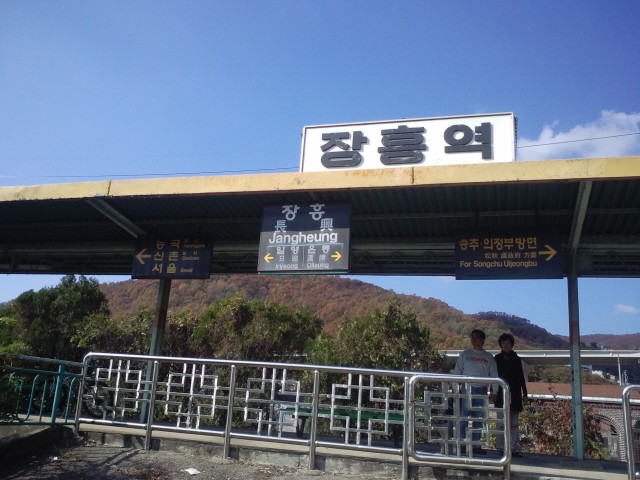
1 Jeonnam Jangheung Station (전남장흥역), 74, Pyeonghwa Umbrella. (updated Dec 2025): The main station is located near the town center (Jangheung). It is a convenient stop for travelers moving along the southern coast of South Jeolla. From the station, you can easily reach the main town area via a short taxi ride or local bus. From Seoul or Gwangju: There is no direct high-speed train (KTX/SRT) to Jangheung. To reach the county from Seoul, you should take a KTX to Mokpo Station, Naju Station, or Gwangju Songjeong Station. From these stations, you can transfer to a local bus or a Gyeongjeon Line regional train to complete your journey to Jangheung.
By bus
Buses are the most common way to reach Jangheung, with the Jangheung Intercity Bus Terminal serving as the primary hub.
From Seoul: Buses depart from Seoul Central City Terminal (Honam Line) 6 times a day. The journey takes approximately 5 hours, and a one-way ticket costs around ₩25,300 (for an Excellent/Premium bus). From Gwangju: Frequent buses depart from Gwangju U-Square. Direct express routes take about 70 minutes. Regional Connections: Buses from Mokpo, Suncheon, and Yeosu also stop here. If you are coming from neighboring Gangjin, buses run frequently between the two counties (taking about 20-30 minutes). Other Terminals: Smaller terminals in Gwansan, Daedeok, and Hoejin are useful for reaching the southern coast
Getting around
By taxi
Regular taxi You can easily find a taxi at the taxi stand located right in front of the Jangheung Intercity Bus Terminal. This is the most convenient place to catch a cab immediately upon arrival.
Call taxi Jeongnamjin Call Taxi: ☏ +8261-863-4616 Jangheung Rideum Call Taxi: ☏ +8261-863-4460 Jangheung Call Taxi: ☏ +8261-863-5444 Daedeok Call Taxi: ☏ +82 61-905-5557 (Useful for the Daedeok and southern coastal areas)
By local bus Local buses (called Gunnae-bus) are an affordable way to reach the rural areas of Jangheung. Most routes originate from the Jangheung Intercity Bus Terminal. Fares and Payment: A flat fare of ₩1,000 for adults applies to all routes within the county. You can pay with cash or use a standard Korean rechargeable transportation card (like T-money or Cashbee).
To Cheongwansan Provincial Park (Gwansan): Buses toward Gwansan run frequently (every 20–30 minutes). Get off at the Gwansan Terminal or the park entrance. To Borimsa Temple (Yuchi): Take a bus bound for Yuchi. Note that these are less frequent, so check the return schedule at the temple or terminal. To Jeongnamjin Observatory (Hoejin): Take a bus bound for Hoejin. This route takes you toward the southern coast where the observatory and Hoejin-myeon are located.
By hiking Jangheung is a fantastic destination for hiking enthusiasts, home to some of the most scenic mountains in South Jeolla.
1 Jeam Mountain (제암산), Hasan-ri, Jang. Known for its royal azalea blossoms in May. It offers well-maintained trails and panoramic views of the South Sea from the summit. (updated Dec 2025) 2 Eokbul mountain (억불산), Gisan-ri, Anyang. Located right behind the Cypress Forest Woodland. It features a "Mallegil" (boardwalk path) that is gentle enough for casual walkers and offers a great view of Jangheung. (updated Dec 2025)
By biking As of 2025, there are no public bike-sharing services available in Jangheung. However, the paths along the Tamjin River are well-paved and offer an exce
See
1 Jeongnam Jinmul Science Museum (정남진물과학관), 20, Haengwongangbyeon, ☏ +82 61-863-0051. It is a water-themed science museum. The building consists of four floors in total. There are an aquarium and a touch pool on the first floor, an aquarium on the second floor, a 4D video theater, and a hydrothermal promotion hall on the second floor, a subclass room on the third floor, and a dessert cafe on the fourth floor where you can relax. Inside, visitors can first meet various fish and green turtles at the aquarium, and learn good information about the water in the Jangheung area and stories about representative water festivals. It also runs an experience program where visitors can experience the principles of hydrothermal energy by making mini mood lamps, studying coloring, making eco-bags, and more. (updated Sep 2025) 2 Jung Namjin Cypress Forest Woodland (정남진 편백숲 우드랜드), 180, Udeuraendeu, ☏ +82 61-864-0063. One of its attractions is the Jeongnamjin Cypress Forest Woodland, created with cypres
Overview adapted from Wikipedia, travel guide fromWikivoyage (CC BY-SA). Photography via Wikimedia Commons.