
Iguazú National Park
Argentina · Americas
About Iguazú National Park
One of the great natural wonders of the world, the Iguaçu Falls are close to the triple border of Brazil, Paraguay, and Argentina. The area is on the UNESCO World Heritage List. Iguazú National Park is on the Argentinian side of the falls, and Iguaçu National Park is on the Brazilian side.
Both the Spanish and Portuguese names are pronounced "ee-gwah-SOO", and you'll sometimes see it spelled Iguassu Falls in Brazil to prevent foreigners from pronouncing it "iguaku".
Iguazú National Park travel guide
Understand
History The first European to see the impressive falls was the conquistador Álvar Núñez Cabeza de Vaca in 1541. Long before that, Guaraní people inhabited the area and gave the falls a name, a variant of which is used nowadays. For a period during the colonial era it was known as Santa Maria falls. These lands once belonged to Paraguay; the borders were redrawn after the Paraguayan War of the 1860s. A German expedition in the late 19th century "rediscovered" the falls, marking the beginning for tourism and more thorough scholarly studies of the falls. Back then, the region was still impenetrable jungle on the Argentinian side. The Argentinian part was declared a national park in 1934, the Brazilian five years later. Fifty years later, in 1984, the Argentinian part was inscribed on the UNESCO World Heritage List followed by the Brazilian part two years later. Later on the falls were elected as one of the New7Wonders of Nature, and is indeed one of the topmost sights on a continent particularly famous for natural attractions.
Landscape The Iguaçu Falls are by some measures the largest in the world, and often compared to two other great waterfalls, the Niagara Falls and Victoria Falls. The former has a somewhat higher mean annual flow rate than Iguaçu and the latter is slightly higher at its highest point. What sets Iguaçu apart is its width of about 2,700 m (8; 900 ft) which is almost as much as Niagara and Victoria Falls combined. Moreover, the highest recorded flow of Iguaçu is far higher than both other falls.
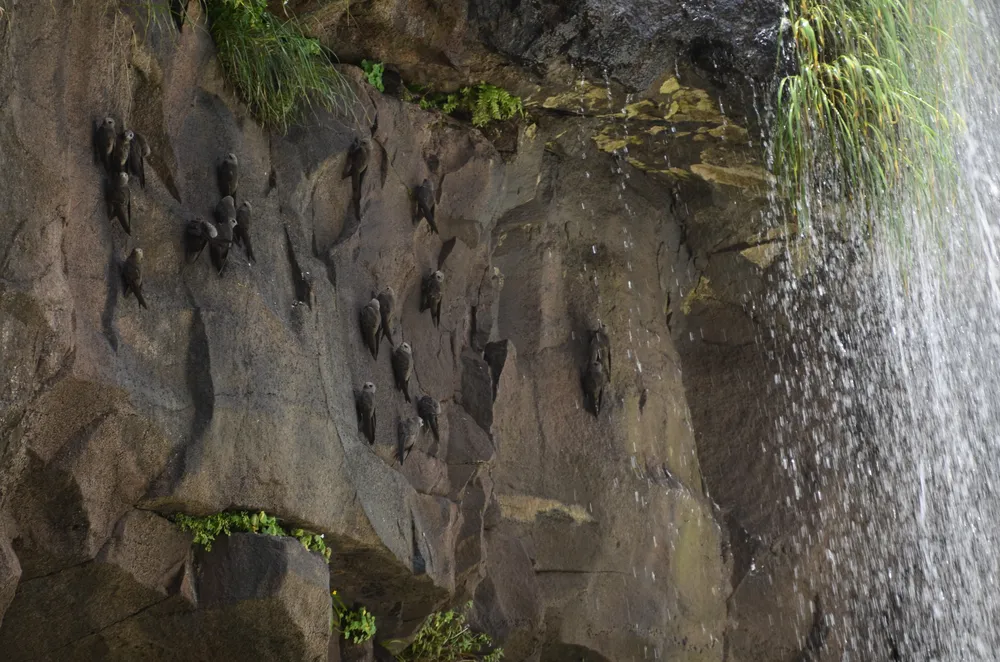
Flora and fauna The natural vegetation here is subtropical rainforest, considered part of the Atlantic Forest ecosystem (separated from the Amazon by the drier Chaco; Cerrado; and Caatinga regions). The forest is generally well-preserved within the parks, and most of the trails, including main waterfall routes, are lush with tropical greenery. One highlight of the local flora is the ceibo (Cockspur coral tree), which blooms with Argentina's national fl
Getting there
The falls are usually reached through one of the three cities in the tri-border between Brazil, Argentina and Paraguay. The city on the Brazilian side is Foz do Iguaçu - big and reasonably safe by Brazilian standards. The town on the Argentine side is called Puerto Iguazu and is small and pretty. Although the falls are between Brazil and Argentina only, Ciudad del Este, the city on the Paraguayan side, is just across the bridge from Brazil. It's a hectic (but exciting) centre for contraband and cheap electronic goods, but it's not the most safe there.
Visa Border formalities are enforced between the two parks. Crossing the border between these countries is fairly relaxed—authorities assume most people are on a day trip across the border. EU passport holders do not need a visa to enter Brazil for tourism. However, do remember to get off the bus on the border to get your passport stamped. Some bus drivers will not tell you when to do this, so it is best to check with them. There may be lines on either side of the border, depending on the time of the day and holidays. Also check regarding immunization requirements. Australian residents, for example, require yellow fever shots if returning to Australia within 6 days following a visit to Brazil. Brazil also requires yellow fever immunization prior to entering if your passport shows that you have visited some specific South American countries (Guyana; for example). Yellow fever together with other mosquito-born diseases are endemic to the Iguaçu Falls region.
By plane Both the Brazilian and Argentinian cities have nearby airports. From Puerto Iguazu airport there are several flights per day to Buenos Aires and other cities in Argentina.
Brazil
1 Foz do Iguaçu International Airport (IGU IATA), Rod. BR 469, Kms 16,5, s/n (just off the main road between Foz do Iguaçu and the park's entrance), ☏ +55 45 3521 4839. Served by LATAM Airlines, Gol Transportes Aéreos, Azul Brasil, Trip Airlines, Sol Linhas Aéreas with dir
Getting around
Both sides of the park are well served with foot trails. On the Argentine side of the park there's a small train leaving about every 30 minutes from near the entrance going all the way to the beginning of the trail to the Garganta del Diablo. On the Brazilian side, there's a bus service connecting the falls with other activities. That service runs from the entrance to the end of the park every 10 minutes in both directions.
Between the countries From Foz do Iguaçu to Puerto Iguazu: there is a bus that leaves from just outside the bus terminal, at the corner of Rua Mem de Sá and Rua Tarobá. It costs R$4 or AR$8. The bus may or may not stop at the Brazilian border checkpoint but typically will stop at the Argentine border checkpoint, where your passport will be stamped. You can also exchange foreign currency at the Argentine border checkpoint, but be aware that the bus may leave without you if you take too long, leaving you to take a taxi (~AR$80) or wait for the next bus. This bus terminates at the Puerto Iguazu bus station where you can catch the bus to the National Park. From Puerto Iguazu to the Brazilian Iguaçu Falls National Park: Rio Uruguay runs an hourly bus from the bus terminal that waits at the Argentinian and the Brazilian immigration. In fact, you don't even have to exit the bus for the Brazilian customs, the driver will collect your passport and have it stamped. First bus to the Brazilian falls: 08:30, last bus to return to Puerto Iguazu: 17:00. A return ticket cost AR$7000 (May 2024). Conveniently there are large lockers that fit backpacks at the falls entrance (buy token in the shop - R$9). Which means you can see the falls and then take the bus back to town (or the airport) and get out.
See
The 1 Falls are an awesome sight as tonnes of water throw themselves over cliffs and the mist rises amongst the jungle. They are taller than Niagara Falls, and more than twice as wide, for which Eleanor Roosevelt is said to have exclaimed on her first sight of the falls: "Poor Niagara!" It is well worth spending a day on each side of the falls, especially if you plan to do any of the boat rides or other activities offered. Don't just rush past the main viewpoints and leave. It's important to get a good perspective on the park overall to appreciate this awesome sight. Whilst the majority of the falls are in Argentina, a better overview is had from the Brazilian side.
Argentine side
The park opens from 08:00 til 18:00. Wear waterproofs and protect your camera as it can get quite wet on some viewpoints. Some people visit the waterfalls in swimsuits (recommended in summer). The park is fairly well organized: they have a train line so you can get from the entrance to the main circuits (Circuito Superior; Garganta del Diablo; etc. See below). They also have food stands inside the park close to the train stations, but food and drinks are very expensive there. It is a good idea to bring some food and water if you are going to spend the day on the par
Overview adapted from Wikipedia, travel guide fromWikivoyage (CC BY-SA). Photography via Wikimedia Commons.