
Guelph
Canada · Americas
About Guelph
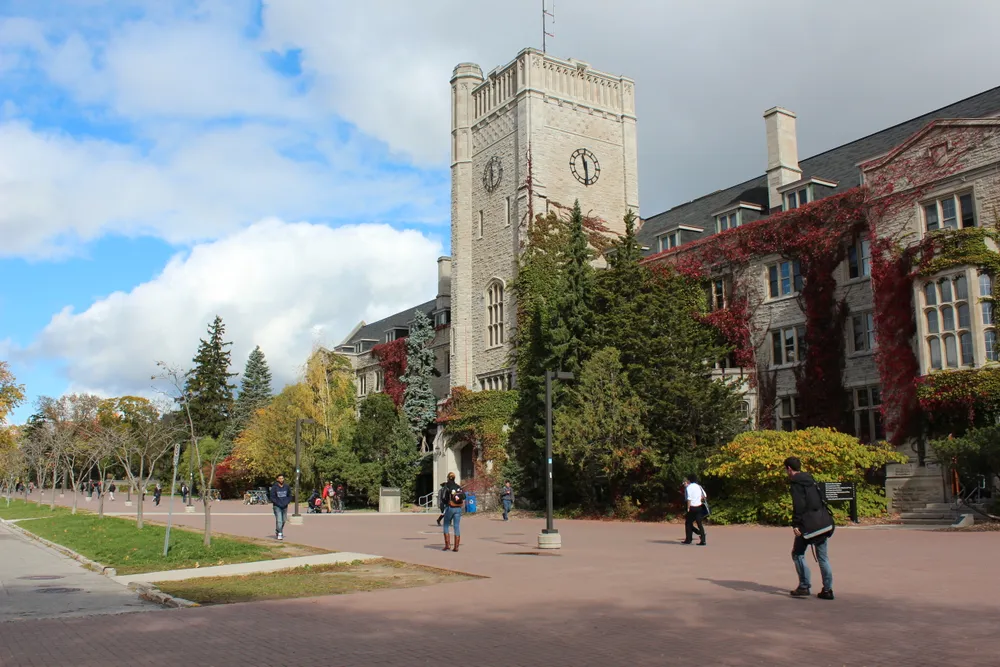
Guelph is a city of 132,000 people (2016) in Southwestern Ontario on the banks of the Speed River less than an hour's drive west of Toronto. Guelph is known for its beautiful limestone architecture, vibrant culture and a variety of festivals.
Guelph travel guide
Understand
It is nicknamed "the Royal City", as its name comes from the imperial House of Guelph that once ruled Great Britain. It is considered one of the most liveable cities in Canada, with a low crime rates, a clean environment and a relatively high standard of living. The city is home to Sleeman Breweries Ltd. The city is home to the University of Guelph, established in 1964. The Ontario Agricultural College (OAC), the oldest part of the University of Guelph, began in 1874 as an associate agricultural college of the University of Toronto.
City of Guelph Tourism Services: ☏ +1-800-334-4519.
History Before colonization, the area was home to a First Nations (Indigenous) community called the Attawandaron who lived in longhouses surrounded by fields of corn. The majority of this nation, about 4,000 people, lived in a village near what is now the Badenoch area of Puslinch, near Morriston. John Galt, the first Superintendent of the Canada Company, was hired to help colonize Upper Canada. He selected Guelph as the headquarters of this British development firm. Galt was a popular Scottish poet and novelist who also designed the town to attract settlers and farmers to the surrounding countryside. His design intended the town to resemble a European city centre, complete with squares, broad main streets and narrow side streets, resulting in a variety of block sizes and shapes which are still in place today. The street plan was laid out in a radial street and grid system that branches out from downtown. The town was named to honour Britain's royal family, the Hanoverians, who were descended from the Guelfs, the ancestral family of George IV, the reigning British monarch; thus the nickname "the Royal City". In 1827, the first houses and the first Guelph Farmers' Market were built. The population growth was very slow until the Grand Trunk Railway reached it from Toronto, en route to Sarnia, in 1856; the town was also served soon thereafter by the Great Western Railway branch from
Getting there
By car From Highway 401:
Take exit 295, Highway 6 North, the Hanlon Expressway; for downtown, exit at Wellington St., to Wyndham; for University of Guelph, exit at Stone Road, or College Road to Gordon St. Alternately, take exit 299, Brock Rd. (also known as "old Highway 6") north through the village of Aberfoyle, becomes Gordon St at the Guelph city limits. The University of Guelph will be on your right after Stone Rd.; Gordon Street becomes Norfolk St. in downtown Guelph. This route is more direct and more scenic; however, it's slower than taking the Hanlon. From Highway 6, Hamilton and Niagara, alternatively continue through the village of Morriston; then, either take Highway 401 West to exit 295, or take Brock Rd. north as above. Two other surface highways run through Guelph — Highway 7, that links Guelph with Kitchener-Waterloo and Stratford in the west and Brampton and the GTA in the east, and Wellington Street/Eramosa Road (formerly Highway 24), which links Guelph with Brantford and Cambridge in the south and Erin and Caledon in the north.
By train
1 Guelph Central Station (Guelph Central GO / Guelph station), 79 Carden St (corner of Wyndham St). The station is in an attractive, railway heritage structure built in 1911. Train operators stopping at this station: GO Transit, ☏ +1-416-869-3200, toll-free: +1-888-438-6646. Operates bus and rail commuter/regional transit within and near the Greater Toronto Area. (updated May 2022) The Kitchener route operates trips from Monday to Friday between Toronto and Kitchener including stops in Mississauga (Malton), Brampton, Georgetown, Acton, and Guelph mostly toward Toronto in the morning rush and toward Kitchener in the afternoon rush, but with a few extra round trip runs during the day and evening. Travel time to Guelph from Toronto takes about 1.75 hours, and is cheaper than by taking VIA Rail Canada. GO Transit trains from Toronto can be crowded; there is no reserved seating. GO Transit fares can be paid
Getting around
While Guelph is starting to experience some urban sprawl, especially in the south of the city, it is still a fairly compact city and traffic is rarely too busy. So, travelling by car is generally a fast option. There is ample parking in the downtown (city-owned lots are on Baker; Macdonell; and Wilson Streets; and there is lots of street parking) that is free on evenings and Sundays and reasonably-priced at other times (the lots charge $1.50 per hour M-F 8AM-6PM; and a flat rate of $2 on Saturday). Walking or cycling are also reasonable options for destinations within walking or cycling distance.
By public transit Guelph Transit, ☏ +1 519-822-1811, [email protected]. Operates buses within the city. The hub of the transit network is St. George's Square in Downtown Guelph. Buses on most routes depart from the Square on the hour and 20 and 40 minutes after the hour Monday to Friday from 5:40AM to 6:20PM, and run on a 30-minute service evenings and weekends, departing from the Square at 15 and 45 minutes past the hour. Cash fare is $3; day pass costs $8 (as of 2018). (updated Sep 2022)
By taxi Guelph has 2 main cab companies:
Canadian Cab, 88 Macdonell St, ☏ +1 519-824-3110. (updated Aug 2022) Red Top Taxi, 77 Macdonell St, ☏ +1 519-821-1700. (updated Aug 2022)
By ride hailing Uber. (updated Aug 2022)
See
1 Timberframe pedestrian covered bridge (near Wyndham St S & York Rd). Built in 1992 by 400 Timber Framers Guild volunteers. A 120 ft (37 m) pedestrian lattice covered bridge over the Speed River. (updated Aug 2017) 2 Basilica of Our Lady Immaculate, 28 Norfolk Street. Stands high above the streetscape, overlooking the city. Built of local limestone in Gothic Revival style. Construction began 1877, completed in 1926. 3 McCrae House, 108 Water St. 1–5PM daily (closed Saturdays in December–June). This small limestone cottage, the birthplace of John McCrae, author of "In Flanders Fields", is now a museum that interprets McCrae's life. A National Historic Site. 4 Art Gallery of Guelph (MacDonald Stewart Art Centre), 358 Gordon Street. Public art gallery houses an extensive collection of Canadian Art, including Inuit artists, as well as an outdoor sculpture park. 5 Guelph Civic Museum, 6 Dublin Street South. Highlights Guelph's history from pre-settlement to present. Also houses the Rogers Yahoo! Hi-Speed Internet Growing Up in Guelph Children's Museum. 6 Locomotive 6167, John Galt Park, Woolwich St at Macdonell St. Preserved "Northern"-type locomotive 6167 on static display. (updated Aug 2017) 7 Petrie Building, 15 Wyndham St N (at Mcdonnell St). Built in 1882, the Petrie Building has an ornamental, stamped-metal façade, and is last remaining example of such metal cladding in Canada. The zinc metal was painted to resemble brownstone. The building has been restored. (updated Mar 2018) 8 Goldie Mill Park and ruins, 75 Cardigan St (behind a modern building). The park contains the ruins of an 1866 flour mill built of limestone. (updated Jun 2
Overview adapted from Wikipedia, travel guide fromWikivoyage (CC BY-SA). Photography via Wikimedia Commons.