
Gros Morne National Park
Canada · Americas
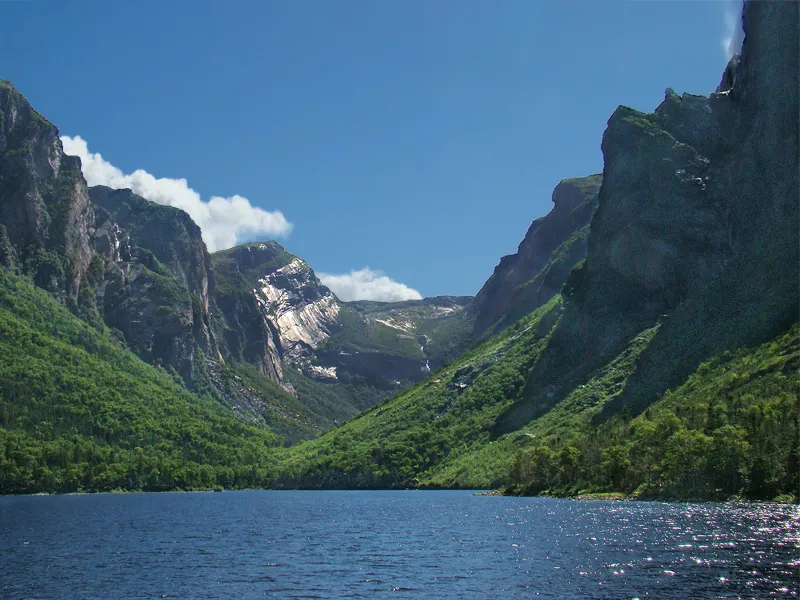
About Gros Morne National Park
Gros Morne National Park is a Canadian national park on the west coast of Newfoundland. A UNESCO World Heritage site, Gros Morne National Park protects an area of impressive natural beauty, rural Newfoundland culture, and unique geological wonders.
Gros Morne National Park travel guide
Understand
The park's namesake mountain, Gros Morne, is the second highest point in Newfoundland at 806 metres. Its French meaning is "large mountain standing alone," or more literally "great sombre." It covers an area of 1,805 km² (697 sq mi). Gros Morne is a member of the Long Range Mountains, an outlying range of the Appalachian Mountains, stretching the length of the island's west coast. It is the eroded remnants of a mountain range formed 1.2 billion years ago. The park's operating season is from mid-May to mid-October: most facilities are open seven days a week, including holidays. This is the high season, so you should book your accommodation well in advance. The park is open in winter with some activities available in winter. All major travel routes are maintained throughout the year, although temporary closures or warnings may come into effect in the event of adverse weather conditions.
History
The Gros Morne National Park Reserve was established in 1973 and received UNESCO World Heritage Site status in 1987. It became a national park on October 1, 2005.
Landscape The park is in the Long Range mountains, an extension of the Appalachian chain running up the west coast of the island of Newfoundland. The landscape of the park is mountainous and rugged, and has a number of interesting geological features, including a number of fjords and the barren Tablelands. The park's rock formations include oceanic crust and mantle rock exposed by the obduction process of plate tectonics, as well as sedimentary rock formed during the Ordovician, Precambrian granite and Palaeozoic igneous rocks.
Tablelands
The Tablelands, found between the towns of Trout River and Woody Point in south west of Gros Morne National Park, look more like a barren desert than traditional Newfoundland. This is due to the ultramafic rock—peridotite—which makes up the Tablelands. It is thought to originate in the Earth's mantle and was forced up from the depths during a plate collision several hundre
Getting there
Most visitors to Gros Morne will probably either fly in to the airport at Deer Lake, about an hour away, and rent a car there (a number of major rental companies have a presence), or take the ferry from North Sydney in Nova Scotia to Port aux Basques. Reservations for the ferry are essential.
By plane 5 Deer Lake Regional Airport (YDF IATA), 1 Airport Road Suite 1, Deer Lake (35 km from the southern park boundary.), ☏ +1 709 635-3601, [email protected]. The airport is served by direct daily flights from Montreal (May–October), Toronto, Halifax, and St. John’s. Intra-provincial flights are available between Deer Lake and St. John’s. There are bus services that can also provide transportation from the town of Deer Lake to Gros Morne. (updated Jun 2018)
By car & ferry If driving from the Canadian mainland, the shortest way to Gros Morne is via the ferry service between North Sydney, Nova Scotia, and Port aux Basques, Newfoundland. It is 300 km from Port aux Basques to the southern park boundary, about a four-hour drive.
Marine Atlantic, toll-free: +1-800-341-7981 (reservations), [email protected]. Ferries run year-round between North Sydney, Nova Scotia, and Port aux Basques on Newfoundland’s southwest coast. Ferry service between North Sydney and Argentia, on Newfoundland’s east coast, is offered from mid-June to late September. The crossing time from North Sydney to Port aux Basques is approximately 6 hours, and 11 hours from North Sydney to Argentia. Reservations strongly recommended. (updated Jun 2018) Labrador Marine. Summer. This ferry links northern Newfoundland with southern Labrador. (updated Jun 2018)
Getting around
A car is probably the most convenient way to get around, because the park is huge, and things are far apart. Biking may also be an option, if you don't mind lots of hills. Be careful if you drive at night, since moose are often spotted on the roads in Newfoundland, and collisions are common. An adult moose can weigh well over a ton, and hitting one at highway speeds is likely to be fatal. Moose are most active around dawn and dusk, so be vigilant if you're driving at those times.
See
The landscapes in Gros Morne are breathtaking. Even the views from the roads around the park can be pretty impressive.
Do
There are about 20 marked day-trip hiking trails in the park, ranging from fairly short, relaxing walks to the challenging climb up Gros Morne mountain. Don't miss the Tablelands, and the view from the top of the mountain really is worth the hike. One of the more strenuous day-hikes is the 16-km hike over Gros Morne Mountain. This trail is also called the James Callaghan Trail after the former British Prime Minister, who visited in 1976, in recognition of his conservation efforts. The interior of the park can also be accessed, notably through the multi-day Long Range Traverse between Western Brook Pond and Gros Morne Mountain. The park is home to many arts festivals, including: Gros Morne Theatre Festival[, Writers at Woody Point, Gros Morne Summer Music, and Trails, Tales and Tunes. Explore the villages and towns within the park - there are lots of small shops and restaurants.
Boat tour on Western Brook Pond, ☏ +1 709 458-2016, toll-free: +1 888 458-2016. 3-hour tour. The park's largest glacially-carved fjord is Western Brook Pond. This 16-kilometre long, 165m deep lake is home to Atlantic Salmon, Brook Trout, Arctic Char, and an unusual colony of cliff nesting gulls. The boat tour can be reached via Route 430, 27 km north of Rocky Harbour. From the parking lot there is a pleasant 45 minute walk (3 km) to the dock over the coastal plain. Along the way, there is a variety of plant life and wildlife, and interpretive panels dotted along the trail. At dockside, there is a sheltered waiting area, indoor washroom facilities, canteen services, gift shop, and picnic areas. $58-67 adult; $26-32.50 age 12-16; $20-25.50 under 12. July & Aug: up to 7 trips/day, June & Sept: 1/day at 12:30; May & Oct: depending on demand. (updated Feb 2017) Bonne Bay Boat Tour, ☏ +1 709 458-2016, toll-free: +1 888 458-2016. Two-hour tour of the two connected fjords of scenic Bonne Bay. Opportunities to view and photograph eagles, moose, whales, and seabirds. Partake in a tradition known
Buy
Handmade wool clothing (especially socks) is ubiquitous. Snowshoes, homemade quilts, wool sweaters, wood carvings, photography, Newfoundland preserves, handmade porcelain jewellery, Newfoundland music. Rocky Harbour has several gift shops and art & craft galleries, including:
Endicott's Crafts, Main St South. year-round, every day 9AM-9PM. (updated Feb 2017) Fisherman's Landing Crafts, Main St at Harbour View. year-round, every day 9AM-9PM. (updated Feb 2017) Gros Morne Crafts & Internet Cafe, 111 Main Street North, ☏ +1 709 458 2572, +1 709 458 2642. summer: Monday thru Saturday 9am - 7pm. (updated Feb 2017) Gros Morne Visitor Centre Gift Shop, Highway 430 - 3 km east of Rocky Harbour, ☏ +1 709 458-3610. May
Overview adapted from Wikipedia, travel guide fromWikivoyage (CC BY-SA). Photography via Wikimedia Commons.