
Gaza Strip
Palestinian National Authority · Other
About Gaza Strip
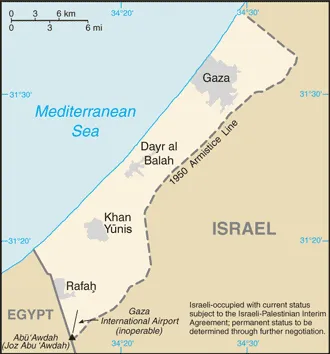
The Gaza Strip (Arabic غزة, Ghazzah, Hebrew עזה Azza) is a Palestinian territory in the Middle East. The capital and largest city is Gaza. Portions of this page may be out of date because the situation on the ground changes quickly.
Gaza Strip travel guide
Understand
Positioned between Israel and Egypt, Gaza Strip contains several towns and cities that have grown together. The capital and largest city is Gaza, with Khan Yunis and Rafah being the second and third largest. Several smaller villages are nestled between these cities. It does have reasonably modern infrastructure and architecture despite its troubles, but a UN report as early as 1952 stated that the Strip was too small to support its population of 300,000, and now there are well over 1.7 million inhabitants. On 7 October 2023, the Israel-Hamas War broke out, and thousands of people have been killed. Most inhabitants are descendants of Palestinian refugees who fled or were expelled from their homes in Israel during or after the 1948 war and were not allowed to return to their homes and villages. As they were not Egyptian citizens they were not allowed into Egypt, either.
History Gaza has been around for a while: the earliest known reference is an inscription in the Temple of Amun at Karnak, Egypt, dated 1500 BC, which states that the town of Gaza is 'flourishing'. And for a long time it did: a staging post on trade routes connecting Asia and Persia with Arabia, Egypt and Africa, even the name means "treasure" in Arabic. Alexander the Great laid siege to the town in 332 BC, executing 10,000 defenders after being held off for two months. Later, the town was held by the Romans, the Crusaders, the Mamluks, the Ottomans and briefly even by the French in 1799, when Napoleon Bonaparte set up camp on his way to defeat in Egypt. The Turks took it back, then lost it to the British in World War I. The Egyptian army grabbed it during the 1948 war that led to Israel's independence, opening camps for Palestinian refugees who fled and were expelled from their homes by Israeli forces — and the current situation began when Israel occupied the Strip in 1967. Spurred by the violence of the 1987–1993 Intifada ("Uprising"), Israel and the Palestine Liberation Organization signed a "Decl
Getting there
Getting into Gaza is both difficult and unwise. As of around 2003, all would-be visitors were required to apply in advance for Israeli permission to enter the Strip. The application is usually submitted through your embassy in Israel and, in theory takes between 5–10 days. In practice, it can take months, and if you're not either a fully accredited journalist or an aid/human rights worker, you're unlikely to get permission to enter Gaza from Israel. Because of the Israel-Hamas war, it is not possible to enter Gaza from Egypt through the Rafah crossing.
By plane Gaza has no functioning airport, as the former Yasser Arafat International Airport (GZA IATA) has been shut down, and the runway was destroyed by Israeli bulldozers in 2002. The closest airports are El Arish International Airport in Egypt (which has no commercial flights) and Ben Gurion Airport near Tel Aviv (TLV IATA). The closest non-Israeli commercial airports are Jordan's Queen Alia International Airport (AMM IATA) and King Hussein International Airport (AQJ IATA), while the closest Egyptian-controlled airport with non-charter commercial service is Cairo International Airport (CAI IATA). Taba International Airport (TCP IATA) is closer than Cairo, but only charter flights fly there.
Entry by land
The main point of entry is through the Erez crossing in the north, on the border with Israel. Getting to Erez is easiest done by taxi, it's also possible to travel by Dan BaDarom bus #20 from Ashkelon to the checkpoint. You will need a permit from the Israeli Army, or a GPO (press) card. If you have a permit, you need coordination with the Israeli Army, specifying when you are planning to enter and leave Gaza. Journalists with a Government Press Office (GPO) card can come and go as they please. Only vehicles with prior coordination (such as a handful of UN cars) are allowed to drive in and only after a thorough search, which may take months. It's very helpful to travel with someone that's run the gauntle
Getting around
There is no public transport in Gaza, but there are numerous service (ser-VEESS) taxis. Navigation is done by landmark, not street address. Stand on the side of the road that is in the desired direction of travel. When a driver stops indicate the destination landmark e.g., "Shifa" and the number of passengers ("wahid" for one; "it-nayn" for two.) If the driver is not headed that way, he may drive on. Travel up and down Omar al-Mukhtar St. will set you back ₪1; trips elsewhere are negotiable. Near al-Shifa hospital is a line of taxis that travel to destinations beyond Gaza city. The drivers yell out their destination and wait until their vehicle is pretty much full before they leave. It is advisable to watch your step if walking, since traffic is chaotic and sidewalks are largely non-existent.
See
Gaza is not exactly a top tourist destination and most of its attractions have taken quite a beating during the past 50 years.
1 Grand Omari Mosque (Great Mosque of Gaza; جامع غزة الكبير; Jāmaʿ Ghazza al-Kabīr). Makes up for its lacklustre appearance with an interesting history: it's a converted Crusader church built on the site of a Hellenic temple with pillars from a 3rd-century Jewish synagogue. Large parts of the mosque, however, were destroyed in 2023 Gaza war and genocide, though works to restore the mosque went underway in 2025 (but remains still hampered by the war). (updated Jul 2026) 2 Ibn Marwan Mosque. Built in 1324. (updated Aug 2023) 3 Sayed al-Hashim Mosque (In Old City of Gaza). (updated Aug 2023) 4 Katib al-Wilaya Mosque (جامع الولايات). A late medieval mosque. (updated Oct 2023) 5 Church of Saint Porphyrius. Orthodox church, celebrating Saint Porphyrius who was Bishop of Gaza around 395-420 CE. The current church was built around 1150 by crusaders and renovated extensively in 1856. (updated Feb 2015) 6 Holy Family Church (كنيسة العائلة المقدسة). Only Catholic church in Gaza. (updated Aug 2023) 7 Caravanserai of Yūnus al-Dawādār (In Khan Yunis; next to the Great Mosque). Also known locally as Barquq Castle. This fortified khan (Arabic inn) dates back to 1387 AD. (updated Aug 2023) 8 Great Mosque of Khan Yunis (المسجد الكبير) (In Khan Yunis). Main mosque in Khan Yunis, built in 1928. (updated Aug 2023) 9 Al-Qarara Cultural Museum (متحف القرارة الثقافي) (In Khan Yunis). (updated Aug 2023) 10 Ruins of Saint Hilarion Monastery. Located att the archaeological site Tell Umm el-'Amr, Saint Hilarion was an active monastery for four centuries, from the late Late Roman to the Umayyad period. Named after Hilarion the Great (291–371 AD), who is venerated as a saint by the Orthodox and the Roman Catholic Church. The tell and monastery were listed as a UNESCO World Heritage Site in 2024. (updated Aug 2023) 11 Gaza War Cemetery, Salah al-Din Rd. Burial site o
Do
There's very little to do in Gaza for the average tourist. There is a beach, however the water isn't the cleanest in the area, you'd be better off on a beach further north in Israel. There are
Overview adapted from Wikipedia, travel guide fromWikivoyage (CC BY-SA). Photography via Wikimedia Commons.