
Gaud
Bangladesh · Asia
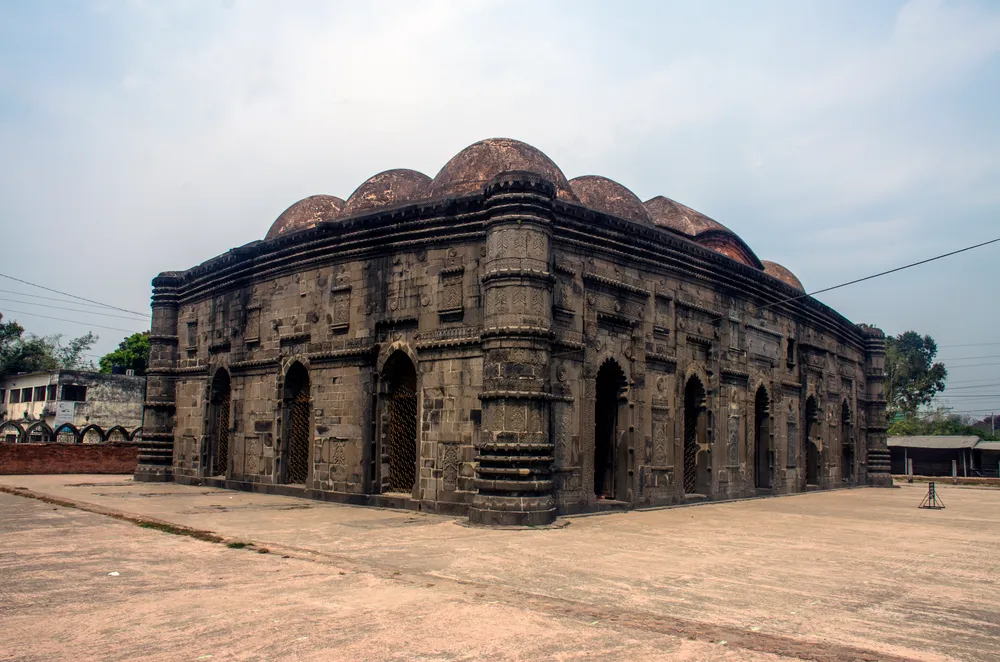
About Gaud
Gaud is a historical place in Chapai Nawabganj district of Rajshahi Division of Bangladesh. It once served as the capital of the Bengal Sultanate. Today the ruins of Gaud consist of several mosques, madrasha (Islamic school), gateways and fortification walls. They are spread across the Sona Masjid - Mahadipur border separating Bangladesh and India. Gour in India houses several historical structures from the same period.
Gaud travel guide
Understand
Gauda was the medieval capital of Bengal. It is virtually in ruins. The ruins of the historical city are divided between Chapai Nawabganj district of Rajshahi Division of Bangladesh and Malda district of West Bengal, India. Once it was a well populated and magnificent city. The Muslim rulers, the Ilias Shah dynasty, built many monuments. Among those buildings some are located in the Bangladesh part of the city. These are all famous for their architectural beauty and have a great significance for the development of the Muslim architecture in Bengal. Though all of the monuments are now in badly damaged shape, the Archaeology Department of Bangladesh is trying to repair or reconstruct these.
Getting there
Rajshahi (38 km) is the nearest major city. Buses are available but not frequent. Rajshahi hotels can arrange for cars for a day or over night tour of Gaud.
From India Indian citizens with passports and necessary visas can travel across the Mahadipur - Choto Sona Masjid border. Similarly citizens of Bangladesh can cross the border. However, other nationals are not allowed to cross the land border.
Getting around
Despite several historical sites the area lacks tourism facilities. There are hardly any local transportation options to get around.
On foot The sites are located in a compact area and can be explored on foot.
By auto The hotel may arrange for an auto (three wheeler).
By car Tourists coming to Gaud by car can continue the local sightseeing in the car.
See
1 Chhoto Sona Masjid (Small Golden Mosque). One of the most graceful monuments of the Sultanate period is the Chhota Sona Masjid or Small Golden Mosque built by one Wali Muhammad during the reign of Sultan Alauddin Husain Shah (1493-1519). Its larger counterpart the Bara Sona Masjid (Big Golden Mosque) lies on the other side of the border in Gour (West Bengal). At first glance, it appears to be a stone mosque but its core has a brick structure covered with stone. The masjid has a total of 15 domes out of which 9 are hemispherical and the three central domes follow the typical chala style. The front (eastern) face has 5 arched entrances and each of the north and south side have 3 entrances each. The mosque has shallow relief stone ornamentation on both the outer and inner sides, The interior has 5 miharabs and the northeastern corner has an elevated platform, probably used by the royals. The eastern side of the mosque houses a large walled courtyard. The south-east corner of the courtyard houses the graves of two martyrs of Bangladesh independence war of 1971. It is an active mosque, where regular namazs are held. 2 Tombs opposite Choto Soma Masjid. Just opposite the Choto Sona Masjid Complex is a cluster of medieval tombs. The site houses several scattered stone tombs, including two large tombs located on an elevated platform. This is believed to contain the mortal remains of the mosque builder Wali Muhammad and his wife. (updated Aug 2024) 3 Tahkhana Complex (Next to Zahedulbala pond). The Tahkhana Complex houses three separate structures. The structures are related to Shah Niamatullah. Niamatullah was the spiritual guru of Shah Shuja, the elder brother of Aurangzeb. Shah Suja served as a subedar of Bengal and made frequent visits to his spiritual guru. (updated Jun 2024) 4 Tahkhana (Southern most of the three structure). The white two-storied building with 17 rooms served as a multipurpose building. Two octagonal rooms on the northwest were used for namaaz. The s
Sleep
1 Parjatan Motel. Run by Parjatan (Tourism), Bangladesh. Located opposite Choto Sona Masjid.
Go next
Rajshahi Gour (West Bengal), India - The ruins of Gour are spread across the border ana hence could be part of a cross-border tourism
Overview adapted from Wikipedia, travel guide fromWikivoyage (CC BY-SA). Photography via Wikimedia Commons.