
Gaocheng Town
People's Republic of China · Asia
About Gaocheng Town
Litang, also Lithang, formally known as Gaocheng Town (Mandarin Chinese), (Tibetan: ལི་ཐང།), is the county seat of Litang County, in western Sichuan Province, south-west China. Litang is a bustling little place with colorful street life thanks to the nomadic shepherds and Tibetan people coming here to sell and buy their products.
Gaocheng Town travel guide
Understand
Litang is part of the ancient and historic Tibetan province of Kham. The town sits at the edge of wide grassland valley, surrounded by tall grassy hills populated by yak and nomadic herders, and has a population of about 50,000; it's one of the highest-located places in the world, at an elevation of 4000 m (13; 123 ft). This topography offers expansive views from many places in town. Several Dalai Lamas where born here, and lived in the local monastery just outside the town, on a hillside. Its older parts are situated on the hill slopes to the east, while busy construction work is extending the place into the surrounding grassy plains. Many of the new buildings are being constructed in the traditional local style. The vast majority of the population is ethnically Tibetan and bi-lingual, but most signage is in Mandarin. The closest thing to big city amenities is Kangding, 8-9 hours to the east over several breathtaking and dangerous passes.
Getting there
By plane As of May 2010, it is possible to fly from Chengdu to Kangding. This takes only 35 minutes and will save you lots of time and energy. Another possibility is to fly to Daocheng Yading Airport, which is some 4 hr away by bus from Litang.
By public bus The Bus Station is at the eastern end of town, near the crossroads between Kangding- and Xiangcheng-bound roads. Buses arrive daily from Batang, Kangding (9 hours; ¥92), Xiangcheng (4 hours; ¥61; difficult to get tickets), and Daocheng (3 hours). As of 2023 a bus directly connects Litang with Chengdu (10-12 hr; ¥240-270). The buses tend to arrive between 14:00-15:00. You should try buy your ticket in the morning before you travel as it can get quite busy. Don't be put off by the fact the 'ticket' looks like a scrap of paper. Private or shared minibuses can be hired in front of the station for ¥100 to Kangding. The price depends on how many other travelers are sharing the minibus with you. Minibuses can also be hired to Xinlong (4 hours) or Ganzi (7 hours). Minibus is a far more comfortable option. The public bus has no suspension and is horrifically bumpy for 9 hours. As of 2015, the reconstruction of highway 318 (to Kanding/Batang) was largely complete with the exception of two segments where tunnel construction was underway. The first tunnel is about 3 hours into the journey from Kangding (the Gao'er Monastery Mountain Tunnel), which results in a detour over a brutal winding hill road for about 75 minutes. The second is just before one arrives at Litang (once again; a detour over a brutal hill road; though this time only for about 15 minutes). The road to Ganzi through Xinlong had been repaved and was mostly in very good condition. The trip from Kangding to Litang now takes about 8 hours, including two stops (one 10-minute bathroom stop; one 25-minute lunch stop at the station in Yajiang). The buses are packed with locals carrying immense amounts of luggage, so it pays to reach the bus station at Kangdin
Getting around
You can easily visit the town on foot. Follow the main street to the market, complete with little baby yaks eating garbage and wild nomads on motorbikes.
See
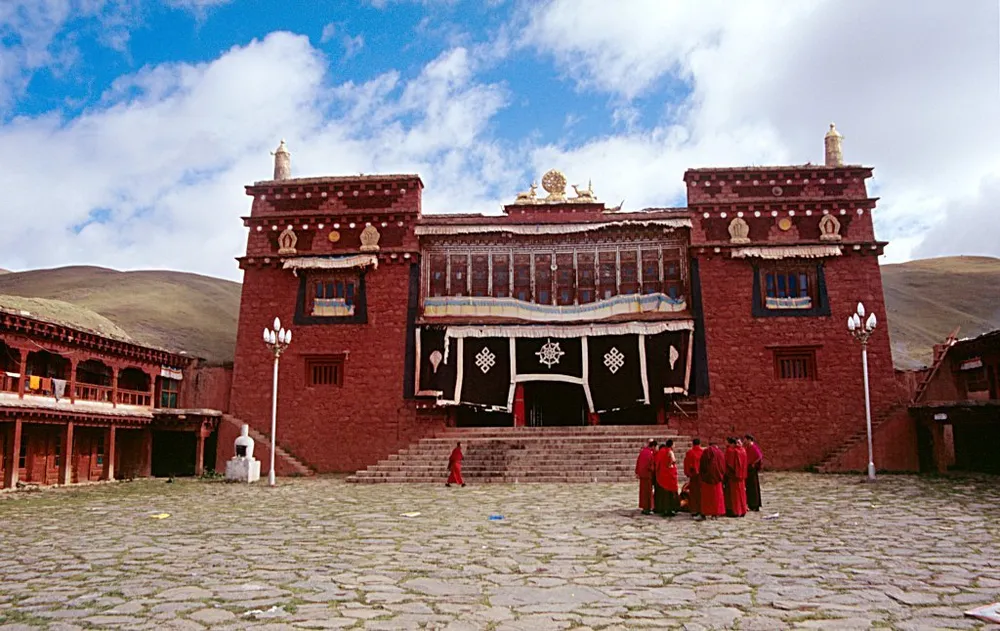
Ganden Thubchen Choekhorling Monastery (Lithang Gompa; Litangsi). The monastery is just on the northern edge of town and belongs to the Gelukpa sect of Tibetan Buddhists. In 1956 the monastery came under siege and them bombing from the People's Liberation Army, following resistance to the attempt to impose communist rule and reforms in Kham. This was a critical turning point in the Tibetan uprising, when some Khampa decided as a result to begin guerrilla warfare. Other monasteries in the region may have similar histories- eg at Xiangcheng there a lot of ex-monastic rubble - but where they did not play such an important historical role as a specific site, this is harder to uncover. What you see is therefore substantially reconstructed, as much of the monastery was destroyed. Monasteries were also devastated by the Han during the cultural revolution. As usual, you are not allowed to take photographs of holy relics inside. The friendly monks will guide you through the main buildings, including some breathtaking views from the temple roofs. The monastery was founded in 1580 by the third Dalai Lama Sonam Gyatso on the site of an older Bön-monastery. There are three main temples in the compound, of which one is under construction. The oldest seems to be the one on top of the hill, still featuring the wooden construction of the upper rim of the buildings. Inside, you can view several chambers and a bedroom in which the 7th Dalai Lama is said to have resided. Many more famous and influential personal figures were born here, including the 7th Dalai Lama, 10th Dalai Lama, the most influential Zebutsundaba Lama of Mogonia, the 7th Gyamuyang Lama, the 7th, 8th and 9th Pabalha living Buddha of Chamdo monastery and the 1st, 2nd and 3rd Xianggen living Buddha. Jiage Shenshan Lamasery. A small temple around 18 km out of town on the road to Daocheng. The lamasery is at the base of a holy cliff which it is possible to walk up. The cliff is supposed to have naturally occurring images
Do
The annual horse racing festival was banned since the 2008 Tibetan riots, but is back on from 2018 on. In 2018, it took place in the beginning of August. It's an easy hour's walk from town, and there are also free shuttles. In addition to the riding, there's traditional dancing. There appeared to be hundreds of riders there. Hike to the surrounding hills to get a view of the outstretched valley including a visit to the sacred "sky burial" grounds. You will find yourself among the remains of many departed making for a strange and unusual experience. Use utmost respect while visiting the grounds. They are marked by large prayer flags. Hot Springs (about 7 km west of town (in the direction of Batang)). Some guesthouses can arrange tours to go there, or just hail a taxi, Or just hitch Hike There. There are indoor tile bathtubs where you can bathe in privacy. The baths are dingy and muddy and not much of a visual experience, but may be enjoyable for their therapeutic effect. You can also find some hot water in open streams however it's not very deep and not really suitable for a good soak. One person ¥20, room ¥40. A popular activity among Chinese tourists is to dress up in traditional Tibetan clothing and have a photographer follow them around the historic part of Litang.
Buy
Typical Tibetan clothing and jewellery and accessories needed by the herdsmen frequenting the town are available in small shops downtown. Supermarkets on main-street sell food and toiletries, you can also buy bottles of beer and decent Chinese wine to make up your own nightlife. In the market you can buy sliced-and-dried apples and pears for a healthy snack.
Eat
Plenty of small restaurants are to be found on the main road, some with English menus. Prices are generally higher than in Chengdu, since everything has to "imported".
Tian Tian Restaurant (across the street from the Crane Guesthouse), ☏ +8
Overview adapted from Wikipedia, travel guide fromWikivoyage (CC BY-SA). Photography via Wikimedia Commons.