
Fujian Tulou sites
People's Republic of China · Asia
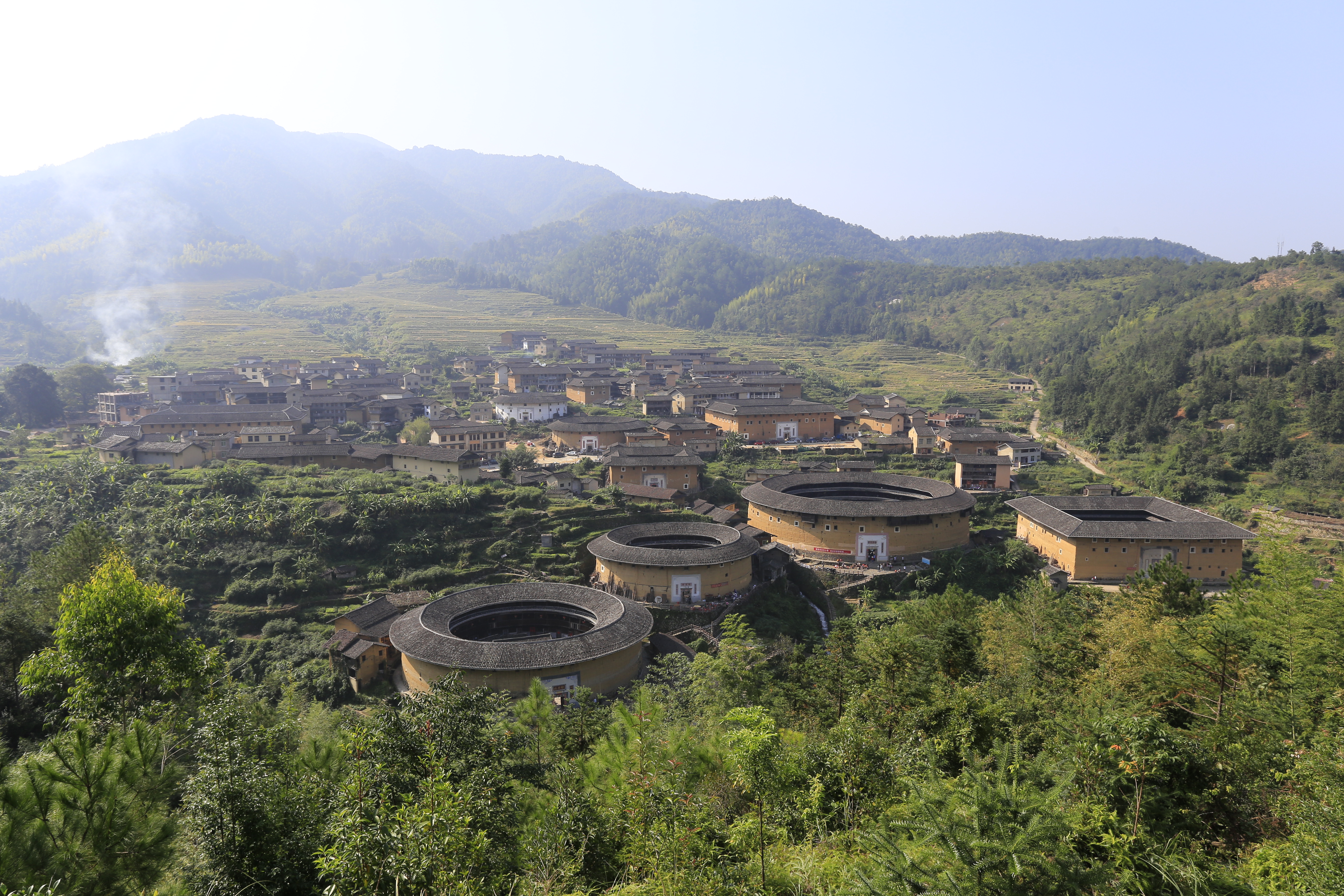
About Fujian Tulou sites
The Fujian tulou, also known as Hakka tulou, Hakka earth houses or roundhouses, are rural dwellings unique to the Hakka people in the mountainous areas in southeastern China. There are also toulou in Guangdong and Guangxi, but the UNESCO World Heritage Site for toulou is 46 buildings in Fujian.
A tulou is usually a large, enclosed and fortified earth building, most commonly rectangular or circular, with very thick earth walls between three and five stories high. Traditionally, tulou have housed an entire clan with up to 800 people. Smaller interior buildings are often enclosed by these huge peripheral walls which can contain halls, storehouses, wells and living areas, the whole structure resembling a small fortified city.
Most of the notable Fujian tulou are in Yongding County and Nanjing County in southern Fujian and this travel guide will provide information on visiting them.
Fujian Tulou sites travel guide
Understand
Hakka (Kèjiā; in Mandarin) translates as "guest families"; they are people who migrated to southern China — Guangdong, Fujian, Jiangxi, Hunan, Hainan, Guangxi and Sichuan — some centuries back because of various wars and other troubles in the north. There are about 80 million Hakka spread out over those provinces and among overseas Chinese; in China they mainly inhabit relatively isolated mountain regions — the fertile valleys were already taken when they arrived — and Yongding is part of such a region. They have their own language, called Hakka in English and kèjiā huà in Mandarin. A tulou is a structure where a number of residences are built inside a single fortified compound. Hakka people have been building these since the 12th century, and in the last couple of centuries some of their non-Hakka neighbors have built some as well. There are now more than 20,000 of them in this district and adjacent areas. The Hakkas have a tradition of building fortified residences due to the fact that they were frequently at war with their non-Hakka neighbors prior to the modern era. The people in the area are friendly, tourist infrastructure is minimal, and the countryside is extremely beautiful - which makes for a very pleasant contrast with other touristed rural areas in China. Tulou generally housed a whole clan (a few dozen households; up to 800 people) and are three to five floors high; most are circular, up to about 70 m (200-odd feet) in diameter. They were designed for easy defense; you can see the openings for archers or riflemen on the upper floors but lower floors have no windows. The walls are typically a mixture of packed earth, lime and straw and about 150 cm (5 feet) thick, or a bit more. Other materials including stone, brick and bamboo are also sometimes used. There are usually only one or two gates, thick oak covered with steel plates, and there is a well and food storage to withstand a siege if necessary. Most of these tulou are still in use, but the area
Getting there
The easiest and most convenient way to get to these tulou is from Xiamen or Longyan by a direct bus. From Xiamen: from 1 Wucun Coach Station. From here you can take a direct bus to the Yunshuiyao Tulou Cluster. From Nanjiang: bus number 6 (¥10) brings you to the Park entrance. From there you can take a "Park bus" to Taxia or directly to the Tianluokeng Tulou Cluster (¥15). All buses arrive at 2 Liulian/Tulou bus station which is also frequently referred to as "Tulou Station", and is next to the Hukeng/Hongkeng tulou cluster.
From Xiamen Direct:
From Xiamen, there are two direct buses per day to Liulian/Tulou bus station - at 08:40 and early afternoon from Wucun Coach Station, next to the Xiamen Railway Station, ticket costs ¥64 as of 2017. There are also seven buses to Yongding that depart from 07:10-16:00 every day from the Fanghu Bus Station. All buses pass the villages of Gaobei and Liulian which are convenient bases for exploring tulou. It takes around 3 hours to travel from Xiamen to Liulian. Xiamen has multiple bus stations, so pay close attention to the station name. Transfer:
There is also a frequent bus service from Xiamen to Longyan, but you will have to transfer buses in Longyan (see below). The bullet trains do the Xiamen North-Longyan trip in less than 1 hr 15 min with greater comfort but higher cost. The fast trains also arrive at Longyan from the south Shantou or even Shenzhen. From either train stations buses and mini-vans are available to take you to tulou.
From Longyan Longyan can easily be reached by high-speed train from many cities in China, including Shanghai, Fuzhou and Xiamen. There are hourly direct busses from Longyan to the Liulian/Tulou bus station every day, leaving between 07:00 and 17:00 mostly from Longyan Bus Station, but some also from Longyan Transport Center Station and Tourism Distribution Station. The exact schedule can be found on www.jt2345.com (Chinese language only). Th
Getting around
The best way to see the different tulou is by private taxi or motorbike. Your guesthouse can help organize this for you, or else just walk around and some local will come up offering their service. Prices range from ¥100 to ¥120 for a half-day tour. Be sure to negotiate a price before the tour. Most tours allow you to choose 4 or 5 tulou to visit and a car with driver, who also acts as impromptu guide is ¥200, (2011 pricing). A motorbike with rider is ¥120 and would therefore be expensive and uncomfortable if there are two or more of you. You are not allowed to rent or ride a motorbike. While you will not be hurried, starting the tour at 07:00 will mean you will be back at your lodging well before lunch time. Just select one from the menu and you are on your way. As of January 2019, official taxis are rare to non-existent on the streets. Services such as Didi, that can be used elsewhere in China to order taxis, are also non-functional in this rural area. Mountain bikes are also available for rent from different places. Ask your guest house if they privide the service, otherwise head over to Fuyu Building in Hongkeng (see "Sleep") and rent one from the owner there. The distances between tulou clusters are not too large, going from Hongkeng to Gaotou takes about 25 minutes by bike. It is fairly easy to arrange a tour with a guide who can serve as translator; you can either join a tour group or hire a guide for you own group, though hiring your own guide will be relatively expensive for a single person or couple. Many travel agents in Xiamen offer such tours. Some of the Xiamen companies will do built-to-order itineraries, and Fuzhou-based Amazing China does those anywhere in China. The main advantage of having a guide is that they can explain many details about the local culture that you'd miss by visiting alone. From Taxia, to visit the Yuanglou Tulou (3 km) and the Tianluokeng Tulou Cluster (7 km) you can walk, hitch-hike or take the park bus. Notice that the park b
See
The UNESCO World Heritage List entry for Fujian Tulou includes 46 buildings at ten locations, mostly but not all in this district. There are also many others scattered in between and around the main attractions. The main clusters are, in this order:
1 Hukeng/Hongkeng Tulou Cluster Scenic Spot, Hukeng (across the street from the Tulou Bus Station in Liulian), ☏ +86 597 3256222. This site contains some beautiful tulou of different shapes - round, square, and U-shaped. Zhencheng Lou is the largest and Rusheng Lou is the smallest tulou. For the real story, though, seek out the smaller tulou, where family life still abounds. A point to note is that Zhencheng Lou is the government showcase unit and is therefore padded up for touristy appeal. Those who know avoid the place, simply because everything looks so spick and span. However, many families do live in the tulous, and before and after the tour busses leave it is a quiet and lovely place to explore. Its rear gate is w
Overview adapted from Wikipedia, travel guide fromWikivoyage (CC BY-SA). Photography via Wikimedia Commons.