
Forillon National Park
Canada · Americas
About Forillon National Park
You'll find Forillon National Park of Canada (French: Parc national du Canada Forillon) at the final Land's End of Quebec's Gaspé Peninsula, where the mighty Chic-Choc Mountains collide head-on with the sea. Its unique landscape — an intoxicating juxtaposition of forests, mountains, and shore — means Forillon is a varied place that wears many hats. For hikers and nature lovers, there are nearly 72 km (45 miles) of trails that pass through ten distinct ecosystems, each with a cornucopia of diverse plant and animal life. If getting out on the water is your game, there are whale watching cruises, sea kayaking and paddleboarding excursions — or perhaps you'd rather just bask in the warm, shallow waters of Penouille Beach. Even history buffs have a place at Forillon's table, with a beautifully preserved 19th-century fishing village that pays homage to the hardworking families of old that made their living off the rich bounty of the sea.
Forillon National Park travel guide
Understand
Located at the far northeastern extremity of the Gaspé Peninsula, Forillon National Park is a roughly triangular expanse of 242 km² (94 square miles) sandwiched between Gaspé Bay and the St. Lawrence Estuary. The Canadian national park is contained entirely within the municipality of Gaspé, and the main entrance is only 15 minutes by car from the town centre.
History For several millennia before the arrival of Europeans, what is now Forillon National Park was known to the local Mi'kmaq people (and; earlier; the rival Mohawks as well) as a fertile hunting and fishing ground. As well, 1 La Penouille — a long, rocky sand spit extending off the south shore of the park into Gaspé Bay — was a source of stone used to produce arrowheads and other tools, with archaeological excavations unearthing chipped rock, fire pits, and pottery dating back as far as 600 BC. Although the cod that once teemed in the adjacent Gulf of St. Lawrence attracted a motley mixture of Basque, Spanish, Portuguese, and French fishermen to the region beginning shortly after Columbus' voyage, the first European to extensively explore the region around Forillon was Jacques Cartier, who, in 1534, sailed past Cap Gaspé and briefly anchored in Gaspé Bay to wait out a passing storm, before coming ashore in what's now the city of Gaspé to claim the entire region for the French crown: the birth of the colony of New France.
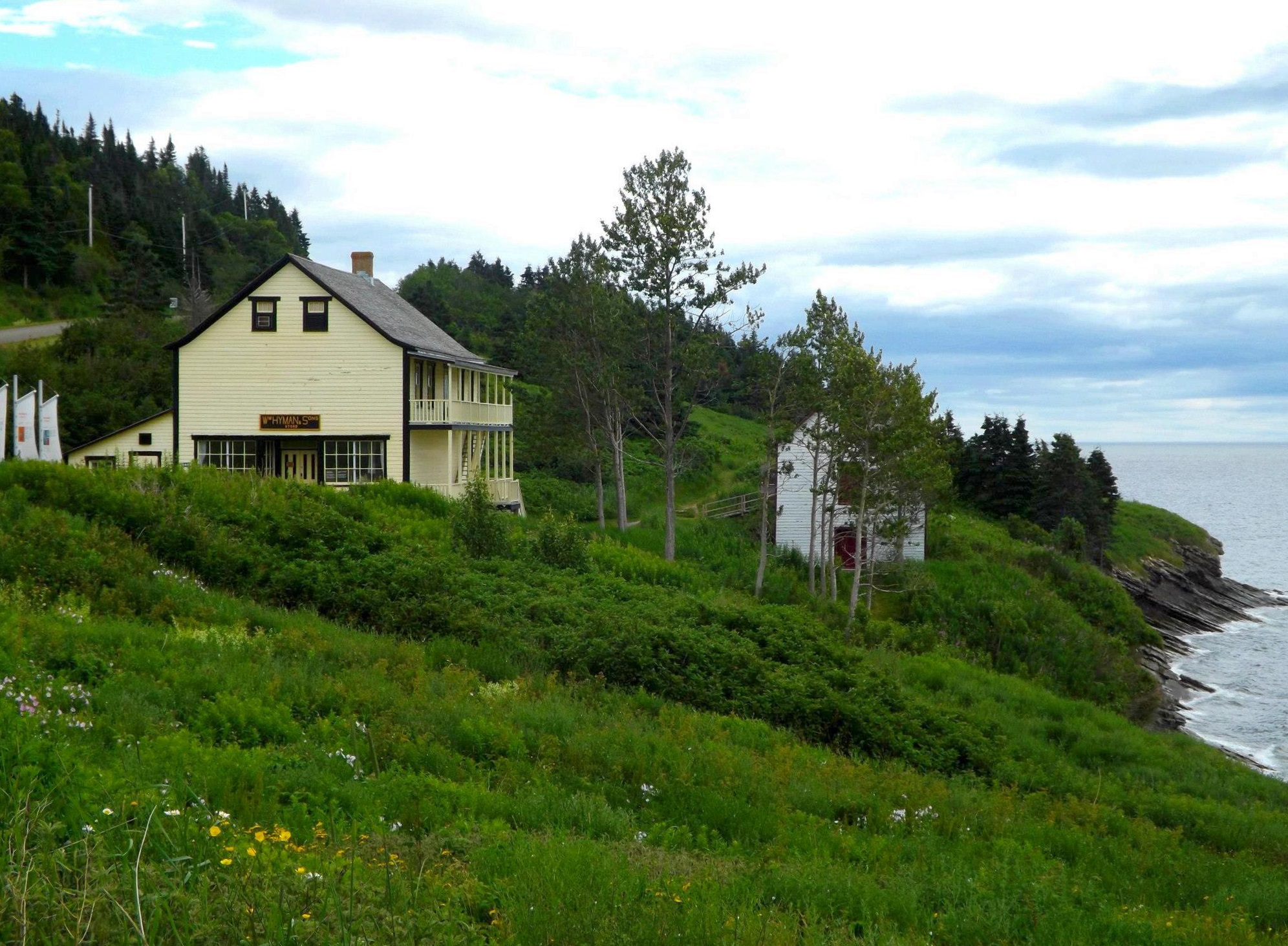
Despite European colonial ambitions and the enduring popularity of the surrounding waters with fishermen, it wasn't until two hundred years after Cartier's voyage — by which time Great Britain had conquered all of France's colonial holdings in what is now Canada — that the first permanent European settlements on the Gaspé Peninsula itself were established. The largest village located within what is now Forillon was Grande-Grave, which thrived in the 19th century as a fish processing centre and site of the main offices of William Hyman and Sons. Grande-Grave was named for its large pebbl
Getting there
By car As elsewhere in the Gaspé Peninsula, the main road to and from Forillon is Provincial Route 132, a lasso-shaped route that circumnavigates the entire peninsula. If, like most visitors, you're arriving from the direction of Montreal or Quebec City, take Autoroute 20 (A-20) eastbound to the end of the road at Trois-Pistoles, where you'll pick up Route 132 heading toward the Gaspé. Forillon is 915 km (570 miles) from Montreal and 700 km (430 miles) from Quebec City — a 9½-hour and 7-hour drive respectively, assuming ideal traffic conditions — and stunning scenery abounds, especially the closer you get to the park. If you're arriving from the Maritimes or certain parts of eastern New England, the route through New Brunswick may be a more direct alternative. Take New Brunswick Provincial Route 17 to Campbellton, then cross the bridge into Quebec where you'll pick up Route 132 headed east through the Chaleur Bay region and Gaspé. Forillon is a little over four hours past the bridge, a distance of about 325 km (200 miles). Forillon's main entrance is located in the southern sector of the park at La Penouille, about 19 km (12 miles) from downtown Gaspé via Route 132 ouest (west). From there, it's another 14 km (9 miles) via Route 132 and Boulevard de Grande-Grave to the tollbooth at Petit-Gaspé, where you pay the park entrance fee. There's also a secondary entrance and tollbooth in the northern sector at Cap-des-Rosiers, which may be more useful to those travelling along the south shore of the St. Lawrence Estuary without stopping in Gaspé first.
By plane In most cases, taking a flight to Forillon means landing at Pierre Elliott Trudeau International Airport (Aéroport international Pierre-Elliott-Trudeau) (YUL IATA) in Montreal or Jean Lesage International Airport (Aéroport international Jean-Lesage) (YQB IATA) in Quebec City, then continuing by car via A-20 and Route 132. Another option is to hop a connecting flight on Air Canada Express from either of those tw
Getting around
Being a relatively small park, getting from place to place within Forillon is a fairly straightforward proposition. With the exception of long-distance hikers and cyclists (q.v. the On foot and By bike sections above; respectively), the vast majority of visitors to Forillon arrive at and travel through the park by car. Route 132 is the main artery though the park for cars: it enters the park at its northwest corner and runs parallel to the St. Lawrence Estuary as far as Cap-des-Rosiers, then cuts across the interior of the park in a hilly zigzag along the Montée Laurencelle before finally reaching the shore of Gaspé Bay at D'Aiguillon, whereupon it makes a sharp turn back toward Gaspé. If you're driving Route 132 in this direction, signs will say est (east), though only on the part along the St. Lawrence Estuary will you actually be heading eastward. As well, Provincial Route 197 runs from Rivière-au-Renard south to Saint-Majorique, marking the western boundary of the national park, and Boulevard de Grande-Grave branches off Route 132 at D'Aiguillon, passing through Grande-Grave and ending in a cul-de-sac at L'Anse-aux-Amérindiens, with access to the Les Graves trail to Cap Gaspé. Parking lots can be found next to the interpretation centres at La Penouille and Cap-des-Rosiers, as well as at Grande-Grave Wharf, Fort Peninsula, L'Anse-aux-Amérindiens, and L'Anse-au-Griffon near the north park entrance.
See
Grande-Grave Heritage Site (Site patrimonial de Grande-Grave) Parks Canada has restored many of the homes and other buildings that once made up the fishing village of Grande-Grave. Today, they serve as museums whose exhibits cover the economic importance of the Gulf of St. Lawrence cod fishery and the daily life of area residents of old.
1 Blanchette House (Maison Blanchette), Boulevard de Grande-Grave, L'Anse-Blanchette. Jun 20-Sep 7: daily 10:00-17:00; Sep 8-13: daily 10:00-16:00. Built in 1901 and now listed on the Canadian Register of Historic Places, this brightly-colored cottage was once the home of the Blanchette family, a typical Gaspesian household of the day whose patriarch, Xavier, made his living catching, drying and selling the cod he caught in the waters of Gaspé Bay and the Gulf of St. Lawrence. The Blanchette House has been painstakingly restored inside and out with rooms furnished in authentic early-20th century style, and it's staffed daily in season by tour guides in period costume who'll lead you through the house, fish shed, and woodshed. Tours conclude in the barn, where the short interpretive video, "We Always Looked to the Sea" (On regardait toujours vers la mer), is screened continuously. (updated Aug 2015)
2 Dolbel-Roberts House (Maison Dolbel-Roberts), Boulevard de Grande-Grave, Grande-Grave. Jun 20-Sep 7: daily 11:00-17:00. Home to successive generations of the Dolbel and Roberts families from 1915 until 1970, this restored building is now a museum whose permanent exhibit, "Gaspesians from Land's End" (Ces Gaspésiens du
Overview adapted from Wikipedia, travel guide fromWikivoyage (CC BY-SA). Photography via Wikimedia Commons.