
Ephesus
Kingdom of Pergamon · Other
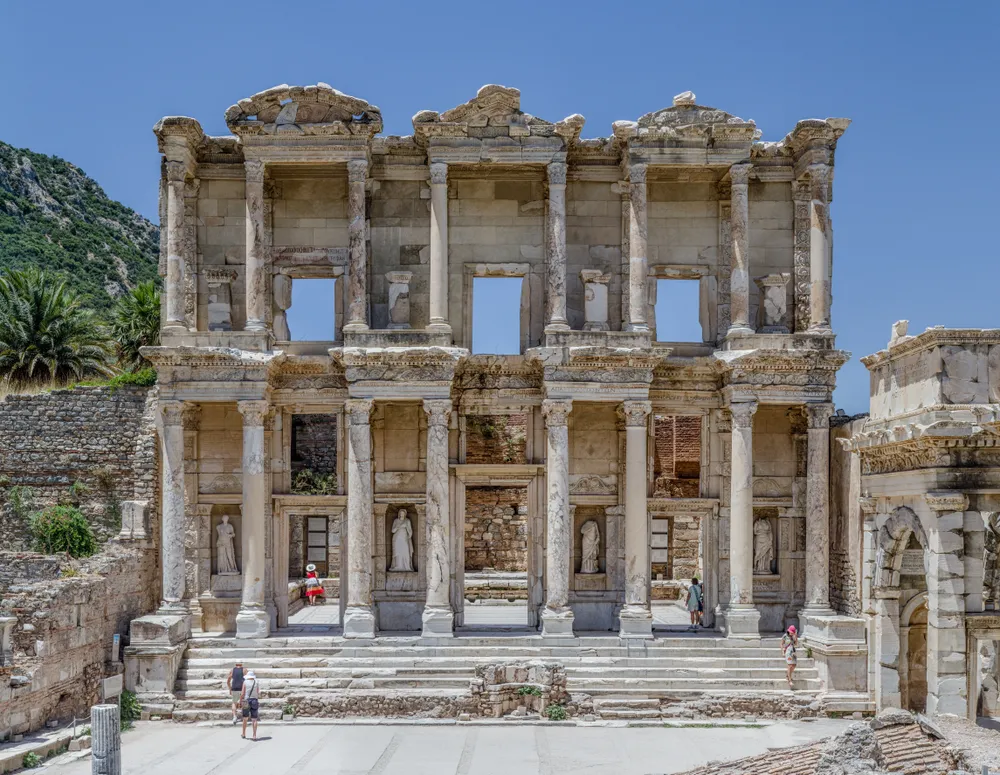
About Ephesus
Ephesus (Turkish: Efes) is a UNESCO World Heritage Site with magnificent Roman ruins. It's in the Central Aegean region of Turkey 4 km west of Selçuk and 19 km northeast of the beach resort of Kuşadası.
This page only describes features within the ticketted area of Ephesus or right by its gates. That city began on the site of present-day Selçuk, where the museum holds antiquities found here. The Selçuk page also describes outlying sites such as the House of the Virgin Mary.
Ephesus travel guide
Understand
The city of Ephesus can be traced back to the 10th century BC, and human settlement here is thousands of years older than that. The river was navigable from the sea, and a trading port grew up at Selçuk 4 km east, which may have relocated from time to time as the river meandered in its lower course. Its estuary was a stinking midden-cum-malarial swamp, so from about 290 BC the city migrated west to its present site. From 129 BC the new Roman regional superpower took over: they began by looting the place but stayed to embellish it, and most of what you see nowadays is their work from 100 BC to 260 AD. The place was wrecked by the Goths in 263 AD but rebuilt, and continued to prosper in the Byzantine Roman era. It was an important centre for early Christianity; St Paul preached here, and Ephesus in 431 AD hosted the Third Ecumenical Council which continued the task of defining orthodoxy and condemning heresy. And they sort-of hosted the Fourth in 449 AD, but that in turn was condemned as heretical by the True Fourth at Chalcedon in 451 and didn't count, unless you were Eastern Orthodox, so the church became divided over how many unifying Councils it had ever held. Meanwhile in the real world the coast retreated, fierce enemies stalked the land, and earthquakes roiled the city. By the 7th century Ephesus had lost its port, its livelihood and value, and declined into a small village. Its stonework was pilfered for re-use but the site was not built over. Serious archaeology and restoration got started from the end of the 19th century and these continue. Ephesus is a year-round site. It has a Mediterranean climate, with hot, dry and sunny summers, with noon temperatures pushing 36-37°C. Always wear sun protection such a big floppy hat even on cloudy days, as a lot of UV penetrates the cloud and there's little shade. Winters are mild and wet, but the site is well-paved so you can dodge the puddles.
Getting there
By dolmuş Dolmuşes run from Selçuk Otogarı to the northern/lower gate every 10-30 min according to season, and cost about €0.50 (8 TL in 2022). They actually connect to Kuşadası along D515, so there's a good dolmuş service here. There are no dolmuşes to the upper/southern gate. To get to Selçuk or Kuşadası see those pages "Get in" for long-distance routes. Both have excellent bus connections, and Selçuk is on the IZBAN suburban railway with trains every hour or two from Izmir.
By taxi Most visitors (including coach tours) explore Ephesus from the southern upper gate: reached by taxi from Selçuk for about €2 (30 TL as of 2022). Leave by the lower gate via dolmuş or another taxi. From Kuşadası a good plan is to negotiate a taxi day-trip, with the driver awaiting you at the lower gate. But many taxis can be found onsite as well.
By tour Since Ephesus is one of Turkey's top sights, tour coaches converge on it from far and wide—you can probably even find a tour starting in Istanbul. (Ignore very cheap or free "tours" - you will be trapped for hours in Uncle Mehmet's souvenir shop then be rushed through Ephesus.) Cruise ships call at Izmir or other nearby ports to bus in their passengers.
By road Independent travellers with their own car can day-trip (though it will be a long day) from any of the Aegean resorts. The site is by the junction of D550 and D515, and well signposted.
On foot You could walk the 4 km from Selçuk to either gate, but you also have a lot of walking to do around the site. Nevertheless, doing one direction by dolmuş (to/from the lower gate) and walking the other, you can make a stop by the 1 Cave of the Seven Sleepers.
Getting around
The grounds of Ephesus are seen entirely on foot, and take 90 min to 2.5 hours (plus 30 min for the Terrace Houses). Pathways are signed clearly and easily navigated. The paving of the main avenue is suitable for wheelchairs and strollers, but with lumpy bits and potholes around ongoing works. This huge site always has ongoing archaeological excavations, maintenance works, and stabilisations after the latest earth tremor or storm, so you might find any individual sight barricaded off. You may enter or exit by either gate, both have parking lots and taxis. However, only the lower/northern gate is served by dolmuşes. If there is not a taxi, ask the closest shopkeeper and they may be able to call one, or the parking lot attendant.
1 Upper Gate (Southern Gate). Entering from the upper gate (like most do), you walk north and downhill, which is easier, so that's what the tour groups do. 2 Lower Gate (Northern Gate). If you enter by the lower gate, it's a gentle gradient up, but you will walk against the general flow. Either way, individual travellers may have enough chances to enjoy gaps between tour groups.
See
Most visitors enter through the Upper Gate, which brings you to an agora (market place), the scrappy Baths of Varius, a stoa (colonnaded walkway) and Odeon (amphitheatre and council meeting place; originally roofed). This would be impressive in any other site, but wait till you see the big one further along. Follow the stoa and crowd past the Prytaneion (meeting place of the city chiefs), Temple of Domitian, statue of Nike, and monument to Memmius grandson of Roman dictator Sulla. Pass through the Gate of Hercules onto Curetes Street descending northwest, the ancient city's main boulevard, which gives way to the following main sites:
2 Fountain of Trajan (Trajan's Nymphaeum). A grand public fountain along this part of the street, astride the main water conduit; its statues have been moved to the Selçuk museum. The water system and fountain were erected from 102 AD by the initiative and personal expense of Claudius Aristion, as the inscription is at pains to have you know. The water was not only for washing and drinking but powered mills, including a sawmill for marble. Aristion at times held just about every great position in the city. He fell foul of political skulduggery but was rehabilitated and was sufficiently esteemed to be buried within the city. (updated Oct 2022) The flat foot. A curious direction sign carved in the street outside the Nymphaeum. Its pictogram reveals that it was pointing the way to a brothel: the House of Pleasure lies that way, but there were others. (At Ephesus you only see the grand stone buildings along main drag; but this was just the nucleus of a sprawl of lesser structures; all the wooden or wattle shibeens; brothels; stables; livestock yards; hostels; workshops and humble dwellings that time has swept away.) The carving is thought to be from life, from someone with modern European shoe size 40, a middle toe longer than the big toe, and pes cavus or "flat foot" - maybe the Bawd or Madame? Various ribald interpretations are possible
Do
Test the acoustics at the Great Theatre, if it's quiet and you're not competing with too many droning tour guides, and preferably with a companion in a back row to signal audibility. Declaim poetry or one of the great speeches from Shakespeare if you don't trust your singing
Overview adapted from Wikipedia, travel guide fromWikivoyage (CC BY-SA). Photography via Wikimedia Commons.