
Edirne
Turkey · Asia
About Edirne
Edirne is the chief city of Eastern Thrace, in the Marmara Region of northwest Turkey. It lies on the gently rolling Thracian plains at the confluence of three rivers, close to the borders with Greece and Bulgaria. Most visitors crossing those borders drive straight on east, or stay on the bus or train, to reach Istanbul. Yet Edirne was for a time the capital of the Ottoman Empire, and continued to be an imperial retreat, adorned with magnificent mosques. It's definitely among the top sights of Turkey.
Edirne travel guide
Understand
History The Thracian settlement of Uskadama was rebuilt from 125 AD by Roman Emperor Hadrian, who (lacking false modesty) named it Hadrianopolis. It was astride a major trade and transport route, and set in a fertile region, so it was frequently fought over, with 16 major battles and sieges during its 1900-year history. Its longest spells of control were as part of the Byzantine Empire, then under the Ottomans. When Sultan Murad I captured Thrace, he turned the city of Adrianople (which he and his people pronounced as "Edirne") into his capital in 1369. Once Byzantium / Constantinople / Istanbul was captured in 1453 the capital moved there, to become the centre of the vast Ottoman Empire. Edirne remained important as a summer palace and imperial retreat, and between 1700 and 1750 it was the fourth-largest city in Europe, with an estimated population of 35,000. But by 1700 that empire was in decline. Austria-Hungary drove the Ottomans out of central Europe; Russia gained control of the Black Sea and sought to seize the Bosphorus and Dardanelles. Edirne's population fled before Russian invasions in 1829 and 1878, which reached the western outskirts of Istanbul. The Balkans were literally "balkanised" - broken up by nationalist movements and wars, and one of those conflicts escalated into World War I, which Turkey joined on the side of Germany. That continued after 1918 with a war with Greece, which became the War of Turkish Independence. The Treaty of Lausanne in 1923 redrew Turkey's borders. Alas for Edirne, these were just west of the city, so much of its hinterlands (even some suburbs) were lost, and trade was stifled across a not-very-friendly border. (See below for the convolutions this caused the railway.) Turkey was neutral in World War II, but just across the river, Nazi flags fluttered over Axis Bulgaria and occupied Greece. Much of the city was then evacuated, and those who couldn't flee suffered cold and famine. Nor was there much reason to return after t
Getting there
By plane Istanbul Airport (IST IATA) has a wide range of direct flights to Europe, Asia and beyond. Istanbul Seyahat bus runs from IST airport to Edirne every two hours for 110 TL single. Otherwise by public transport you have to head into Istanbul city centre then travel out again, but with a hired car you're quickly on the road to Thrace. If you fly into the city's other airport Sabiha Gökçen (SAW IATA), that's Asia-side and you face a congested cross-city journey.
By bus Buses run from Istanbul Esenler station at least hourly, taking 2 to 4 hours non-stop, for a fare of 75 TL. Metro Turizm is the main operator. In normal times buses run round the clock but in early 2021 they cease between midnight and 05:00. Buses also run to Edirne from Çanakkale via the Gallipoli peninsula, Keşan and Uzunköprü. In early 2021 they only run once a day, operated by Isparta. Istanbul Seyahat operates buses to Edirne from IST Airport several times a day making two stops along the way. The trip takes about 2.5 hours and costs about TRY 600. There is excellent WiFi service on board. The 1 bus station in Edirne is 5 km southeast of the centre, junction of D100 and the city bypass. Town buses will take you to city centre. There are no direct buses to Bulgaria. You could take a taxi to Kapikule on the Bulgarian border, where you might be lucky and wave over a bus towards Plovdiv and Sofia. Or walk across the border and take a bus or train from Kapitan Andreevo in Bulgaria.
By train
The train from Bucharest and Sofia to Istanbul runs overnight year-round. The east- and westbound services both arrive at Edirne around 02:00; you're not destined to get much sleep because everyone has to get off at the border for passport and customs checks. See TCDD for tickets. Optima Express is a car-train from Villach in Austria to Edirne two or three times a week April-November, taking 33 hours. Departure days vary. This train enables motorists to avoid the tricky, tiring roads through the Bal
Getting around
The centre is compact, fairly flat and walkable. The outlying districts are within a long walk, but you might prefer to take a taxi or dolmuş at least one way. There are also buses running regularly (about every 10 minutes) from the centre to the Otogar (bus station) and to all outlying districts. To board the bus, you can use a Kent Kart (city card; which can be topped up with credit) or a "Tekli QR Bilet" (one-time QR-code ticket), that are sold at some kiosks (büfe). The fare for one ride, as of August 2025, is 36 TL. Alternatively, you can pay in the bus directly with a credit card, for which the fare is 46 TL, as of May 2026. Bus connections can be found on the moovit app.
See
Downtown
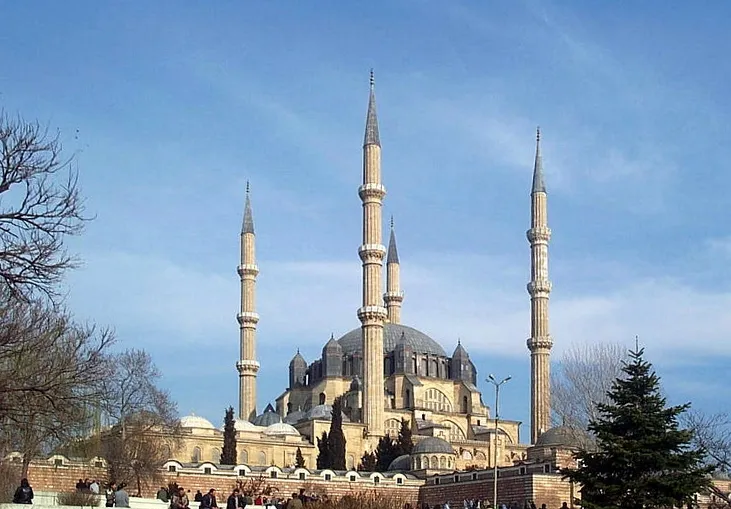
1 Selimiye Mosque (Selimiye Camii), Mimar Sinan Cd. Daily 05:30-23:30. Magnificent mosque that dominates the city skyline, approach from northwest to appreciate the full effect and miss the shops. It's the masterpiece of Mimar Sinan, built 1569-75, and listed as a UNESCO World Heritage Site. The eight pillars supporting the dome are unobtrusive, so the dome hangs over a vast interior space, while 999 windows admit a flood of light. Four delicate fluted minarets soar to 70.89 m, surpassed only by Qutb Minar in Delhi. The interior is decorated with calligraphy and geometrical designs in pink and blue. The inverted tulip decoration, an emblem of Edirne, is said to acknowledge the previous landowner who was reluctant to give up his tulip garden for the mosque to be built. Free. (updated Feb 2021) Arasta Bazaar, if you do want to find the shops, is the covered market along the southwest flank of the mosque. 2 Old Mosque (Eski Cami), Muafakathane Sokak 1. This was built in the 15th century, so it's the oldest and smallest of the city's three imperial mosques. It's a low building with nine domes and two minarets, with striking calligraphy within. Free. (updated Feb 2021) 3 Üç Şerefeli Mosque (Burmalı (Serpent) Mosque). Mosque built 1438-1447, its name refers to the three balconies or galleries on its tallest minaret. The other three minarets are all of different designs. The mosque interior has a colourfully decorated central dome, surrounded by smaller domes in different colour patterns, supported by stately columns. Free. (updated Feb 2021) Macedonian Tower (Makedonya Kulesi) is the crumbling bastion just west of Üç Şerefeli Mosque. The last remnants of the city's Roman walls are here: they were part of the fort established by Hadrian in the 2nd century AD, then extended in the Byzantine 10th century. There were four watchtowers, and this one looked towards Macedonia, though what they were most anxiously watching for was the Bulgarians, or fires taking hold i
Do
Oil-wrestling (yağlı güreş) is practised all over Turkey, but a major competition (which has become the national event) is at Kırkpınar stadium. Wrestlers coat themselves in olive oil then try to grapple their slippery opponent to the ground. Bouts last up to 40 min. There's evidence of the sport from 2650 BC, an
Overview adapted from Wikipedia, travel guide fromWikivoyage (CC BY-SA). Photography via Wikimedia Commons.