
Donghai Island
People's Republic of China · Asia
About Donghai Island
Donghai Island, by the Pacific Ocean, is the fifth largest island in China and largest in Guangdong. Throughout history, it has been a hub of the Maritime Silk Route.
Donghai Island travel guide
Understand
Donghai Island has an area of 286 km2 (110 sq mi) and a shoreline of 160 km (99 mi), its extent is 20 km north–south and 32 km west–east. The island serves as an important crossroads for China’s trade with countries along the Indian Ocean, the Pacific, and Europe. It is also a key gateway for imports and exports in China’s Southwestern Golden Triangle Economic Zone. The Maritime Silk Road has brought cultural exchanges. In the west, the island is connected to the mainland by a long causeway/bridge. The north-central part of the island has a new industrial zone, with a steel mill, an oil refinery, pharmaceutical factories, etc.; it even has a railway connection to the mainland (freight only). The rest of the island, including its south shore, is mostly rural, with fishing villages, aquaculture (shrimp) ponds, and fields of sugar cane, corn, and "lucky bamboo".
Districts Dongshan District blends urban and rural landscapes, traditional local culture and modern development. Dongshan Bridge and Dongshan Square are area landmarks. Min’an Town is famous for its rich historical and cultural heritage, with many local temples and traditional festivals. Major landmarks include Min’an Temple and Min’an Old Street. It's of interest for cultural tourism, local crafts and festivals. Donghao Town boasts beautiful coastal scenery and agricultural landscapes, with charming ocean views, and the Donghao Agricultural Museum. Naozhou Town is a vibrant fishing hub known for its unique seafood cuisine. Its landmarks include Naozhou Harbor and Naozhou Seafood Market.
History Historically, this island served as an important hub for maritime transport and trade due to its strategic location. During the Ming and Qing dynasties, it was known for its fishing and salt industries. In modern times, the island has developed strong petrochemical and tourism industries.
Climate
Donghai Island is a large, flat island. It has a tropical monsoon climate which is warm and humid all year. T
Getting there
Connections by road are via the bridges from Zhanjiang, the main one (and an old parallel one) from Huguang, another from Leizhou.
By bus 1 Dongjian Passenger Station. Several city bus routes from Zhanjiang (mostly from Xiashan; but some also from Chikan) run into Donghai Island, making frequent stops along their routes. Their destinations include Donghai Island Bus Station in Dongshan Town, Dongjian Bus Station in Dongjian, Longhaitian Bus Station near Donghai Beach, and the Dongnan Harbor (where ferries to Naozhou dock). Take a bus from "Xia Mountain - Southeast," "Xia Mountain - Longhaitian," or "Xia Mountain - Min'an" (make sure to inform the driver that you want to go to Donghai Island). You will arrive at the Donghai Island bus terminal, with a fare of 8 yuan. Buses depart every 20 minutes from near the Xia Mountain Railway Station, with a fare of 8 yuan. (updated Dec 2024) 2 Xiashan East Dike Station. No. 32 (Dongti bus station in Xiashan to Dongnan Harbor at the southeastern tip of Donghai Island). (updated Dec 2024) 3 Southeast Wharf. There are also express buses from the mainland (from both bus stations in Zhanjiang; and from Leizhou) to some points in Donghai Island, in particular to the Dongnan Harbor. (updated Dec 2024)
By taxi The distance from Zhanjiang Railway Station to Donghai Island is about 35 km, and the fare is approximately ¥110.
By car Donghai Island has a 6.8-km road connecting the island to Zhanjiang city’s road and rail networks. An old causeway (can be used by bicycles and motorbikes) and the new bridge parallel to it run to Donghai Island from the southern suburbs of Zhanjiang (the Huguang area).
Getting around
By road A 28-km central road connects all parts of the island. Roads like Zhanlin Road, Haiming Road, Taosheng Road, Shugang Road, and Southeast Avenue are all paved.
By train Donghai Island is connected to the mainland via a high-speed railway that has 6 stops on the island. It consists of two parts: from Huanglue to Zhanjiang West, and from Zhanjiang West to the steel factory. The first part starts from the Maozhan Railway Huanglue Station and heads west to Zhanjiang West Station on the Yuehai Railway, a distance of 18 km. The second part starts from Zhanjiang West Station, crosses Tongming Bay, and reaches the Donghai Island steel and refining base and is 40 km long.
See
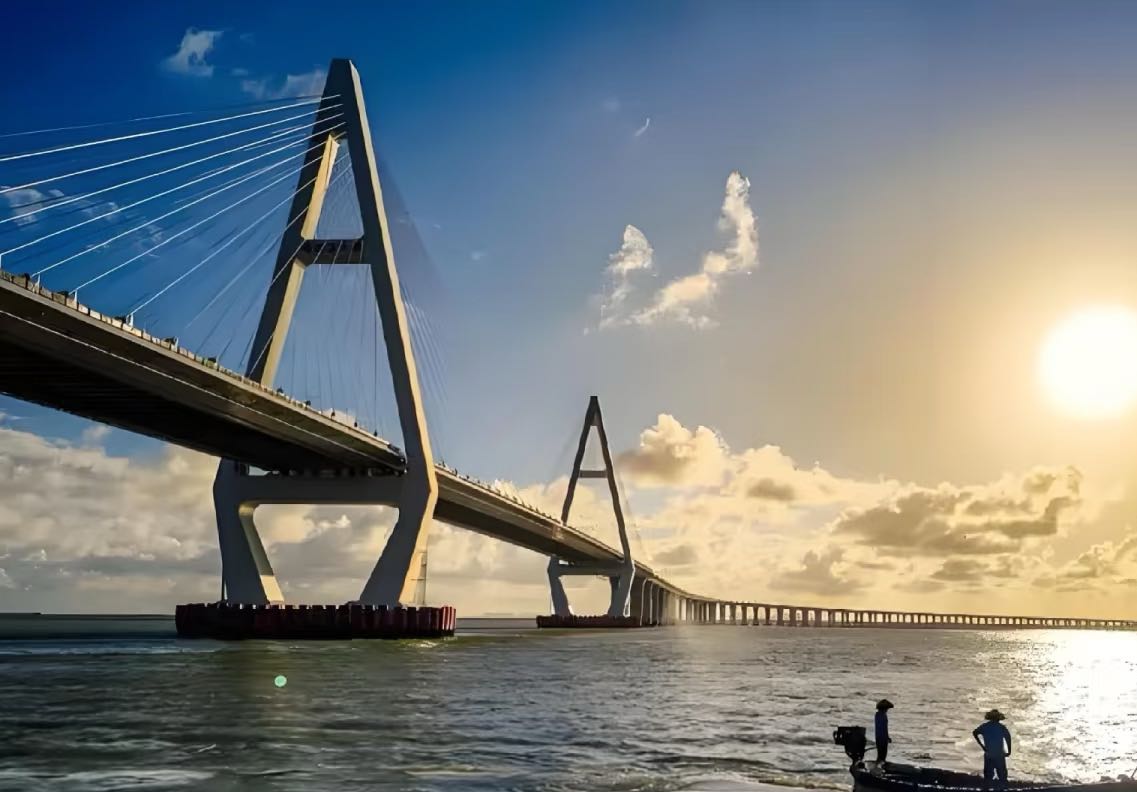
1 Cross-Sea Bridge. The Donghai Island Cross-Sea Bridge is 32.5 km long, one of the longest cross-sea spans in the world. (updated Apr 2025) 2 Longhaitian Tourism Area. Longhaitian is in the eastern part of the island. It is a natural area formed by mountains, valleys, hills, beaches, and green forests. Longhaitian is one of the most remarkable scenic spots in the area. It is believed to have formed from a volcanic eruption in ancient times. Standing at 110 meters, the area is perpetually lush and picturesque. It is said that before the French colonizers took over Guangzhou Bay, the area around Longhaitian was covered in white sand, with only the peaks being reddish clay. On the summit of Longhaitian, there is a temple called the "Gaoshan Gong" temple, carved from a large stone, a delicate piece of craftsmanship. According to legend, when Gaoshan Gong was traveling to the South Sea to attend the Peach Banquet hosted by Guanyin, he could not fly over Longhaitian because of its height. In his frustration, he kicked a large portion of the mountain away, creating the current landscape. Later, Gaoshan Gong stayed in the area. Near the temple, there is a cave with a diameter of one meter and an immeasurable depth. On the mountain, there were figures, drums and gongs, all made from stone. When struck, the stone drum produced a mystical sound. Unfortunately, it was destroyed by the French colonizers who blasted it to build a lighthouse. (updated Dec 2024) 3 Longshuiling. Longshuiling is the gateway for ships entering and exiting Zhanjiang Port, a natural "green marker." Beneath it, there are abandoned military tunnels carved through the mountain, full of clever mechanisms. It is planned to be developed into a multifunctional entertainment spot called the "Underground Dragon Palace." Longshuiling is not high, and compared to the average natural elevation of about 20 meters on Donghai Island, it gives the feeling of ascending Longshuiling and looking
Do
Festivals
Donghai Island God Parade Activities (Min’an Town). Every year on the 4th day of the Lunar New Year. In Zhanjiang, many towns and villages share a tradition of processions known as “You Shen” (God Parade), a custom deeply rooted in the region’s culture. Activities like piercing with “Ling Jian” (divine arrows) or walking on “Zhang” (rods) are part of these vibrant rituals. Commonly referred to as the “Nian Li” (Annual Festival), this unique tradition in western Guangdong centers on communal worship and celebration. The event rotates across different areas
Overview adapted from Wikipedia, travel guide fromWikivoyage (CC BY-SA). Photography via Wikimedia Commons.