
Dali
People's Republic of China · Asia
About Dali
Dali (Dàlǐ) is a city in Yunnan Province in China famous for its old town and handicrafts.
Dali travel guide
Understand
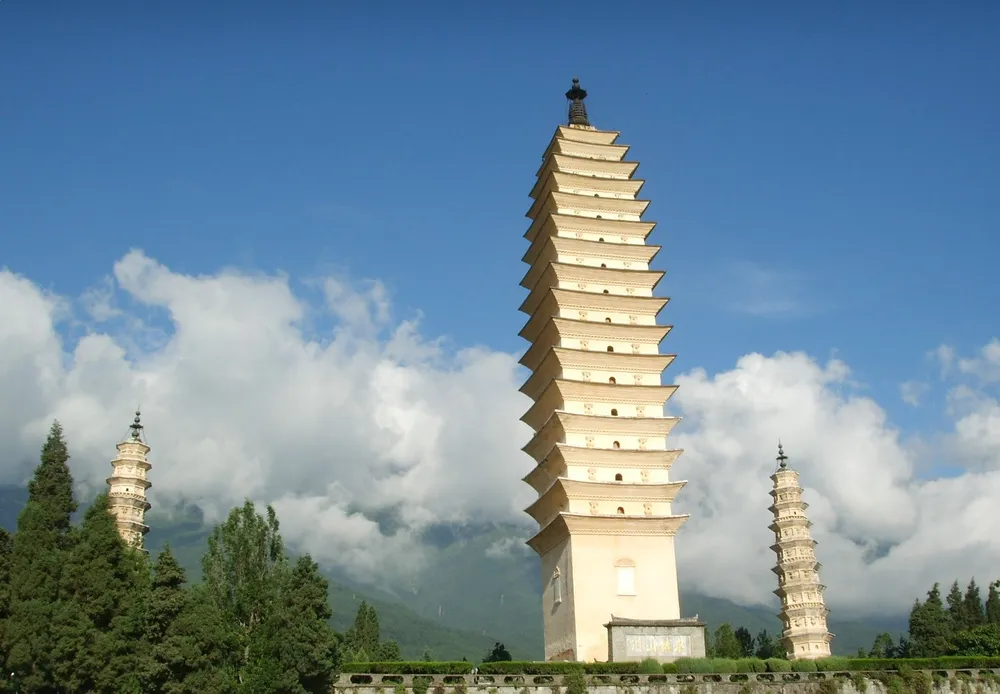
Dali is a popular tourist destination for domestic Chinese tourists, one of the string of towns described in Yunnan tourist trail leading up to the beautiful Tiger Leaping Gorge. It is a medium-sized city of 650,000 but its tourist draw is the "Old Town.". Like many Chinese tourist destinations, the old town, which has architecture that dates back to the Ming dynasty, has been extensively renovated, rebuilt and modernized, including newly constructed city walls and gates. You can still see the remnants of the old wall in the form of long mounds that surround the old city, but only part of the actual city wall survives, in the areas next to the north and south gate. The old town section of Dali is sandwiched between two multi-lane highways. While it lacks the authentic rustic charm of other old Chinese cities (e.g. Pingyao or even Lijiang) and much of the old town has been renovated and is devoted to tacky knick-knack stores for Chinese tourists, it does sit in the shadow of a beautiful mountain range, the Cangshan and is close to the large Erhai lake. There is an expensive cable car (¥90) that you can take to reach the top and there are some hiking paths that offer beautiful views of Lake Erhai. In addition to the old town and various traditional villages scattered around the lake, Dali now has a new town comprising of modern buildings, 20-story residential towers, and a Wal-Mart. The train station is located in the modern part of the city and quite some distance from the old town. You can also see factories belching emissions on the other side of Lake Erhai.
History In 738 the Nanzhao Kingdom was established; the original capital of the Nanzhao Kingdom was located in Weishan (within Dali Prefecture) and later moved to sites around Erhai Lake. The territory conquered was quite substantial; covered a large area of Yunnan and northern Burma, and parts of what are now Sichuan and Guizhou. The kingdom survived almost 200 years and had 13 kings before collapsin
Getting there
By bus Buses from Kunming West Bus Station take about 4½ hours and cost around ¥100 for an ordinary bus (as of March 2019) and around ¥130 for an express luxury bus, and will bring you to Xiaguan (Dali New City). Some buses go to Dali, too, so check with the driver. There are three different bus stations in Xiaguan. From nearby the bus station you should be able to take bus 12 (¥2 as of March 2019) and then transfer to bus 8 (¥3 as of March 2019) or bus 4 (¥2), 45 minutes (approx. 18 km) to Dali Old Town 13 km to the north (Bus 4 also runs through the town). It's also possible to catch a white mini-bus on Jianshe Lu that run between Xiaguan and Dali, there's usually a white sign displayed inside the front wind shield that reads (<->) in Chinese. The cost for the mini-bus is ¥3 per person. Taxi fare between Xiaguan and Dali should be around ¥40. If the expressway is closed or under construction the bus may take the more scenic route akin to the notorious "road of death" in Bolivia, though paved. Buses coming south from Lijiang are about ¥60-80 and stop outside the old town, from where it is possible to get a taxi or walk to the main guesthouses. You can save about ¥20 on the Lijiang bus by hailing one on the highway east of the old town. There is a bus service to Xiaguan from Jinghong, Xishuangbanna prefecture, which has buses running at 17:00 and 21:30, possibly earlier too. The ticket price is ¥195 and the journey was about 17 hours. The bus used on this route is a sleeper bus so you get a fairly comfortably bed and a blanket. This service may be useful for people who have arrived in China from northern Laos, e.g. Luang Namtha.
By train High-speed trains leave from Kunming and Kunming South railway stations to Dali station (in Dali New City) every 30 minutes, and take two hours to reach Dali, running at speeds of up to 200 km/h. Once you've arrived at the train station, take bus 8 to the old town for ¥3 (2019) from just outside the station, taking about an
Getting around
Dali Old Town is small enough to get around on foot, and being laid out in a grid format it is relatively easy to navigate. The major landmarks are the South and North Gates with Fuxing Road running between them, and Yangren Street (Westerner's Street) lined with cafés and tourist shops. City maps are readily available for around ¥5 but tend not to follow the usual north-at-the-top standard because the natural orientation of someone in Dali is to look towards the huge looming Cangs Mountain which run north-south next to the city. As you look at the mountains and face west, the lake is at your back, or east. This method of orientation makes even more sense when you realize that the entire town gently slopes from the mountains to the lake, making those two landmarks a natural way to find your bearings. Bikes are available at many guesthouses and rental huts around town and cost ¥5-40 per day. Bikes vary greatly in quality so shop around for the best deal. The Chinese brands Merida and Giant are among the better ones to consider. Electric scooters and electric micro cars (smaller than a Smart) seem to be license-less, hence available for renting, no driving license required. E-scooters go for different rates depending on the range of the battery, ranging from ¥30 to just bike around the vicinity of the old city to ¥80 for enough battery to comfortably ride all the way around Erhai Lake. The e-car seems to go for about ¥140, and has a range of 100 km. The e-taxis in Dali Old Town generally cost ¥5 for under 3 km (though most drivers will ask for ¥10). For other locations outside the old town, all prices are negotiable. A taxi to Dali New City will cost around ¥40. In addition to the Old Town, Dali is a Prefecture of over 10,000 km2. A whole range of destinations exist within the Prefecture that are perfect for the adventurous traveller. All are relatively easily accessible from either Dali Old Town or Dali New City, the major city 13 km to the south. A lot of useful
See
Old Town Foreigner Street In the ancient city of Dali," the road" in the beginning of Yunnan people against Yuan Shikai proclaimed himself Emperor, named after the war of asylum. The road east-west, 1000 meters long, 7 meters wide, green stone pavement. Dali of Foreigner's Street is on the road in the West Dali section. City Wall: Take a walk in Dali Old Town's city wall for an elevated view on the town. Access from the Southern Gate. Wuhua-Tower: Climb the stairs to the old gate-looking tower for a nice view. It's in the center of the pedestrian street of Dali Old Town. Entry free of charge. The tower is in accessible (as of March 2019). Dali Municipal Museum. summer 08:30-17:30, winter 09:00-17:00. Mostly ancient steles, gravestones, and the like. Free. (updated May 2019) 1 Puxian Temple (Pǔxián Sì). An authentic, non-touristy temple. (updated May 2019)
Cangshan Mountains There are two accessible "peaks" of mountain you can choose: First, the 2500-m alt
Overview adapted from Wikipedia, travel guide fromWikivoyage (CC BY-SA). Photography via Wikimedia Commons.