
City
Australia · Oceania
About City
Canberra's downtown area, Civic (officially City) is what is now Walter Burley Griffin's design for a Civic Centre. Established in 1927, this is Canberra's central business district and one of its oldest centres, surrounded by the rest of North Canberra, Acton and Lake Burley Griffin.
Civic is not particularly large and has few tall sky-rise buildings, shockingly few for a city of 450,000. However, it's the only CBD of its size located in inland Australia; the next closest you could find is Toowoomba CBD.
Civic is known by a handful of other names: City, Canberra CBD, or Canberra City Centre; for simplicity, Wikivoyage has chosen to go with "Civic". To add to the merrymaking of inconsistent naming, the sign designers also couldn't agree on a name for consistency.
City travel guide
Understand
History
Civic was established in 1927, 14 years after the city was founded. Before Civic was established, there wasn't a clear town or city centre; the closest that resembled anything like one was Queanbeyan town centre, but Queanbeyan is in NSW, not in the ACT. The area encompasses Burley Griffin's original plan for a Civic Centre with nearby Russell planned to be Canberra's vibrant "Market Centre". However, Russell is now the headquarters of the Australian Defence Force (ADF), resulting in an unexpected abundance of markets and malls in Civic, more than what was anticipated in Burley Griffin's original plan. Due to Civic's constraints with height restrictions and limited space, many larger stores and markets have opted to move to Belconnen, Canberra's second largest town centre (excluding Queanbeyan). As Civic approaches its centenary, it remains a relatively new central business district. Whilst you'll find an abundance of historic buildings and sites in the CBDs of Sydney, Melbourne, Brisbane or even tiny little Hobart, there are very few in Civic; many would fail the criteria for being "historic" in Tasmania, perhaps even Sydney, and certainly lacks the antiquity of the Old World (most of it; at least). The scarcity of true historic buildings have elevated the prominence of the few that are considered historic in a Canberran context. Most of Canberra's important government buildings are in South Canberra, whilst museums are scattered throughout Canberra, leaving only one in Civic. Canberrans also don't tend to pride in these buildings; the Sydney building, for example, may look good on the outside but are in a state of despair on the inside. Despite this, there are only two important historic buildings in Civic, the Sydney and Melbourne buildings — they have their problems, but they do contribute to Civic's architectural character. Contrary to all the negativity with Canberra's historic sites, there is one thing that Canberra has that most other Australian
Getting there
As with any city's downtown area, Civic is well-connected by both road and public transit.
By bus
All buses to Civic stop at one interchange, 1 City Interchange; one of few in Canberra to have both bus and light rail services. Being in the centre of Canberra, many lines connect to the rest of Canberra. The ideal way to get into Civic by bus is using these R-routes (i.e.; the main important routes), which are as follows:
R2 from Belconnen to the northwest and the Canberra Outlet Centre in Fyshwick to the southeast. These operate at 12-minute frequencies until the 7:12PM service from Fyshwick. R3 from Canberra Airport to the east, and Spence/Belconnen to the northwest. R4 from Belconnen to the northwest, and Tuggeranong passing South Canberra to the south. R5 from Lanyon Marketplace in Tuggeranong in the south, terminating in Civic. R6 from Woden in the southwest via Barton. If you're arriving from Canberra Railway Station in Kingston, South Canberra, then use this rapid route. R7 from Weston Creek also from the southwest. R10 from Molonglo in the southwest. There are also other ordinary bus lines. Unlike the R-routes, services are not very frequent, and these routes come from rather obscure or specific places, such as the Australian Defence Force Academy or the National Museum of Australia. Except for bus line 53 to/from the National Museum of Australia in Acton and the Dickson Shops in North Canberra, all ordinary bus lines terminate at Civic. Otherwise, the ordinary bus routes are as follows:
31 from the Dickson Shops in North Canberra passing Braddon. 32 from several interchanges in Belconnen, including Cohen Street Interchange, Westfield Belconnen and Belconnen Interchange, and a lot of other minor stops along the way. However, if you're coming to Civic from these interchanges, you're better off taking the R2, 3, or 4 lines that don't go the long and convoluted way. 50 from Watson Terminus in North Canberra, passing the Dickson Shops
See
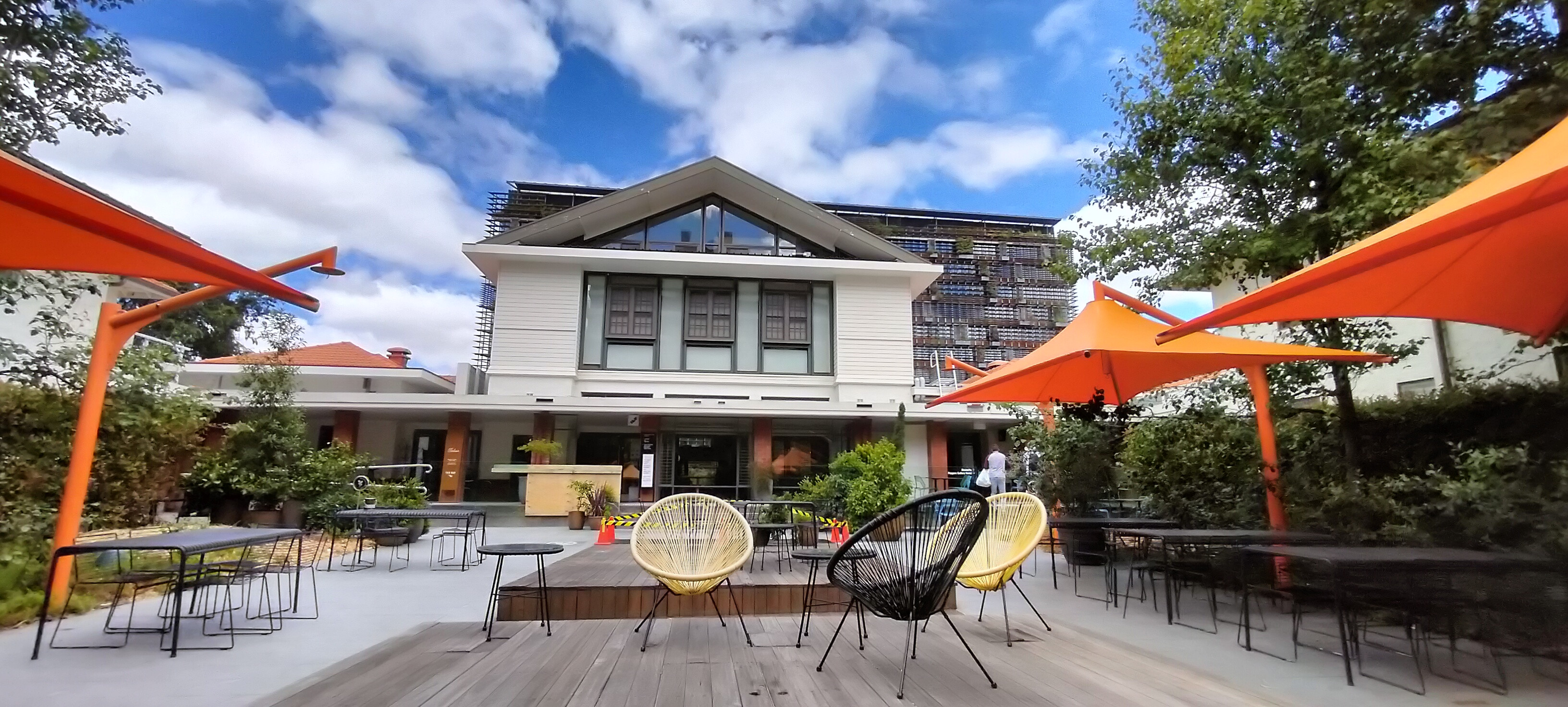
When it comes to things to see, Civic has very little to offer in comparison to other districts of Canberra. Unlike Sydney, Melbourne, Brisbane, Perth or Adelaide, most of Canberra's museums aren't in Civic but in the areas surrounding Civic such as Acton or South Canberra. Nevertheless, the Civic has some buildings with some unique architecture, making Canberra quite a different CBD compared to other Australian CBDs. Most of Civic's sights are in 1 Civic Square, a small block at 180 London Cct, including the Legislative Assembly building, Canberra Museum and Gallery, Civic Library and Canberra Theatre. Its location was deliberately chosen to be directly in line with Mount Ainslie; if you want to see it for real, stand at the very centre of the lookout, and whilst Anzac Parade will certainly take the spotlight, look a bit to the right and you'll see the square perfectly in line with City Hill and Ainslie Avenue.
2 Artworld ADG, cnr London Cct and Gordon St, ☏ +61 2 6230 2922, [email protected]. F 11AM–6PM. An Aboriginal art gallery that is sister to the Aboriginal Dreamings Gallery in Nicholls. It's a smaller version of the art gallery in Nicholls, but there are still plenty of Aboriginal artworks and artifacts on display. However, do note this place is not wheelchair accessible. (updated May 2022) 3 Canberra Museum and Gallery (CMAG), 176 London Cct, ☏ +61 2 6207 3968, [email protected]. M–F 10AM–5PM; Sa Su noon–5PM. A museum and art gallery featuring works and exhibits of the local region. It includes an interesting permanent gallery on the history of Canberra and several galleries that host temporary exhibitions, generally by local artists and photographers. It also features the Sydney Nolan Collection - the works of Sir Sydney Nolan, a famous Australian artist. Free. (updated Jun 2023) 4 Glebe Park, cnr Bunda St, Akuna St and Cooyong St. Where's Canberra's Hyde Park, you ask? This small 40-ha park is a remnant of the land allocated in the 1840s to the Ang
Do
Civic isn't a place to "do" things. Perhaps humorously, the most strenuous thing is maneuvering around the city, scrambling for parking, or if it's not a very good day, then maybe both. While there have been several entertainment venues that have opened and closed in Civic, many have closed; some like the former Center Cinema have been taken over by dining establishments.
1 Casino Canberra, 21 Binara St, ☏ +61 2 6243 3700. Daily noon–4AM. Perhaps Canberra's equivalent of Melbourne's Crown Casino, with multiple gambling areas, a sports bar, and an eatery but the casino is quite compact. (updated Mar 2022) 2 Canberra Theatre Centre (Canberra Theatre), Civic Square, London Cct, ☏ +61 2 6275 2700. Canberra’s central performing arts venue, Australia’s first performing arts centre, and the first Australian Government-initiated performing arts centre to be completed having opened on June 24, 1965, with a gala performance by the Australian Ballet. (updated May 2022) 3 Palace Electric Cinemas
Overview adapted from Wikipedia, travel guide fromWikivoyage (CC BY-SA). Photography via Wikimedia Commons.