
Caravan Reef
South Africa · Africa
About Caravan Reef
The dive site Caravan Reef is a large area of inshore rocky reef between Miller's Point and Rocklands Point on the False Bay coast of the Cape Peninsula, near Cape Town in the Western Cape province of South Africa.
Caravan Reef travel guide
Understand
Caravan Reef is a large area of granite reef to the north east of the slipway at Miller's Point, and as such is very close to the launch area. One would think that it would be a popular dive site, but it is largely unexplored, unlike the adjacent wreck of the SAS Pietermaritzburg, which is one of the most frequently dived sites on the Cape Peninsula.
Position Approximately half a square kilometer of reef centred about 750 m north-east of the Miller's Point slipway, and about 700 m in diameter.
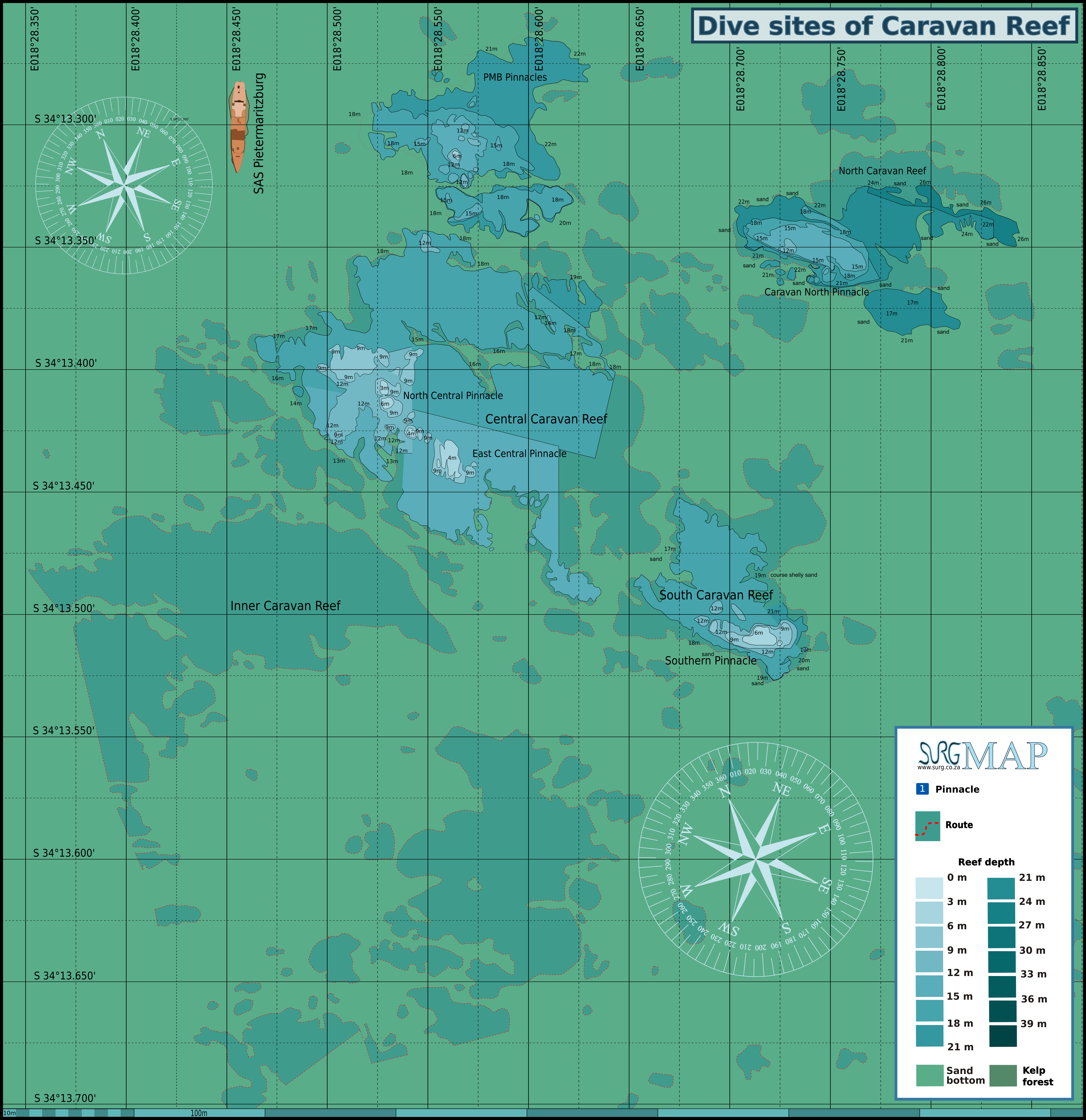
1 PMB Pinnacles: S34°13.311' E018°28.564' — named for its proximity to the wreck of SAS Pietermaritzburg 2 North Caravan: S34°13.352’ E018°28.733’ 3 Caravan Central north pinnacle: S34°13.408’ E018°28.528’ 4 Caravan Central east pinnacle: S34°13.436’ E018°28.562’ 5 South Caravan: S34°13.513' E018°28.721' 6 Inner Caravan: S34°13.500' E018°28.450' — (estimated) This site is in a Marine Protected Area (2004). A permit is required.
Name This site is offshore of the caravan park at Miller’s Point, which may be the origin of the name "Caravan Reef".
Depth Central: Maximum about 19 m, Top of reef about 3 m North: Maximum about 22 m, Top of reef about 12 m South: Maximum about 20 m, Top of reef about 4 m PMB Pinnacles: Maximum about 22 m on the sand to the east. Top of highest pinnacle about 6 m.
Visibility
Topography
This is an extensive area of granite reef. It can be subdivided into a number of sections: North Caravan Reef: Sand at about 26 m on the north-east side, 21 m to the south-west. Top of the reef is at about 12 m. There is a long ridge running roughly north-west/south-east which is high to the south-west side, with a steep wall and occasional transverse jointing, and lower to the north, with steeper parts further south. Below the wall there are some clusters of fairly large boulders on the sand. This section is separated from Central Caravan Reef by a band of sand bottom at about 20 m depth. The reef has a relatively low area to the north east of the high
Getting there
Boat dive from Miller's Point slipway or Simon's Town jetty. About 1 km from the slipway to (Caravan North) or less to the other sites. From Simon's Town jetty it is about 6.8km to Caravan Central.
See
Marine life
A wide range of typical False Bay invertebrates may be found on the reefs. The sand patches of the central area are known for lamp urchins. Southern area: In the 15 to 20 m depth range the cover is split between a dense turf of large sea squirts with common feather stars on the steeper surfaces, occasional gaps with strawberry anemones or encrusting sponges, and upper surfaces often covered by red-chested or mauve sea cucumbers, with a scattering of golden cucumbers. Some low areas with serpent skinned brittle stars. A fair number of gorgonian sea fans, a few cauliflower and sunburst soft corals. Quite a number of smallish thickets of arborescent hydroids. Occasional small plocamium. In shallower areas a lot of red-bait or similar on top of the reef. Lamp urchins are relatively common on the sand patches. There is not much kelp, and most of it is Laminaria (split-fan kelp).
Photography On a day with good visibility, a wide angle setup is likely to produce spectacular results. The reef is also full of small critters, so a macro setup will also work well. Because of the depth, external lighting is highly recommended to achieve good colour.
Routes No particular routes recommended.
Overview adapted from Wikipedia, travel guide fromWikivoyage (CC BY-SA). Photography via Wikimedia Commons.