
Bourtange
Netherlands · Other
About Bourtange
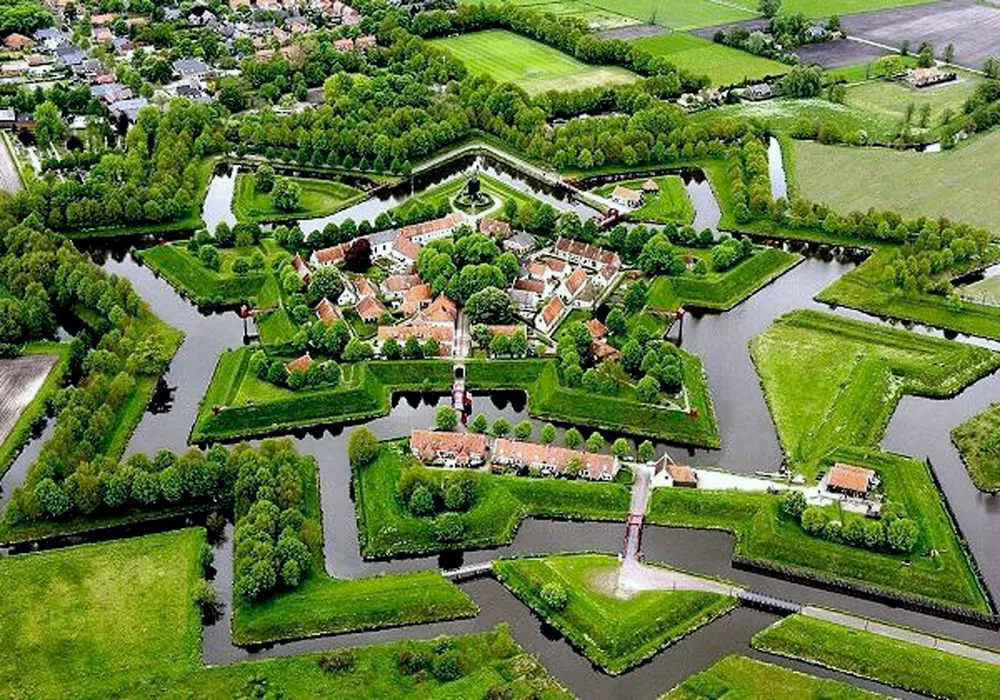
Established during the Eighty Years' War, the fortified town of Bourtange is a charming destination in the Westerwolde region of the Northern Netherlands, right on the border with Germany. Its stunning architecture and beautifully renovated state make it one of the best surviving examples of a star fort in Europe. Although mostly unknown to international visitors from further away, German and Dutch tourists are increasingly discovering this quaint village, where it seems to the eye that little has changed since 1782. The small community that lives in and around the fort -about 430 people in total- caters to the visitors' needs by means of friendly hotels, pleasant cafés and an abundance of related activities in summer.
Bourtange travel guide
Understand
The star shaped fort was designed and built at the orders of William I of Orange, during the Dutch Revolt against Spain. The fort served a simple goal: to control the main road through the Bourtange swamps to Germany. The city of Groningen and its surroundings were still under Spanish control at the time, and received their supplies from allies in Germany. According to some sources, the assignment to build a fort was given to Diderick van Sonoy, one of the leaders of the Dutch "Geuzen", the Calvinist Dutch nobles who took on the battle with the Spaniards. It was Adriaan Anthoniszoon who drew the designs of what would become a 5 sided bastion. Works began in 1580. The fort was hardly finished when the city of Groningen was finally taken, and the fort was adapted to now suit a new purpose. It became part of the border defence lines of the three provinces of the Northern Netherlands. It was enforced and expanded several times, during wars that followed, but as the swamps around Bourtange slowly dried, the importance of the fort slowly diminished.
Decline With the further development of warfare and increasing fire power, the star shape lost its benefits in rapid pace and ever few soldiers were stationed in Bourtange. Ever more citizens found a home within the walls, however, and after the once mighty fort was officially abandoned as a military stronghold in 1851, Bourtange quickly grew into a flourishing agricultural village. Most of the moats were filled up, with the exceptions of part of the main canal. Shortly before the restorations, an old cannon barrel was one of the few visible reminders of the town's grand history. Trade and agriculture bloomed until the 1950s, when a time of deterioration began. Young people moved away and many local businesses closed, turning Bourtange into a backward village with no future.
Restoration That changed completely when the municipality of Vlagtwedde, of which the village was part, decided to heavily invest in a reconstructio
Getting there
The N365 is the only major road into Bourtange. It doesn't directly lead to any significant other towns, but connects to several other provincial roads, making the village quite well-reachable. It's a 25 minute drive to both Stadskanaal and Winschoten, the nearest larger towns, and a 35 minute drive to Veendam. Groningen, the capital of the province, is about 50 minutes away by car. The wide, flat landscapes of the region make biking in the surroundings of Bourtange an appealing way of transport, even if you're not the fittest of travellers. For an average to fit person, it's a 3 hour bike trip from Assen and a bit longer from Groningen. Taking smaller roads will of course make your route a bit longer, but can provide nice, typical Dutch countryside landscapes, dotted with black and white cows. For Dutch standards, this place on the German border is pretty much as remote as it gets. Despite the fort's tourist aims, getting here by public transport is neither fast nor cheap, and not especially convenient either, unless you already happen to be in nearby Stadskanaal. Nonetheless, it's possible. From Groningen, it's a one and a half hour trip (± €11). First take a train to Winschoten and take bus line 11 from there to Bourtange. From the bus station in Assen, it's 1.45h, and requires changing buses once (± €10). Take line 24 direction Stadskanaal, and there change to line 14 in the direction of Winschoten. After reaching Winschoten, this bus changes into line 11 to Bourtange, allowing you to just stay seated. On the west side of the fort lies the Bourtangerkanaal, an arm of the Ruiten-Aa-kanaal, and the only navigational water way. Boats of up to 3m high can pass under the bridges over the canal, and there's a small "harbour" with a few landing places near the fort.
Getting around
Everything you're in Bourtange for, lies within the walls of the fort. It's charmingly small, and the only real way to get around is on foot. You can park your car at the entrance of the fort. The information centre lends out wheel chairs, if you need one. In summer, you can make use of a "tourist bus" and on weekends and some weekdays, there's a large horse carriage too. They take routes through and around the fort. There's no reservations for this in advance, so just check with the tourist information office upon arrival.
See
The fort, restored to its mid-18th century state, is a town and attraction in one. There's a range of historic buildings and some artefacts, including a pointy wooden horse once used as a torture devise. Everything you really want to see, lies within this intimate, confined area. It's not just the fort as it is, there are also some museums to visit. You can enter the fort for free, but there is an admission fee for the museums. The obvious place to start any visit is the 1 Information Centre, W. Lodewijkstraat 33, ☏ +31 599354600, [email protected]. M-F 09:15-17.00, Sa-Su 10:00-17:00. Located at the entrance of the fort, this is where you park your car, can buy combined entrance tickets for the museums, and get all the information you'd like about this place. It provides a short visual introduction to the history of Bourtange and can help with bookings for lodging. Here, you'll also find toilets and an ATM.
Main sights Keep in mind that this was a military stronghold, a place for officers and soldiers. There's no grand architecture here but rather functional, mid-18th century lodgings, offices and a small church. The picturesque market square is a cosy place, especially when the outdoor terraces fill up on a sunny summer's day. Note the fourteen linden trees here, which are some 300 years old. The square lies in the middle of the fort, and all the roads lead here. At the market square, you'll also find the most important of the officer's houses. There's a Major’s House, a Captain’s House, the Commander’s House, the Schoolmaster’s House and others. In front of the Major's house you'll find the red-painted wooden horse. Used as a torture tool, victims were placed on the horse's pointy back with weights attached to their feet. The soldiers barracks are located in a circle behind their officers' dwellings. The pretty little 1 Protestant Church replaced an earlier church in 1869. The dismantled one was the first Protestant church in the Groningen province, built befo
Do
Especially in summer, regular events are organized to increase the historic feel of town. In high season (March–October) a cannon shot can be witnessed every Sunday at 15.00h. This small tradition is nothing compared to the annual re-enactment of the Battle of Bourtange, held in June and the largest re-enactment event in the country. It's a quaint and fun two day happening during which hundreds of volunteers fulfil their roles as commanders, gunners, flag-beares, musketeers, pike men and camp guards, sleeping in tents.
Buy
There's a surprising number of small shops lining the market square and the few other streets of the fort. They mostly sell souvenirs, from standard small
Overview adapted from Wikipedia, travel guide fromWikivoyage (CC BY-SA). Photography via Wikimedia Commons.