
Botswana
Botswana · Africa
About Botswana
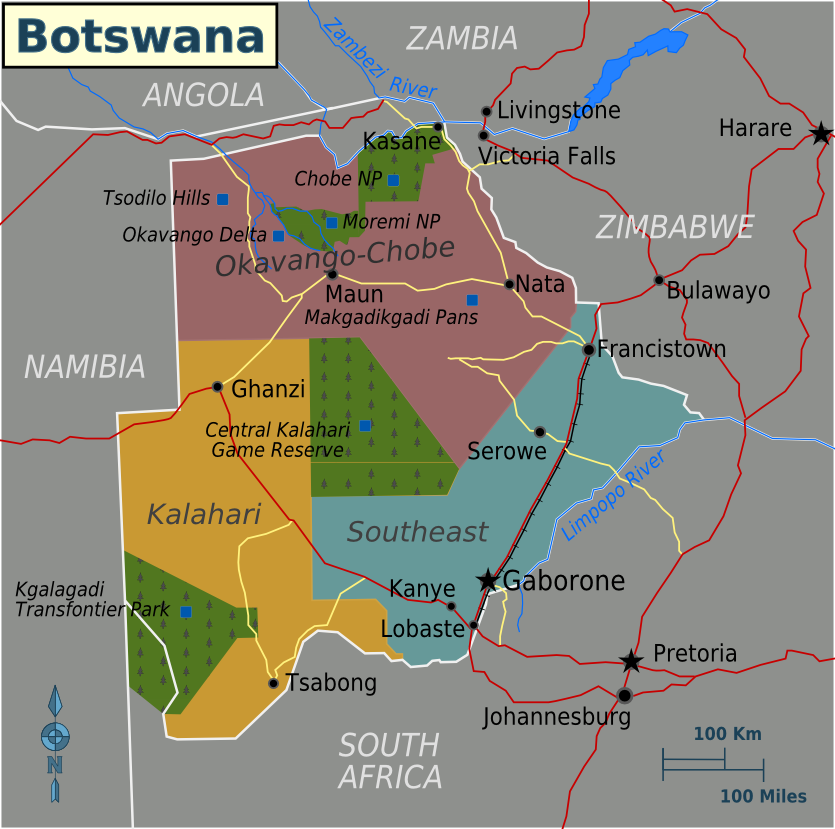
Botswana is a landlocked country in Southern Africa, completely surrounded by four countries: Namibia, South Africa, Zambia, and Zimbabwe. Botswana is a true gem among African nations, boasting a remarkable level of wealth and tranquility that few other countries on the continent can match. With its high standard of living and extremely low crime rates, Botswana has established itself as an oasis of stability amidst the many challenges faced by its neighbours. But Botswana is much more than just a peaceful haven. This captivating country is also home to a wealth of attractions that are sure to delight any traveller. From the stunning Tsodilo Hills and Chobe National Park to the Moremi Game Reserve in the Okavango Delta and the Central Kalahari Game Reserve, there is no shortage of natural wonders to explore.
Botswana travel guide
Understand
History Botswana was never really colonised by the Europeans: instead in 1885, John Mackenzie, who was a Scottish Christian missionary, argued for the land and human rights of the tribe of Bamangwato which he worked really close with. He believed the territory of the Ngwato was being threatened by the Boers to the south who were then capturing and settling in areas owned by the African tribes. Because of this he and the three chiefs of the three major tribes travelled to Britain to negotiate for the establishment of what became the Bechuanaland Protectorate, to be ruled directly from Britain. As a protectorate rather than a British colony, the local Tswana rulers were left in power, and British administration was limited to the police force to protect Bechuanaland's borders against other European colonial ventures and the Boers. However, the protectorate was still impoverished during British governance, with an economy heavily relying on cow herding and remittance from workers in South Africa. Seretse Khama, the founding father of modern Botswana, was born in 1921 in a Tswana chieftain family. When he was practicing law in the United Kingdom, he married Ruth Williams, a white clerk. The interracial marriage elicited strong opposition from then Apartheid South Africa, the United Kingdom and his own family, and ended up in a five-year exile. Unexpectedly, because of his exile, Khama gained reputation as an independence activist. In June 1964, the British queen accepted proposals for a democratic self-government in the protectorate. In 1966 the protectorate came to be known as the Republic of Botswana as it had gained independence from the British, with Seretse Khama becoming the first president. The country now celebrates Independence Day on the 30th of September annually. Formerly one of the poorest countries in the world, Botswana is now an upper middle-income country, thanks to an abundance of diamond reserves and good governance: corruption was firmly crushed, a
Getting there
Entry requirements Unlike more stiff necked administrations such as India, Pakistan, Nigeria and China, the Botswana government has not erected high bureaucratic barriers to tourism. Citizens of Commonwealth countries do not need a visa to visit except those from Bangladesh, Cameroon, Ghana, India, Nigeria, Pakistan, and Sri Lanka. Citizens of European Union countries, Norway, Iceland, Liechtenstein and Switzerland do not require a visa to visit. Citizens of Argentina, Angola, Bahrain, Brazil, Chile, Costa Rica, Cuba, Dominican Republic, Israel, Japan, Kuwait, Mexico, Oman, Paraguay, Peru, Qatar, Russia, Saudi Arabia, South Korea, South Sudan, Turkey, United Arab Emirates, United States, Uruguay, Venezuela and Zimbabwe do not require a visa to visit. For citizens of other nations, a visa must be obtained prior to arrival and this usually takes about a week to process. Visas can be applied for at a Botswana embassy in Australia, Belgium, Brazil, China, Ethiopia, India, Japan, Kenya, Namibia, Nigeria, South Africa, Sweden, Switzerland, the United Kingdom, Zambia, Zimbabwe and at the United Nations in New York City, USA. If you require a visa to enter Botswana, you might be able to apply for one at a British embassy, high commission or consulate in the country where you legally reside if there is no Botswana diplomatic post. The UK Government website lists UK embassies around the world where Commonwealth visas can be issued. British diplomatic posts charge £50 to process a Botswana visa application and an extra £70 if the authorities in Botswana require the visa application to be referred to them. The authorities in Botswana can also decide to charge an additional fee if they correspond with you directly.
By plane Botswana's main airport is Sir Seretse Khama International Airport (GBE IATA) which is located roughly 15 kilometres (9 mi) north of downtown Gaborone, which has international flights from Zimbabwe, Zambia, South Africa, Namibia, Kenya and Ethiopia. The
Getting around
Very few locals know street names and addresses, and you are likely to have to get directions in terms of landmarks. Botswana doesn't have a postal delivery system to addresses (just to centralised mail collection points), so even when streets are well-marked, the names may be unfamiliar to residents. Through a combination of coaches and combies (minivans) and taxies, you can get anywhere in Botswana without any trouble, though public transport is spotty away from big cities and major routes but hitchhiking is popular and very easy. However, hitchhiking should only be done in desperate circumstances, as Botswana driving is often very erratic and it can be a harrowing experience to have a stranger drive you somewhere. It is advisable to arrive at the bus station quite early, as the buses do fill up quickly, and it is not uncommon to spend several hours standing in the aisle waiting for a seat to free up (remember to bring water; as the buses are often not air conditioned).Apart from Public transport you can opt to call a private cab which can take you anywhere you want in around and around the city, phone numbers for cabs can be found anywhere around the city in pamphlets pasted on bus stops or can be found in notice boards mainly located in shopping malls.
By taxi Taxis are the most common way to travel; the taxis can only travel on designated routes so it's best to ask first where the taxi is heading and where it makes its stops, taxis can only travel in the city it is in, i.e. you can't catch a taxi in a specific city and intend to travel outside that specific city with that taxi. Taxis as of 2022 cost only P9.00 which roughly equals 0.80 US Dollars.
By car The roads are paved and well maintained, so travel by car is also not a problem. Traffic is on the left in right-hand drive vehicles (as in South Africa or the United Kingdom). Much of the road network outside urban areas is unpaved and requires four-wheel drive vehicles. There are no signposts in rural a
See
Wildlife is Botswana's main draw. Wildlife parks compose nearly one-fifth of the country. In these parks you will find lions, cheetahs, crocodiles, hippos, elephants, antelopes, wild dogs, and hundreds of species of birds. Visitors can take safaris and stay in lodges running the gamut from inexpensive dorms for backpackers with tour buses to $1,000+/night private lodges with your own maid & driver. Among Southern Africa's most impressive—and popular—wildlife destinations is the Okavango Delta where the Okavango River widens into the world's largest inland delta. Lying in the middle of the arid Kalahari, the swamps & water channels attract animals from thousands of kilometres around and triples in size (to 100; 000 km2!) during floods in July and August. Nearby Chobe National Park has a large population of elephants and it's also easy to spot many of Africa's well-known species, especially zebras and lions. The bleak salt pans of Makgadikgadi Pans National Park attract a large number and
Overview adapted from Wikipedia, travel guide fromWikivoyage (CC BY-SA). Photography via Wikimedia Commons.