
Bishnupur
India · Asia
About Bishnupur
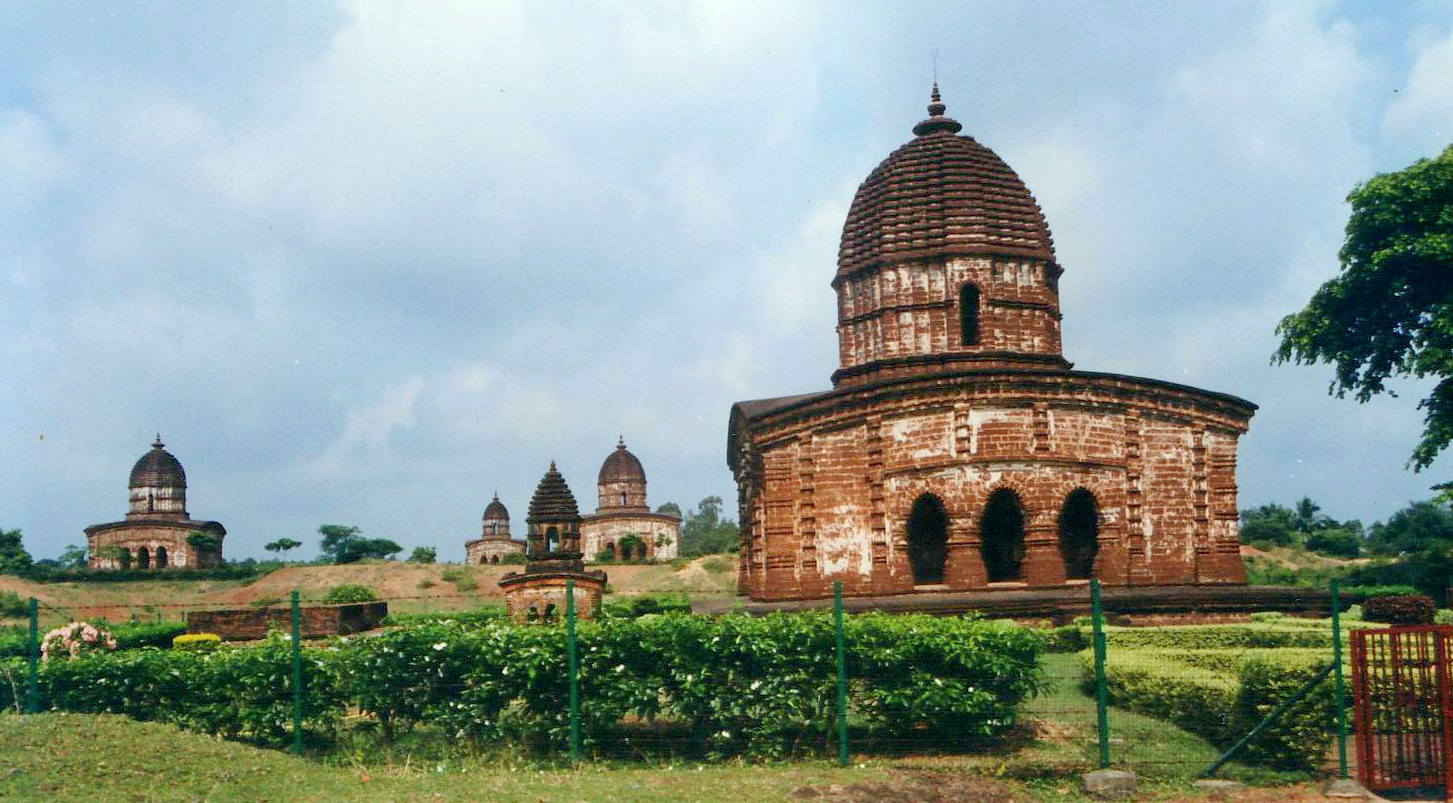
Bishnupur (বিষ্ণুপুর Biṣṇupur) is a town in the Bankura district of West Bengal, India. Although famous for terracotta temples, Bishnupur also houses several laterite stone temples. Bishnupur also houses several other ancient religious and non-religious structures. The town probably contains the highest number of historical sites of any town in West Bengal. The terracotta temples are in the tentative list of UNESCO World Heritage Site since 1998.
Bishnupur travel guide
Understand
Bishnupur (BIHSH-noo-poor) was the citadel of the Malla dynasty. The dynasty was founded in the late 7th century by Adi Malla. Adi Malla was the abandoned son of a North Indian king. He was brought up by a Bramhim of the present-day Bishnupur region. The brahmin family provided him with the best education along with physical and warfare training. The boy not only excelled in education but also turned out to be an outstanding wrestler. Soon on the request of the local elders, he ascended the throne of the local kingdom, which was renamed as the Malla Kingdom (Malla meaning wrestling) and he is known as Adi Malla. The Malla Kingdom flourished and after about 300 years the 10th Malla King Jagat Malla decided to shift his kingdom to Bishnupur. Over the next 800 years, Jagat Malla and his descendants built several temples and structures (both of brick and stone) turning Bishnupur into a temple town. Among the present structure, the oldest structure of Bishnupur is the Rasmancha dating back to 1600. The other structures were built in the next 150 years. Although known for its terracotta temples Bishnupur also has its fair share of stone temples. In fact, these laterite stone temples outnumber the brick or terracotta temples. Moreover, the temples of Bishnupur follow different styles of Bengal temple architecture and include both chala (sloped roof) and ratna (pinnacle) temples. Apart from the temples and other religious structures a small portion of the fortification of the citadel remains.
Getting there
By plane The nearest airport is Kazi Nazrul Islam Airport (RDP IATA) at Durgapur, but only a few flights are present at the airport. Netaji Subhas Chandra Bose International Airport (CCU IATA) at Kolkata is the nearest airport to get to Bishnupur smoothly.
By train 1 Bishnupur railway station SER. It takes about 3 hr 30 min to 4 hr 15 min from Kolkata, distance 201 km. Convenient connections - Rupashi Bangla Express departing Howrah at 6AM, Purulia Express departing Howrah at 4:45PM and Aranyak Express departing Shalimar at 7:45AM. To come by Aranyak Express from Howrah to Bishnupur, first go to Santragachi by local train. All these trains are via Kharagpur and Midnapore. You can also opt for Howrah-Chakradharpur passenger which leaves Howrah at 11:05PM. This train has a sleeper class.
By bus 2 Bishnupur Bus Stand. West Bengal Transport Corporation (WBTC) buses ply regularly between Esplanade Bus Terminus of Kolkata and Bishnupur. It takes about 4–5 hours to reach here. The road distance is about 150 km. Buses are also available from Tarakeswar, Durgapur. Kharagpur, Bardhaman, Asansol and other nearby cities.
By car From Kolkata travel to Dankuni, take the Durgapur Expressway (NH 19), at Ratanpur crossing turn left and take the Sheoraphuli-Tarakeswar road, go straight through to Arambagh and Bishnupur.
Getting around
Many of the temples are near each other and walking is a good option. Cycle rickshaws are another option. A combination of walk and cycle rickshaw can work out very well. Auto (diesel-powered three-wheelers) and toto (battery powdered three-wheelers) are also available and are good for tourists with limited time. Cars are also available on hire and hotels can arrange for them. One day is more than enough to visit the major sites of Bishnupur. For more detailed observation minimum of two days are absolutely necessary.
See
Bishnupur being a temple town, the focus is on temples, several of them built of terracotta during the reign of the Malla kings, who ruled over the area prior to the arrival of the British. Bishnupur also hosts several laterite stone temples along with several other religious and non-religious structures. The sites of Bishnupur are clustered around the Rasmancha. They can be classified into four groups:
Rasmancha and north of Rasmancha South of Rasmancha Further north North west
Rasmancha and north of Rasmancha This area contains three of the best-known terracotta structures of Bishnupur. They are Shyamrai Temple, Kestorai Temple and the Rasmancha. This is a compact area and walking can be a good leisurely option. People who are short of time can opt for a cycle rickshaw.
1 Rasmancha. Built in 1600 by Bir Hambir it is the oldest standing structure in Bishnupur. The pyramidal structure stands on a high platform approached by a long flight of stairs. It consists of arched entrances separated by pillars and is crowned with a stepped pyramidal structure surrounded by smaller typical Bengal styled sloped roofed structures. It is architecturally unique and one of its kind in the whole of Bengal, probably in the whole of India. Sadly apart from a few floral lotus motif the Rasmancha does not contain any terracotta art work. It is not a temple and hence does not house any idol but during the festival of Ras all the idols from different temples of Bishnupur are brought at the Rashmancha for public display. 2 Shyamrai Temple (Pancha Ratna Temple). The temple has five pinnacle, hence the name Panch Ratna. Built in 1643 by King Raghunath Singha. It is one of the largest temples of Bishnupur. The temple is accessible by triple arched entrance on all the four sides All the walls are richly decorated with terracotta carvings featuring aspects of Lord Krishna’s life. 3 Gumgarh. A square structure without windows or doors atop a small mound. Nothing much is known about the co
Do
It is also a great centre for music - the Bishnupur gharana is well known in classical music. Look out for opportunities, check where you stay, if you are an Indian classical music fan.
Buy
The town of Bishnupur has several shops selling baluchari and swarnachuri saris, terracotta artefacts, conch shells and artefacts and Dasabatar Cards. Panchmura is a nearby terracotta artisan village which can also be visited.
Brass Utensils. Brass and German Silver utensils are famous in Bishnupur. Brass and German Silver artefacts are also available. (updated Jun 2020) Conch shell artifacts. Decorated conch shells and items made out of conch shells, including bangles, are also popular shopping items in Bishnupur (updated Jun 2020) Dasabatar Cards (Set of hand-painted cards). A card game of 120 cards with 10 suits representing the 10 avatars of Vishnu. The game was introduced by Bir Hambir (reign 1565–1620). It is a complex game played by 5 players. The circular cards of four and a half inches in diameter are works of art and collector's items. The cards are made of several layers of cloth pasted together with glue, made out of crushed tamarind seed. Then they are cut into circles of four and a half inches in diameter. The inner side is painted with pictures of the das avatars with organic colours. The reverse side is layered with lac and hence red in colour. Full set (120 cards) cost ₹ 12000 - 15000, Set of 10 ₹ 1500. (updated Jun 2020) Saris. Handloom saris are in great demand in Bishnupur. Baluchari Saris are famous Bishnupur products. Inspired by the terracotta panels of the temples the saris are woven with repl
Overview adapted from Wikipedia, travel guide fromWikivoyage (CC BY-SA). Photography via Wikimedia Commons.