
Ballarat
Australia · Oceania
About Ballarat
Ballarat is a city about 110 km (68 mi) north-west of Melbourne in the Goldfields region of Victoria. Ballarat is most noted as a former goldmining town with excellent examples of Australian colonial architecture, and as the site of the famous miners' revolt at the Eureka Stockade in 1854. With a population of approximately 117,000 it is the third largest city in Victoria.
Ballarat travel guide
Understand
History The traditional owners of the land are the Wadawurrung people. Ballarat was named in 1837 by the Scottish settler Archibald Yuille who established the first settlement, a sheep run called Ballaarat, with the name derived from local Wathaurong Aboriginal words for the area, balla arat, thought to mean "resting place". The present spelling was officially adopted by the City of Ballarat in 1996. It is one of the most significant Victorian-era boomtowns in Australia. Just months after Victoria was granted separation from New South Wales, the Victorian gold rush transformed Ballarat from a small sheep station to a major settlement. Gold was discovered at Poverty Point on 18 August 1851 and news quickly spread of rich alluvial fields where gold could easily be extracted. Within months, approximately 20,000 migrants had rushed the district. Several Australian mining innovations were made at the Ballarat diggings including the first use of a Chilean mill in 1851 and the first use of a mine cage in 1861. Unlike many other gold rush boom towns, the Ballarat fields experienced sustained high gold yields for decades. The Eureka Rebellion began in Ballarat, and the only armed rebellion in Australian history, the Battle of Eureka Stockade, took place on 3 December 1854. In response to the event the first male suffrage in Australia was instituted and as such Eureka is interpreted by some as the origin of democracy in Australia. The gold rush and boom gave birth in many other significant cultural legacies. The rebellion's symbol, the Eureka Flag has become a national symbol and is held at the Museum of Australian Democracy at Eureka in Ballarat. Other nationally significant heritage structures include the Ballarat Botanical Gardens, established 1857, the best example of a regional botanic gardens in Australia with the greatest concentration of public statuary including the official Prime Ministers Avenue; the longest running lyric theatre building, Her Majesty's, establis
Getting there
By car Ballarat is an easy 90-minute drive from Melbourne on the Western Freeway (M8). Alternatively, from Geelong take the southern section of the A300; from Bendigo and Castlemaine take the northern section of the same highway.
By train
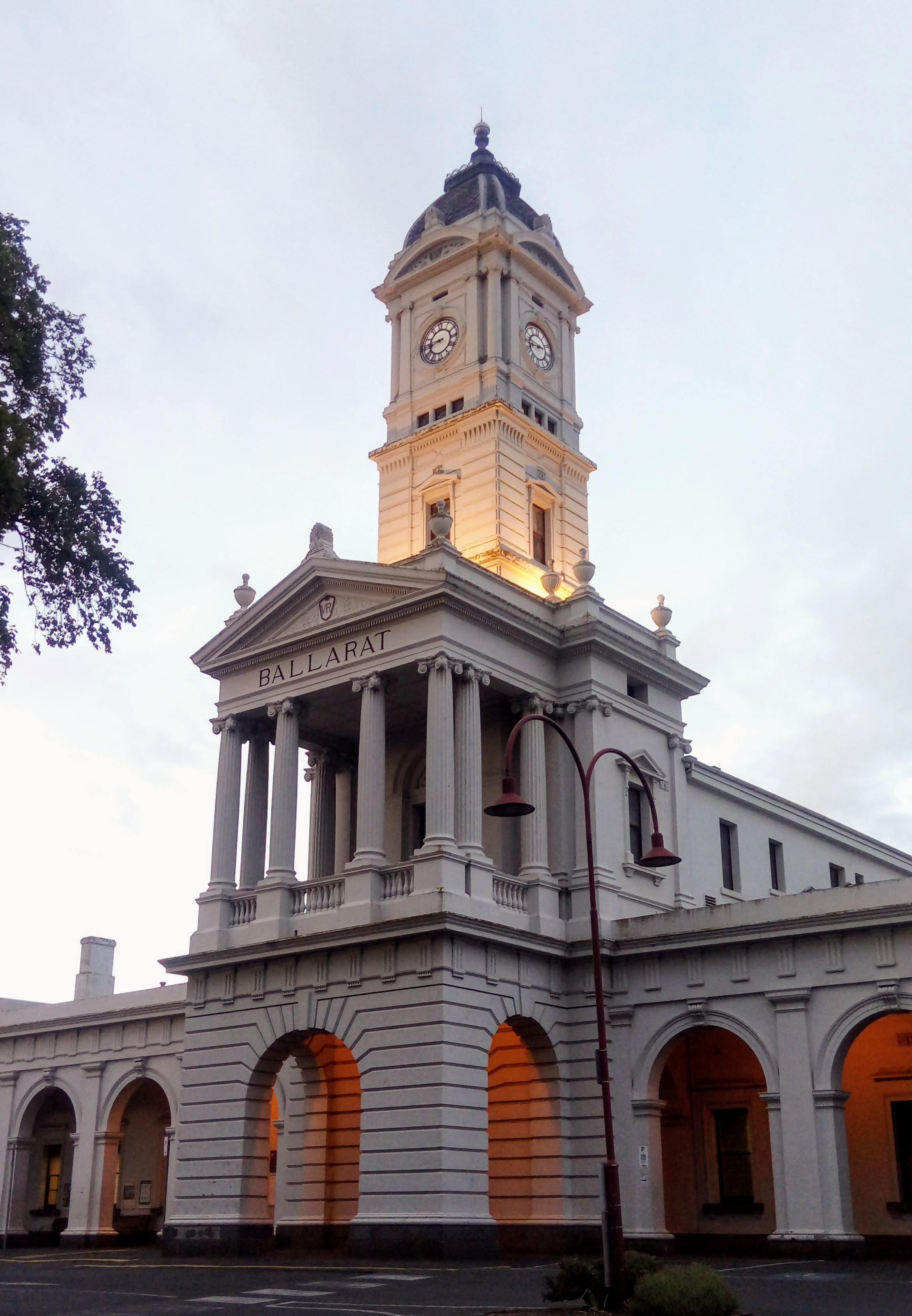
The train station is in Lydiard Street in the centre of the city. Take a look around as Lydiard Street has one of the best examples of Victorian-era streetscapes in Australia.
1 Ballarat Railway Station, Lydiard Street, North Ballarat Central. There are frequent V/Line trains that run from Southern Cross Station in Melbourne. The trip takes approximately 1 hour and 20 minutes with a usual frequency of one every forty minutes off-peak in each direction. More frequent services run during weekday peak times, but they can be crowded occasionally. (updated Oct 2025) 2 Wendouree Railway Station, Gillies Street. Most V/Line trains also continue to Wendouree, which is a station serving western Ballarat. (updated Oct 2025)
By plane Ballarat is not served directly by commercial passenger flights. You therefore need to fly to Melbourne. There is an Airport Shuttle Bus between Ballarat and Melbourne's main domestic and international airport, Melbourne airport (MEL IATA), also known as Tullamarine on some booking sites. The shuttle bus costs $30 for adults, $76 for families, $16 for children 3 to 16, and children under 3 are free. For more information on Tullamarine see Melbourne airport. There is no direct connection between Melbourne's secondary Avalon airport (AVV IATA) and Ballarat, and the options are to either hire a car, or get the SkyBus into Melbourne's Southern Cross train station and then the train to Ballarat, which will take 3-4 hours in total.
Getting around
By car Most visitors will rent a car from Melbourne to travel in and around Ballarat. Car rental is also available in Ballarat through Budget & Thrifty.
By public transport
CDC Victoria, 804 Norman St, ☏ +61 3 5331 7777, [email protected]. CDC runs the local bus network. All parts of Ballarat are served by the network with most buses stopping at the Ballarat Train Station in Lydiard Street. The standard frequency on almost all routes is one bus every half hour. A couple of routes have only one every hour. In the evenings and on Sundays services on most routes are infrequent, while less important routes have no services. As with public transport in Melbourne, passengers will need a Myki card to use the buses in Ballarat. V/Line. Ballarat has two train stations, Ballarat Station and Wendouree Station. Most tourist destinations are situated near one of the two stations. However, with at least a 40-minute wait between services, taking the train just to travel between these two stations is impractical. Take the bus instead. (updated May 2023)
By bicycle You can get around Ballarat by bicycle. There are two options for bicycle hire.
Bicycle Centre Ballarat, 24 Armstrong Street Nth, ☏ +61 3 5334 4388, fax: +61 3 5331 8155. Welcome Nugget – Bicycles for Hire, 128 Lydiard Street Nth, ☏ +61 423 268 618, [email protected].
See
1 Art Gallery of Ballarat, 40 Lydiard Street North, ☏ +61 3 5320 5858, fax: +61 3 5320 5791. 10AM-5PM. The gallery has a large collection of both old and modern works. It also holds the iconic Eureka Flag, flown by the miners at the Eureka Stockade in 1854. Free. Australian Ex-Prisoners of War Memorial. Cnr Wendouree Parade and Carlton Street, south end of the Ballarat Botanical Gardens. The 170-metre-long granite wall has the names of more than 36,000 prisoners-of-war carved into it. 2 Ballarat Botanical Gardens, ☏ +61 3 5320 5135. 3 Ballarat Tramway Museum. Western shore of Lake Wendouree. The museum operates a fleet of historic trams along 1.3 km of original track through the Ballarat Botanical Gardens. The museum is open Saturdays, Sundays, public and school holidays from 12:30 till 5PM. A 20 minute ride costs $4 adults, $2 for children. There is also a free display of stationary trams and memorabilia at the depot. An 1887 horse tram operates several times per year. Trams are also available for hire.
4 Ballarat Wildlife Park, Corner York and Fussell Streets, Ballarat East, ☏ +61 3 5333 5933, fax: +61 3 5333 4025, [email protected]. 9AM-5:30PM. Closed Christmas Day. Has a large display of Australian animals, birds and reptiles. Adults $25, children $15. 5 Museum of Australian Democracy at Eureka (M.A.D.E), ☏ +61 3 5333 0333, [email protected]. 10AM-5PM daily. Cnr Eureka St and Rodier St, East Ballarat. The 1854 Eureka miners' rebellion against license fees took place here. The new museum opened in May 2013, and focuses on the Eureka miners' rebellion and the changes it caused in Australian democracy. It also provides information on democracy world wide. The exhibits are interactive, and follow you through the history of the rebellion, and its outcome. They have the original Eureka stockade flag preserved and on exhibit. Adults $12, concession $8, fam
Overview adapted from Wikipedia, travel guide fromWikivoyage (CC BY-SA). Photography via Wikimedia Commons.