
Arnhem
Netherlands · Other
About Arnhem
Arnhem is the capital of the Dutch province Gelderland. It was built on both banks of the rivers Nederrijn and Sint-Jansbeek, which were the source of the city's development. The larger area of the municipality of Arnhem has a south-eastern border that is partly formed by the river IJssel. It forms the northern part of the Stadsregio Arnhem Nijmegen. Arnhem had a population of 151,356 in 2014 and is one of the larger cities of the Netherlands.
Arnhem travel guide
Understand
History Though the early tracks of settlements showed that the early residents of Arnhem descended from the forests on the hills, Arnhem was not built on the banks of the river Rhine, but a little higher along the Sint-Jansbeek. Arnhem arose on the location where the road between Nijmegen and Utrecht/Zutphen split. Seven streams provided the city with water, and only when the flow of the Rhine was changed in 1530, was the city located on the river. in 1543, it fell to the emperor Charles V. As capital of the so-called "Kwartier van Veluwe" it joined the Union of Utrecht during the Eighty Years' War in 1579. After its capture from the Spanish forces by Dutch and English troops in 1585 the city became part of the Republic of the Seven United Provinces of the Netherlands. The French occupied the town from 1672 to 1674, and preoccupied it from 1795 to 1813. In the 19th century, Arnhem was a genteel resort town famous for its picturesque beauty. It was known as "The Little Hague of the East", mainly because a number of rich former sugar barons or planters from the Indies settled there, as they did in The Hague. In the World War II, during Operation Market Garden, the British 1st Airborne Division were given the task of securing the bridge at Arnhem. A second battle of Arnhem took place in April 1945 when the city was liberated by the British 49th Infantry Division fighting as part of the First Canadian Army. Much of the old centre had been destroyed, resulting in a modern city arising in its place.
Getting there
By car Arnhem is connected with multiple highways. A12: (west-east) The road connects the city of The Hague, with the German border, connecting to the German Autobahn A3. A50: (north-south) Is a highway in the Netherlands, stretching from Eindhoven in the southeast up to Zwolle in the northeast of the country. A325: The highway between Arnhem and Nijmegen
By train or bus Arnhem has four train stations to its name: 1 Arnhem Centraal NS ICE ARR BRG RE is the main station of Arnhem, opened in May 1845. The station, which with 40,000 passengers per day is the ninth busiest station in the Netherlands, has two exits, one of which, Sonsbeekzijde, is on the northwest side of the train station, and can be identified as the elevated walkway across the tracks. As the exit's name implies, it is closest to Park Sonsbeek and has a smaller bus halt at which international buses, most notably FlixBus, stop. The city side exit is found on the east side, and has escalators and steps going down. Here you'll find on-the-go shops, though these are quite expensive compared to their counterparts outside of the station. The city centre is a few minutes away by foot. Optionally, you could take a (trolley) bus from the bus station, which is incorporated into the train station. It too can be found on the city side of the station. Arnhem Centraal is on the Amsterdam — Frankfurt am Main InterCity Express (ICE) line, as well as an international stopping train to Dusseldorf (RE 19) serviced by Abellio. The Deutschlandticket is valid for rides between Arnhem and North Rhine Westfalia in the RE19. Sprinters and Intercity's connect to 's-Hertogenbosch, Utrecht, Amsterdam, Schiphol, Ede-Wageningen, Wijchen, Zutphen and many more. Stoptreinen serviced by Arriva and Breng will get you to Doetinchem, Winterswijk or Tiel. The other three stations in Arnhem which connect to more urban areas of the city are:
2 Arnhem Zuid NS, on the south bank of the river Rhine, 3 Arnhem Presikhaaf NS, near
Getting around
By bus
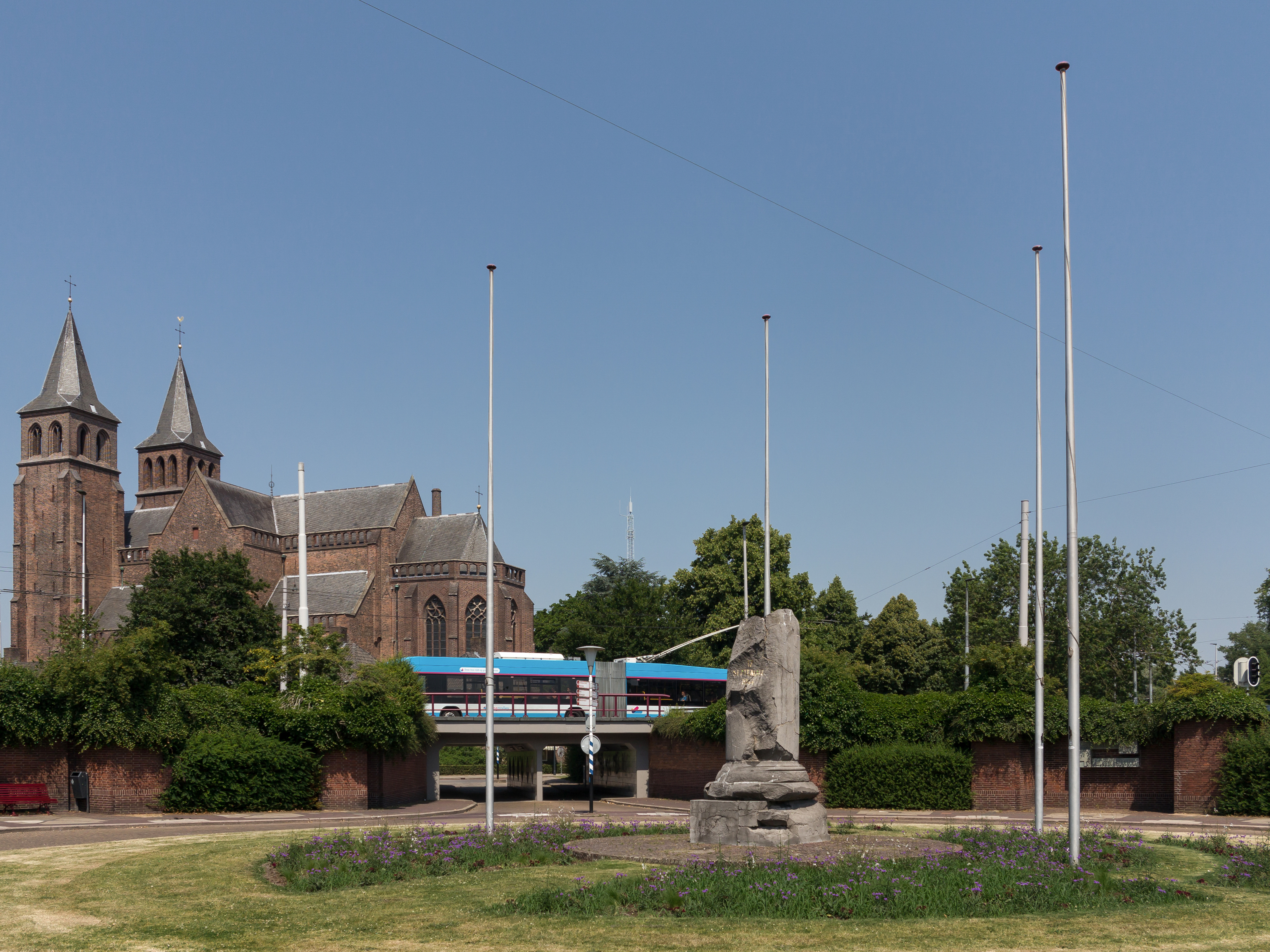
Arnhem is the only city in the Netherlands that uses trolleybuses as a means of public transportation. The bus station is next to the train station in the city centre. There is a fast and frequent trolleybus network. From here you also can take a local bus or buses to cities like Apeldoorn (bus 91 and 231) and Nijmegen (331 stops only on the main stopping places; also 33 but he takes a longer route). Timetables and prices can be found here.
By bicycle There is a bike rental at the Stationsplein (Station square) next to the exit of the Station. (☏ +31 26 4421782) The rate per day is €5.20, per week (5 days or longer) it's €21. At the bike rental a deposit of €25 per bicycle is required. Payment by credit card is accepted. It is possible to take out a bicycle insurance. The premium amounts to €0.50 a day per bike. The deposit amount is doubled when a bicycle insurance is not taken out.
By taxi There are several taxi services in Arnhem. The most common service is Taxi Arnhem, they can be reached 24/7 at ☏ +31 26 260 26 26. You can also arrange for the taxi to pick you up from Schiphol Airport or Eindhoven Airport. Taxis can be found waiting near Arnhem Central Station. Taxi drivers in Arnhem do not use Uber, Lyft, or a similar service, so you have to phone a taxi to book one.
By car There are several car rentals in Arnhem:
Europcar, Boulevard Heuvelink 5. ☏ +31 26 445 3701 Hertz, Bergstraat 2. ☏ +31 26 351 3222 KAV, Stieltjesweg 17. ☏ +31 26 351 5819
See
Points of interest 1 De Gruyterpassage, Roggestraat 43 (entrance via "Musiskwartier" building). De Gruyterpassage is a covered, 75-metre-long pedestrian passage built in 1916 in the Art-Nouveau style. It was originally used as a grocery store until about 1980. In 2006, after restoration, the passage reopened as part of a shopping complex. (updated Apr 2019) 2 Duivelshuis (Huis van Maarten van Rossem), Koningstraat 38. This 15th century house was once owned by Maarten van Rossem. Today it belongs to the city and is used as the mayor's office. Duivelshuis literally means Devil's house owing its name to the satyrs on the front facade. (updated Apr 2019) 3 John Frostbrug (John Frost Bridge), Nijmeegseweg. This is a 1948 replica of the bridge made famous in the film A Bridge Too Far. John Frost was the commander of the unsuccessful British assault on the original bridge during the 1944 Battle of Arnhem. The original bridge was destroyed by an allied air raid after the battle to deny its use to German forces. (updated Apr 2019) 4 Koepelkerk, Jansplein 60. This octagonal neo-classical church stands in the middle of Jansplein, a public square, and was built in 1837-1838. It is used today by the Reformed Church. (updated Apr 2019) 5 Korenmarkt. Korenmarkt (literally: corn market) is a small, attractive city square lined with sidewalk cafés. (updated Apr 2019) 6 Postamt, Jansplein 56. The former post office is in a Neo-Gothic building built from 1888 to 1890. The space is now largely occupied by 't Taphuys bar and café (see entry below). (updated Apr 2019) 7 Sabelspoort, Eusebiusplein (near Markt). This Baroque-style city gate was built in 1642 and is the only surviver of four original city gates. (updated Apr 2019) 8 Sint-Eusebiuskerk, Kerkplein 1, ☏ +31 26 4435068. Apr-Oct 10:00–17:00. This medieval church has high towers equipped with a glass elevator and a panoramic viewing platform. The church hall is closed due to renovations until September 2019, but the t
Overview adapted from Wikipedia, travel guide fromWikivoyage (CC BY-SA). Photography via Wikimedia Commons.