
Ada West District
Ghana · Africa
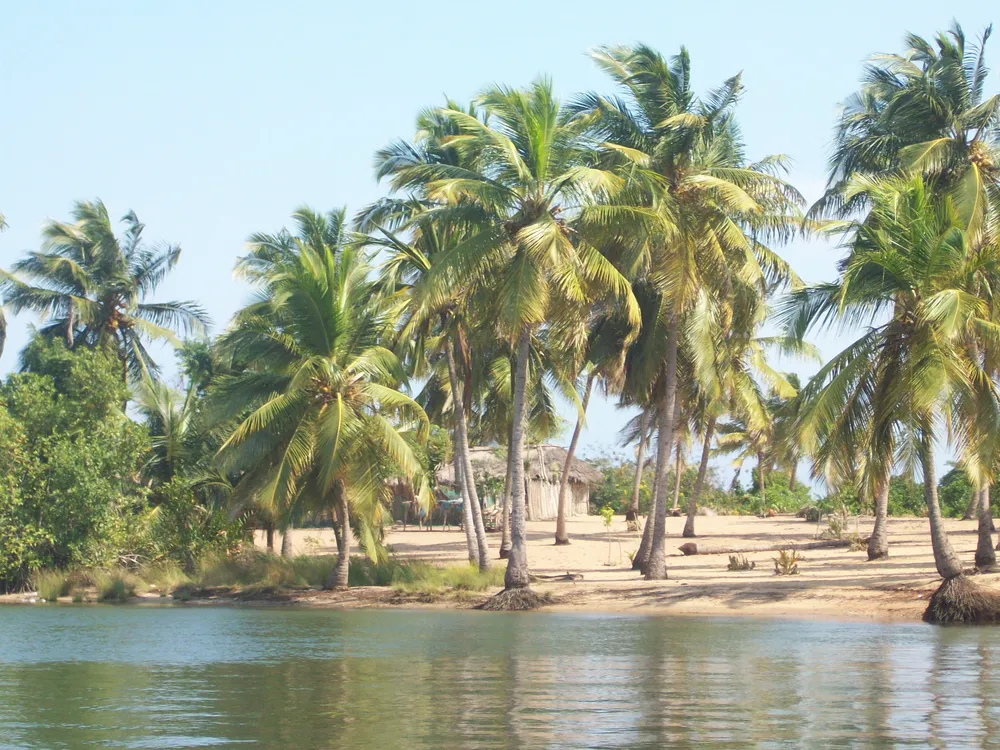
About Ada West District
Ada is an area in the Dangme East District which is in the eastern part of the Greater Accra Region in the southeast of Ghana. It is comprised principally of the "towns" of Ada Foah, Big Ada, and Ada Kasseh. Ada Foah, which is also the district capital, is located at the beach and river estuary, and naturally is where most visitors spend their time.
Ada West District travel guide
Understand
The district's coconut palm fringed coastline is 45 kilometers long and provides a living to many people that are employed in fishing and fish processing. However, this coastline is constantly being eroded by the strong tidal waves that are washing away or threatening several villages that are located close to the beach. In order to solve this problem, the construction of a sea defense wall is under way since 2010.
The long, sandy beaches are certainly some of the most important tourist attractions. However, there are certain obstacles such as the lack of toilets in the villages close to the beach and the consequence of using the beach as such. Also, garbage – mostly plastic – is piling up at the beach, some of it disposed there, some washed up from the sea by the tide. Apart from the sandy beaches, another natural attraction in the district is the Volta River and its estuary. The Volta River forms the eastern boundary of the district before it reaches the Gulf of Guinea. The islands in the river and in the estuary are a wildlife paradise: marine turtles, birds, crocodiles and monkeys are some of the animals living there. The mangrove vegetation in the salty parts of the estuary is another attraction and an important ecosystem. It is however endangered by human activity along with rare animals that are often hunted down. The estuary also offers the best conditions for water sports like sailing, canoeing, fishing, water skiing, wake boarding and jet skiing. Another important water body and one of the most important salt mining areas in the country is the Songor Lagoon. Additional to visiting it and learning about salt mining it serves as a base for birdwatchers.
Getting there
The best way to get to Ada is by Tro-Tro (small bus), taxi, your own or a rental car. From Accra: there is a regular connection (1½ to 2½ hours, about 120 km) from Tudu Station or from Tema Roundabout. Some Tro-Tros go directly to Ada Foah, with others you have to change in Ada Kasseh. The usual times of operation are between 04:30 and 21:30, but can vary according to the day of the week. From Aflao:take a Tro-Tro in the direction to Accra and get off at Ada Kasseh (3-4 hours, about 80 km). You can also get there by ferry from the Volta Region (Anyanui). It only operates on Wednesdays and leaves Anyanui at around 13:00 and 18:00 and takes about 1½ hours. It departs in Ada Foah around 08:00 and 15:00.
Getting around
Taxis are readily available, either by car or by motorcycle. Even though motorcycles are not officially allowed to operate as taxis, it is a very common and affordable means of transport. And it can bring you to faraway places that don't seem to be accessible with any vehicle. Just stand at the street and stop a passing one. You can also ask your guesthouse or the Tourist Information Center to book one for you. The best way to get around is the ever present Tro-Tro (small bus). It's easy to get around with a reagular connection between Ada Foah and Kasseh (about 20 km). If you feel like taking the water route, consider joining the ferry to the market in Anyanui on Wednesdays. This is a very fun way of getting to the other side of the Volta River with a big crowd of locals who bring their products to the market. The ferry leaves Ada Foah around 08:00 and 15:00 and returns from Anyanui around 13:00 and 18:00. It takes about 1½ hours one way. These are only approximate times - in general, the ferry operates similar to the Tro-Tro: it leaves when it's full. The Estuary Beach camps are a little harder to reach. The typical way is to grab a motor canoe from virtually any beach on the bayside, with the closest, cheapest option being from the end of the taxi-passable road at the entrance to Azazanyi Village. You can do the sandy 30-minute walk through Azazanyi too, with the most direct (and lightest hassle) route being along the oceanside beach.
See
Community zoo. Samuel Kabutey Kabo caught his first snake when he built a well some years ago. He went to town to get some supplies and accidentally ran over a cobra with his bike. The snake got very angry and followed him back to his house where it fell into the half-finished well. Samuel's first instinct was to kill the snake, but the Wildlife Division told him that he should keep it and show it to the people to educate them about local animals. That is how the community zoo started. After the Cobra Samuel also caught some pythons and crocodiles that can all be visited at the zoo. Crocodile Island. There used to be a great number of crocodiles living on one of the islands in the river. But increased human activities drove them away. All that is left nowadays are two or three crocodiles living in a small walled cage on Pediatorkope island. There is no tour to visit them, but any boat operator will take you there if you want or just rent a canoe and paddle there yourself. Fetish shrines. Shrines are part of daily life in Ghana. The two major shrines in Big Ada were closely connected to Trokosi, or girl child slavery. In this traditional perception, a crime is atoned for when a girl of the offender's family is sent to a shrine to serve the gods. This can be for months, but also for many years. Although this practice was legally abolished in 1998, there are still some groups who want to hold on to this tradition. Other opposing groups on the other hand have put much effort into the liberation of the girls and their education and reintegration into society. In Big Ada, Dasume Shrine and Dada Shrine (also called Ogbekpe) can be visited. There is another big one in Goi, one on the island of Alorkpem and one on the other side of the Volta in Anyanui.
Fetish priests. Every shrine has its priest who takes care of it and worships the gods in it. So naturally, there is a great number of shrines in the district – most of which can also be visited. Many priests have special h
Do
Asafotufiami Festival. Historically, the Asafotufiami is a remembrance of ancient wars with neighboring tribes. The "Asafotu" are companies of warriors who fire their muskets in celebration. These days, the festival is a grand homecoming for the Ada diaspora. The celebration starts on Thursday in the first week of August and goes on until the following week. The days are filled with celebrations, traditional ceremonies, beach parties, boat races, river excursions and football matches. Bird watching. The Songor lagoon is an area of international importance as it hosts thousands of migratory European birds wintering in Ghana. The lagoon provides feeding, breeding and resting ground for over nearly one hundred migrant and local birds. The best time to watch birds is towards the dry season (August to February) – the European winter, and in the early morning or late afternoon. Boat race. A boat race can be witnessed on the river near the estuary every year in December. Paddle boats for 5 or 15 people compete against each other. Visitors can watch the race and also participate if they register as a group about a week in adva
Overview adapted from Wikipedia, travel guide fromWikivoyage (CC BY-SA). Photography via Wikimedia Commons.