
Dresden Castle
Germany · Europe
About
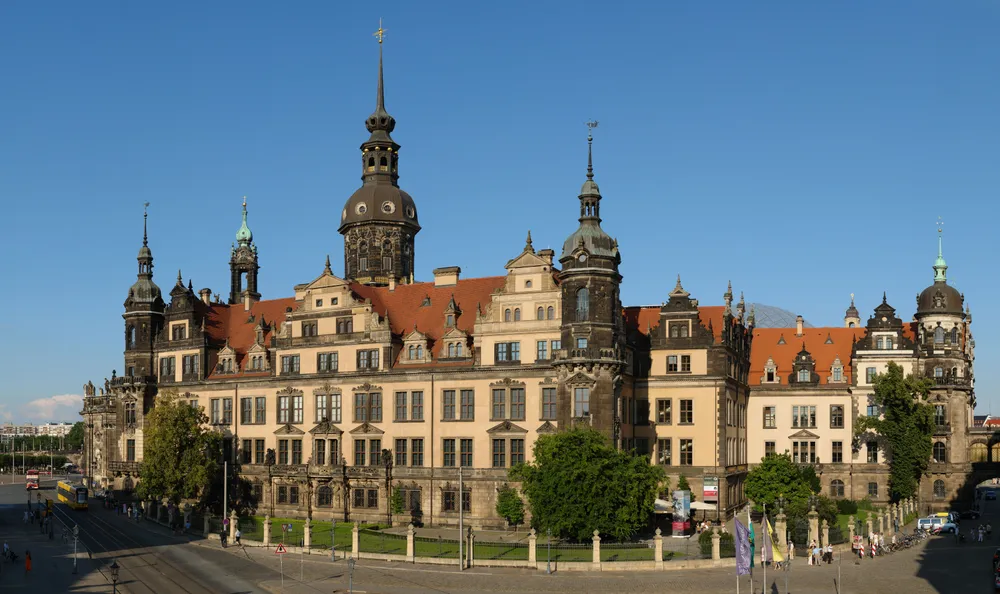
Dresden Castle or Royal Palace (German: Dresdner Residenzschloss or Dresdner Schloss) is one of the oldest buildings in Dresden, Germany. For almost 400 years, it was the residence of the electors (1547–1806) and kings (1806–1918) of Saxony from the Albertine House of Wettin as well as Kings of Poland (1697–1763). It is known for the different architectural styles employed, from Baroque to Neo-Renaissance. Today, the residential castle is a museum complex that contains the Historic and New Green Vault, the Numismatic Cabinet, the Collection of Prints, Drawings and Photographs and the Dresden Armory with the Turkish Chamber. It also houses an art library and the management of the Dresden State Art Collections.
The original castle was a Romanesque keep, built around 1200. The Hausmannsturm was built at the beginning of the 15th century. From 1468 until 1480, the keep was extended by the master builder, Arnold von Westfalen, becoming an enclosed four-wing construction. In the middle of the 16th century, an addition was made in the Saxon Renaissance style. After a major fire in 1701, Augustus II the Strong rebuilt much of the castle in the Baroque style. The collection rooms were created at this time in the western wing. The Silver Room, Heraldic Room and the Pretiosensaal were built from 1723–1726 and the Kaminzimmer, Juwelenzimmer (Jewel Room), Ivory Room and Bronze Room were built from 1727–1729.
The 800th anniversary of the House of Wettin, Saxony's ruling family, resulted in more rebuilding between 1889 and 1901. A Neo-Renaissance renovation was undertaken, followed by various modernizations, such as in-floor heating and electric lights in 1914. On the outside of the Stallhof (Stall Courtyard), which links the castle complex with the adjacent Johanneum, the "Procession of Princes" was painted by the artist Wilhelm Walther. The 102-meter-long mural represents the history of the Wettins. Since it quickly faded, it was transferred to about 23,000 Meissen porcelain tiles between 1904 and 1907. Most of the castle was reduced to a roofless shell during 13 February 1945 bombing of Dresden in World War II. Three rooms of the Green Vault were destroyed. However, the collections survived, having been moved to safety at Königstein Fortress in the early years of the war.
For the first 15 years after the end of the Second World War, no attempt was made to rebuild the castle, except to install a temporary roof in 1946. Restoration began in the 1960s with the installation of some new windows and progressed slowly in following decades (see the photo of the central wing from 1980). The castle's restoration is ongoing, with part of the State Apartments reopening in September 2019.
Dresden Castle houses five museum sections, the Historic Green Vault and the New Green Vault, the Numismatic Cabinet, the Collection of Prints, Drawings and Photographs and the Dresden Armoury with the Turkish Chamber and the Renaissance Wing. Also accessible is an art library (Kunstbibliothek) with approximately 260,000 volumes of special literature on art history. The character of the holdings is closely related to the collecting focal points of the museums.
The Green Vault (Grünes Gewölbe) is a museum that contains the largest collection of treasures in Europe. Founded by Augustus II the Strong in 1723, it features a unique and rich variety of exhibits from the period of baroque to classicism. The museum consists of the Historic Green Vault (Historisches Grünes Gewölbe) and the New Green Vault (Neues Grünes Gewölbe). The Historic Green Vault is known for its treasure chambers and is itself a baroque work of art. The New Green Vault is more modern. The Historic Green Vault is located on the ground floor of the Dresden Castle and visits require an advance booking; admittance to the New Green Vault, which is on the second floor, is not limited.
Adapted from Wikipedia (CC BY-SA). Photography via Wikimedia Commons.